Compute Collaboration to Create Personal Robocar
What you'll learn:
- The goal of the collaboration.
- What the vehicle will incorporate as its technological infrastructure.

Tensor and Arm announced a multi-year strategic collaboration to develop a foundational compute architecture to create the first agentic AI personal Robocar. Tensor will implement Arm's compute platform.
The effort will unify hardware and software to drive physical AI workloads throughout the entire vehicle. More than 400 safety-capable, power-efficient Arm-based cores are in each vehicle. The companies will work together to enable the Level 4 autonomous capabilities required for next-generation mobility.
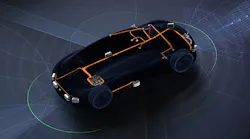
Leveraging Arm's software ecosystem, the Robocar is powered by a vertically integrated Level 4 autonomy stack and comprehensive sensor suite. The suite includes 37 cameras, 5 LiDARs, 11 radars, 22 microphones, 10 ultrasonic sensors, 3 IMUs, GNSS, 16 collision detectors, 8 water-level detectors, 4 tire-pressure sensors, and a smoke detector.
The hardware and software integration, supported by triple-channel 5G connectivity, represents a meaningful advancement in automotive sensing, enabling continuous perception, environmental awareness, and resilient system performance in a variety of operating conditions. Tensor is using the Arm compute platform to distribute safety-capable intelligence across the vehicle so that the Robocar can safely perceive and navigate its environment.
Among the Tensor Robocar's 433 Arm-based cores are the Neoverse AE for high-throughput AI processing; Cortex-X for agentic AI cabin and system control; Cortex-A for drive-by-wire, LiDARs, redundancy, and general compute; Cortex-R for real-time safety-critical systems; and Cortex-M for low-power subsystem management.
The Arm compute platform enables Tensor to deploy AI workloads across diverse compute domains while meeting automotive safety, thermal, and power requirements. It operates in concert with NVIDIA-accelerated AI processing to support Tensor’s proprietary autonomy stack.
Related links:
More Industry News
 dreamstime_martinkonopka_57631954_promo
 tariffs_dreamstime_xl_148337160
About the Author
 Alix Paultre
Alix Paultre
Editor-at-Large, Electronic Design
An Army veteran, Alix Paultre was a signals intelligence soldier on the East/West German border in the early ‘80s, and eventually wound up helping launch and run a publication on consumer electronics for the US military stationed in Europe. Alix first began in this industry in 1998 at Electronic Products magazine, and since then has worked for a variety of publications in the embedded electronic engineering space. Alix currently lives in Wiesbaden, Germany.
Also check out his YouTube watch-collecting channel, Talking Timepieces.

Comment About the Article
To join the conversation, and become an exclusive member of Electronic Design, create an account today!
 Leaders Logo
Leaders relevant to this article: