5 Arduino Shields for Summer 2026 Projects and Prototyping
What you'll learn:
- Insight into new and popular Arduino shields and expansion boards.
- How these add-ons expand base platforms with connectivity, displays, and industrial interfaces.
- Potential applications for CAN, UWB, SPE, RS-485, Qwiic, Grove, and Modulino-based project designs.
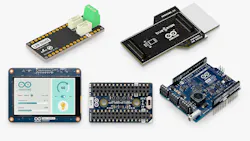
Arduino's ecosystem goes beyond its development boards with innovative shields that provide an easy way to add increased functionality for everything from industrial communications and IoT to robotics and automation. Whether you're looking to integrate CAN bus networking, ultra-wideband connectivity, interactive displays, or expand a board's available interfaces, there's likely a shield designed for the application.
In this roundup, we look at five Arduino shields and expansion boards that can help drive your next summer project.
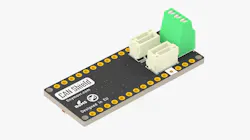
Tinymovr’s Nano CAN Bus Shield is designed to bring Controller Area Network (CAN) communication capabilities to the Arduino. The tiny board is built around an MCP25625 controller and transceiver, offering a seamless interface for automotive, industrial, and robotics projects without the need for external breakout boards. The MCU combines a CAN 2.0B controller and transceiver for reliable, high-speed communications and is designed for the Nano RP2040 Connect socket.
Product: Tinymovr Arduino Nano CAN Bus Shield
Company: Motion Layer
Form Factor: Arduino Nano Shield Footprint
Communication: CAN bus 2.0B through a Microchip MCP25625 integrated CAN controller/transceiver; SPI interface with CS on D10 and INT on D2; external 16-MHz crystal for timing.
Expansion: Arduino Nano-compatible shield for adding CAN bus capability; supports 3.3-V logic/VIO and includes onboard 5-V regulation via AP3602 boost converter; switchable 120-Ω termination resistor.
Connections: 3-pin screw terminal for CAN H, CAN L, and GND; 2.54-mm or similar pitch; SPI connection through the Nano header pins.
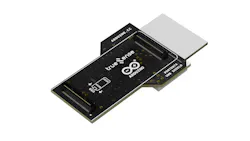
Arduino’s Portenta UWB Shield is designed to provide ultra-wideband (UWB) connectivity to the Portenta Family for building advanced IoT systems. The Shield was developed with Truesense DCU150 technology and operates as both a UWB base station and a client device. It offers two-way ranging with advanced IoT applications in industrial automation, smart logistics, and interactive environments.
Product: Arduino Portenta UWB Shield
Company: Arduino
Communication: Ultra-wideband (UWB) via Truesense DCU150 UWB module based on the NXP Trimension SR150 UWB IC; supports channels 5 and 9, 6.24- to 8.24-GHz frequency range, 14.1 dBm at channel 9, and 2D ranging.
Expansion: Adds UWB connectivity, RTLS, and two-way ranging capability to Portenta projects; compatible with Portenta C33; operates from 3.3 V DC supplied by the Portenta main board.
Connections: 2x 80-pin high-density connectors; includes 3 PCB-embedded UWB antennas.
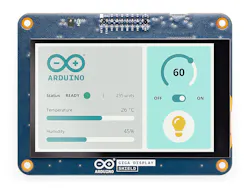
Arduino’s GIGA Display Shield is a 3.97-in. RGB touchscreen display designed for the Arduino GIGA R1 Wi-Fi board. Beyond the display, the GIGA Shield features a MP34DT06JTR digital microphone, a Bosch BMI270 6-axis IMU, a 20-pin Arducam camera connector, and an RGB LED. According to Arduino, the new features allow users to fully utilize the other 54 available pins, suiting it for creating handheld devices or dashboards.
Product: Arduino GIGA Display Shield
Company: Arduino
Form Factor: Display shield for Arduino GIGA R1 WiFi; attaches through the GIGA R1 WiFi middle headers J5 and J6, leaving the top-side 54 pins available.
Communication: I2C interface; includes a capacitive touchscreen with five-point touch/gesture support, a BMI270 6-axis IMU, and an MP34DT06JTR digital microphone.
Expansion: Adds a 3.97-in. 480×800 RGB touchscreen display, 16.7M color support, digital microphone, 6-axis IMU, and Arducam camera expansion to Arduino GIGA R1 WiFi projects.
Connections: GIGA R1 WiFi middle header connection via J5/J6; Arducam-compatible 2-row, 20-position vertical pass-through camera socket; display and touch connections integrated on the shield.
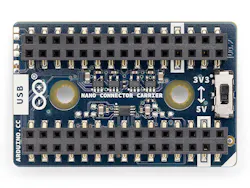
While technically not a shield, Arduino’s Nano Connector Carrier board fills a similar role for the Nano family. The board allows for easy connection to Qwiic, Grove, and Modulino expansion modules via plug-and-play connectivity, and is well-suited for industrial automation proof-of-concepts (PoCs), smart home prototyping, controller projects, and educational platforms.
Product: Arduino Nano Connector Carrier
Company: Arduino
Form Factor: Nano-family connector carrier board; compact 28 mm × 43 mm carrier with double female board headers for Arduino Nano boards.
Storage: microSD card reader for onboard data logging and real-time storage.
Communication: Qwiic I2C, Grove I2C, Grove UART, and Grove analog/digital I/O interfaces
Expansion: Plug-and-play expansion carrier for Arduino Nano projects; supports Qwiic, Grove, and Modulino modules; compatible use cases include Nano RP2040 Connect, Nano ESP32, and Nano Matter projects.
Connections: 2x Grove analog/digital I/O, Grove I2C, Grove UART, Qwiic I2C, microSD card reader, double female board header, and selectable 3.3/5-V I/O voltage.
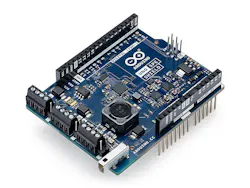
Arduino’s Uno SPE Shield combines single-pair Ethernet (T1S) and RS-485 communication on a single module, suiting it for smart automation, retrofitting, and IoT applications. The board takes advantage of the RS-485 interface, which allows for seamless integration with legacy systems, making it an ideal bridge between existing infrastructure and emerging technologies.
Product: Arduino UNO SPE Shield
Company: Arduino
Form Factor: UNO R4-compatible shield; 68.85 mm × 53.34 mm
Communication: 10BASE-T1S single-pair Ethernet using Microchip LAN8651B1 MAC-PHY Ethernet controller over SPI; 10 Mb/s over a single balanced pair; half-duplex RS-485 using XR33058 with up to 20-Mb/s data rate
Expansion: Adds industrial connectivity to Arduino UNO R4 projects, combining single-pair Ethernet with Power over Data Line (PoDL) support and RS-485 legacy-device integration. Also exposes digital I/O, analog input, I2C, serial, and PWM interfaces.
Connections: T1SP/T1SN single-pair Ethernet on screw terminal block; dedicated T1S SPE connector; RS-485 on screw terminal block; 6- to 24-V power input from T1SP via PoDL or from VIN on screw terminal block.
Final Thought
Arduino shields continue to offer an easy way to expand development board capabilities without requiring complex hardware modifications or custom circuit design. The boards featured in this roundup highlight the wide range of applications these platforms now support, from industrial networking and CAN communications to ultra-wideband positioning, interactive displays, and modular prototyping.
Whether you're upgrading an existing project or starting one from scratch, these shields provide a way to add new functionalities without requiring a complete overhaul.
>>Check out this TechXchange for similarly themed articles and videos
About the Author
 Cabe Atwell
Cabe Atwell
Technology Editor, Electronic Design
Cabe is a Technology Editor for Electronic Design.
Engineer, Machinist, Cartoonist, Maker, Writer. A graduate Electrical Engineer actively plying his expertise in the industry and at his company, Gunhead. When not designing/building, he creates a steady torrent of projects and content in the media world. Many of his projects and articles are online at element14 & SolidSmack, industry-focused work at EETimes & EDN, and offbeat articles at Make Magazine. Currently, you can find him hosting webinars and contributing to Electronic Design and Machine Design.
Cabe is an electrical engineer, design consultant and author with 25 years’ experience. His most recent book is “Essential 555 IC: Design, Configure, and Create Clever Circuits”
Cabe writes the Engineering Life & Engineering on Friday blog on Electronic Design.
See Cabe's cartoons & comic strips here.