5 Raspberry Pi HATs: Long-Range Wireless to AI
What you'll learn:
- Insight into the latest Raspberry Pi HATs.
- Potential applications for AI, storage, remote power, and wireless mesh projects.
- What each HAT adds to Raspberry Pi-based designs.
The Raspberry Pi is a versatile single-board computer that forms the foundation for any number of great projects. While it can handle most anything thrown at it as a standalone platform, the SBC can be limited based on the projects at hand.
To overcome that limitation, the Raspberry Pi Foundation developed HATs — add-on boards that provide increased functionality. Whether it’s adding AI acceleration, increasing storage capacity, managing power for remote deployments, or integrating wireless networking, there's likely a HAT designed for the task.
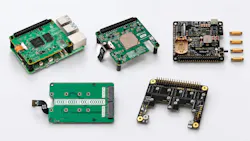
In this roundup, we look at five Raspberry Pi HATs that can help expand the platform for a wide range of different applications.
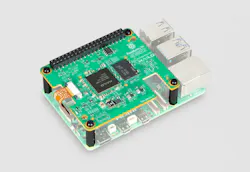
The Raspberry Pi AI HAT+ 2 is a significant upgrade to the previous model, which pushes out 40 TOPS over the former’s 26 TOPS. The HAT achieves this goal using the Hailo-10H AI accelerator, which also allows it to process large language models (LLMs) locally. The board also incorporates 8 GB of onboard RAM, a PCIe Gen3 x1 FPC connector, and the all-familiar, 40-pin GPIO header, only it acts as a pass-through for the Raspberry Pi.
Product: Raspberry Pi AI HAT+ 2
Company: Raspberry Pi Ltd.
Form Factor: Raspberry Pi HAT+ add-on board for Raspberry Pi 5; approximately 66 × 56.5 mm; supplied with optional heatsink, 16 mm stacking header, spacers, screws, and PCIe ribbon cable.
NPU: Hailo-10H AI accelerator / neural-network inference accelerator, rated at 40 TOPS INT4 inferencing performance.
Memory: 8 GB of dedicated onboard RAM; supports local LLMs and vision language models (VLMs) up to about 6 billion parameters.
Communication: PCI Express interface to Raspberry Pi 5; Raspberry Pi OS can automatically detect the onboard Hailo accelerator and offload supported AI workloads.
Expansion: Adds generative AI, LLM, VLM, and computer-vision acceleration to Raspberry Pi 5; fully integrated with Raspberry Pi’s camera software stack and compatible with rpicam-apps / Picamera2 AI workflows.
Connections: Connects to Raspberry Pi 5 through the PCIe port using a ribbon cable and through the 40-pin GPIO header via a GPIO stacking header.
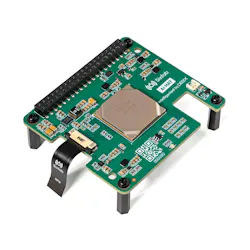
Sixfab recently launched its AI HAT+ for the Raspberry Pi 5. It’s based on the DEEPX DX-M1 AI accelerator for rapid prototyping and local inference. Because the accelerator is soldered directly to the board, it can run AI vision locally without the need for the cloud or GPU, allowing it to process object detection, segmentation, and classification in real-time.
Product: Sixfab AI HAT+
Company: Sixfab
Form Factor: Raspberry Pi HAT+ add-on board for Raspberry Pi 5; 56.5 × 65 × 6.56 mm; HAT+ specification compliant with EEPROM auto-configuration.
NPU: DEEPX DX-M1M or DX-M1ML neural processing unit; 25 TOPS INT8 with DX-M1M, or 13-TOPS INT8 with DX-M1ML.
Memory: 2 GB of LPDDR4X NPU memory on the 25-TOPS DX-M1M version; 1 GB of LPDDR4X NPU memory on the 13-TOPS DX-M1ML version.
Communication: PCIe Gen 3 x1 host interface to Raspberry Pi 5 over a 16-pin FFC cable; runs local AI inference with Sixfab dxrt-runtime, Python/C++ APIs, and ONNX-to-DXNN model pipeline.
Expansion: Adds local edge-AI / computer-vision acceleration to Raspberry Pi 5 for object detection, segmentation, and classification; supports Raspberry Pi OS Trixie and is intended for Raspberry Pi 5 / Compute Module 5 via the official CM5 IO Board.
Connections: 16-pin PCIe FFC cable connection to Raspberry Pi 5; 40-pin GPIO header for power; onboard 2-pin JST fan connector; no auxiliary power connector.
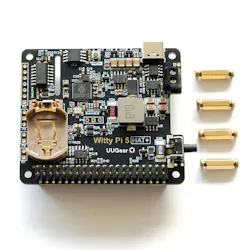
UUGear’s Witty Pi 5 HAT+ is a power scheduler for Raspberry Pi that comes with an RP2350 MCU that’s capable of performing power-management functions. It features an onboard RTC with voltage and temperature monitoring for automated power on/off, suiting it for applications such as solar-powered projects, environmental monitors, and industrial controllers. The Witty Pi 5 HAT+ is also suitable for use with all Pi boards equipped with the 40-pin header.
Product: Witty Pi 5 HAT+
Company: UUGear
Form Factor: Raspberry Pi HAT+ add-on board; Mode 1 Power HAT+; 65 × 56 × 19 mm; 28 g net weight; supports Raspberry Pi models with a 40-pin GPIO header.
CPU: RP2350 microcontroller for onboard control and power-management functions; not a standalone Raspberry Pi CPU.
Memory: External 16-MB flash memory; also includes a HAT+ ID EEPROM.
Storage: N/A for general-purpose user storage; the onboard flash is used for firmware/configuration/log-related functions rather than removable storage.
Communication: I2C slave interface to the Raspberry Pi, internal I2C access to the RTC and temperature sensor, plus USB serial / USB flash-drive emulation for configuration, logs, and firmware updates.
Expansion: Adds high-precision RTC, power scheduling, temperature-based power control, voltage-based power control, UPS-style dual-input power backup, and up to 5-A output for the Raspberry Pi and peripherals.
Connections: 40-pin Raspberry Pi GPIO header; USB-C 5-V DC input; KF350-2P screw terminal for 6- to 30-V DC input; CR2032 battery holder for RTC backup; power output through the HAT/GPIO connection.
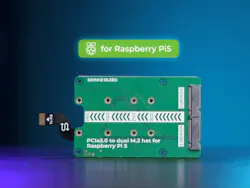
Seeed Studio’s PCIe3.0 Switch to Dual M.2 HAT is designed for Raspberry Pi 5, allowing it to access dual NVMe SSDs, driving Hailo8/8L (only M.2 key B+M) and Google Coral AI accelerators at PCIe 3.0 speeds. This is thanks to the onboard ASMedia ASM2806 PCIe 3.0 switch chip, which maintains the larger throughput. Seeed does state, however, that due to compatibility issues with Raspberry Pi's PCIe, not all NVMe SSDs are supported.
Product: PCIe3.0 Switch to Dual M.2 HAT
Company: Seeed Studio
Form Factor: Raspberry Pi 5 HAT-style expansion board with back-mounted installation; keeps the Raspberry Pi 40-pin GPIO header free for other HATs.
NPU: N/A onboard — the board itself doesn’t include an AI accelerator, but it supports M.2 AI accelerators such as Hailo 8/8L and Google Coral through its M.2 slots.
Storage: 2x M.2 slots for NVMe SSDs; supports M.2 2230, 2242, 2260, and 2280 sizes; SATA SSDs aren’t compatible.
Communication: PCIe Gen 3.0 through an ASMedia ASM2806 PCIe 3.0 switch chip; connects to the Raspberry Pi 5 by FPC cable.
Expansion: Adds dual M.2 PCIe capability to Raspberry Pi 5 for dual NVMe SSDs, SSD booting, or combined AI accelerator + high-speed SSD use.
Connections: 2x M.2 slots, FPC cable connection to the Raspberry Pi 5 PCIe connector, pogo-pin power support, and 5-V/3-A max power-supply path split as 2 A through pogo pins plus 1 A through the PCIe connector.
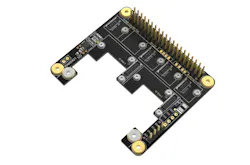
RAKwireless’ WisMesh Pi HAT RAK6421 is designed to transform the Raspberry Pi 4/5 into a modular Meshtastic gateway, enabling users to connect WisBlock LoRa radios and sensors directly to the Pi. The HAT takes a modular approach, providing two WisBlock IO slots and four sensor slots. Thus, users can easily plug in or swap modules on-demand.
Product: WisMesh Pi HAT RAK6421
Company: RAKwireless
Form Factor: Raspberry Pi HAT / HAT+ compliant WisBlock Pi HAT; mounts to the standard 40-pin Raspberry Pi header; compatible with Raspberry Pi 4 and Raspberry Pi 5, with documentation also noting Pi Zero 2 W compatibility with caveats.
Memory: Onboard HAT+ ID EEPROM for automatic hardware identification/configuration.
Storage: N/A on the HAT itself; bundle variants may include a TF card when purchased with Raspberry Pi 4 or Raspberry Pi 5.
Communication: Supports Meshtastic via meshtasticd on Raspberry Pi; provides fixed SPI, I2C, UART, and GPIO routing for WisBlock modules; supports WisBlock LoRa radio modules including the RAK13300 SX1262 and high-power RAK13302 SX1262 + SKY66122 booster.
Expansion: 2x WisBlock IO slots for LoRa radios, 4× WisBlock Sensor slots for I2C sensors/GPS/environmental modules, built-in I2C ADC for analog input, and support for GPS, environmental sensors, motion sensors, LoRa, and I2S audio.
Connections: Standard 40-pin Raspberry Pi connector; WisBlock IO slots; WisBlock Sensor slots; J8 header with analog input/GPIO/VBAT; J9 header with 3.3 V, GND, I2C SCL, and I2C SDA; powered from the Raspberry Pi 5-V rail with 3.3 V and VBAT outputs to WisBlock modules.
Final Thought
As Raspberry Pi hardware continues to evolve, so too does the ecosystem of HATs designed to expand its capabilities. The boards featured in this roundup show how versatile the platform has become, offering everything from local AI inferencing and high-speed NVMe storage to intelligent power management and long-range LoRa connectivity.
Whether it’s developing an edge-AI application, building a remote monitoring station, or creating a custom IoT gateway, these HATs provide an easy way to transform the platform for most any project.
>>Check out this TechXchange for more Raspberry Pi-related articles

About the Author
 Cabe Atwell
Cabe Atwell
Technology Editor, Electronic Design
Cabe is a Technology Editor for Electronic Design.
Engineer, Machinist, Cartoonist, Maker, Writer. A graduate Electrical Engineer actively plying his expertise in the industry and at his company, Gunhead. When not designing/building, he creates a steady torrent of projects and content in the media world. Many of his projects and articles are online at element14 & SolidSmack, industry-focused work at EETimes & EDN, and offbeat articles at Make Magazine. Currently, you can find him hosting webinars and contributing to Electronic Design and Machine Design.
Cabe is an electrical engineer, design consultant and author with 25 years’ experience. His most recent book is “Essential 555 IC: Design, Configure, and Create Clever Circuits”
Cabe writes the Engineering Life & Engineering on Friday blog on Electronic Design.
See Cabe's cartoons & comic strips here.