Prints Charming: 3D Printing’s Advance to Transform Electronics Manufacturing
What you’ll learn:
- Whether its connectors, sensors, or advanced packaging components, the ongoing trend for miniaturization represents one of the foremost challenges for today’s electronics designer.
- Add to that, the growing number and density of electronic components, further compounded by faster data speeds that generate more heat, and it’s clear to see that this particular group has its work cut out.
- The bitter reality is that traditional production techniques aren’t really up to addressing these issues, resulting in lengthy lead times, excessive costs, and inflexible designs.
- To counter the problem, many electronics manufacturers are looking to 3D printing, which provides a more versatile, cost-effective alternative.

The demand for highly precise, small-scale components is ramping up as electronics get smaller and increasingly complex. Whether its connectors, sensors, or advanced packaging components, the ongoing trend for miniaturization represents one of the foremost challenges for today’s electronics designer.
Add to that the growing number and density of electronic components, further compounded by faster data speeds generating more heat, and it’s clear to see that this particular group has its work cut out.
The bitter reality is that traditional production techniques aren’t really up to addressing these issues, resulting in lengthy lead times, excessive costs, and inflexible designs. To counter the problem, many electronics manufacturers are looking to 3D printing, which provides a more versatile, cost-effective alternative.
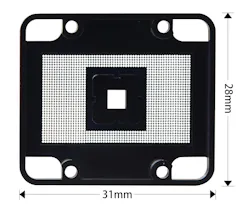
Micro-scale 3D-printing technology, including projection micro stereolithography (PµSL), continues to be a go-to option, delivering the accuracy and design flexibility needed to stay in step with ever-changing product evolution (Fig. 1).
Accelerating Prototyping with 3D Printing
Unlike technologies such as micro injection molding, which can take 10 to 12 weeks for certain critical parts, 3D printing counters typical bottlenecks, providing quicker manufacturing timelines and greater flexibility in design iterations. In fact, its fundamental capability to speed up the design-to-production process is one of the primary advantages of micro-precision 3D printing.
Where traditional methods require molds and tooling, 3D printing enables fast iterations, allowing manufacturers to rapidly fine-tune designs while avoiding expensive delays.
A prime case in point is a project that BMF took on for Hirose Electronics, a high-performance electrical connectors company. Faced with the requirement to rapidly prototype circuit connectors for its innovative products, the team encountered the typical obstacles of lengthy lead times, high tooling costs, and the problem of design inflexibility. Deploying traditional micro injection molding would have held up its innovation pipeline, so the company looked to 3D printing as a solution (Fig. 2).
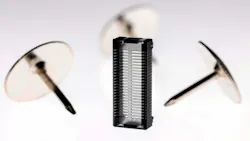
As a result, Hirose enjoyed faster iterations on its connector designs, testing multiple versions before finalizing manufacturing-quality prototypes much quicker than it could previously. The flexibility of 3D printing enabled the team to apply design changes on the fly — avoiding the costly delays inherent with retooling. Thus, the company was able to slash prototyping time significantly, making way for a faster and more efficient road to validation by saving on both costs and lead time.
If you’re a manufacturer looking to incorporate 3D printing within your setup, take a structured approach to strengthen your hand when it comes to optimizing the benefits.
A good idea is to begin by zeroing in on the specific areas of your product that demand multiple design iterations or are holding up the process. After that, assess your exact design needs, checking for precision tolerances and material requirements. Micro precision 3D printing is perfect for minute, intricate parts. In addition, before advancing to full production, you should ask for a sample part from a 3D-printing provider to evaluate how it can accelerate your prototyping.
At that point, with your prototype ready, the move to production is simple. The same flexibility and accuracy that ensure 3D printing is ideal for prototyping will also deliver genuine benefits during full-scale production.
Scale Like a Boss with No Quality Loss
Naturally, it’s necessary to make sure the materials you used at the prototyping stage can sufficiently manage the demands of production. Check that they conform to robustness and performance standards for sustained use over time and that they address any prerequisite heat or mechanical-resistance standards.
Another wise move is to run small batches to check that your 3D printer can reproduce high-quality results consistently across multiple units. Repeatability in precision, tolerances, and surface finish is vital when scaling up.
Also, to optimize efficiency for production, you’ll want to standardize your processes and refine your printer settings. Concentrate on designs that may alter early on in production or where 3D printing offers lower costs than traditional methods.
Lastly, don’t forget to monitor your manufacturing operations continually and explore ways to improve where possible; for example, using data from early production runs to refine your process.
Ready, Set, Print!
By incorporating 3D printing within your operations, it’s fully possible to lower prototyping time by as much as 60% to 90% and reduce costs by 50% to 70%, contingent upon the complexity and volume of your project. It’s also generally accepted that the technology is ideal for parts with evolving designs, where it provides an improved cost per unit against traditional methods.
To kick off, it’s useful choosing a pilot project. Find a component that’s able to benefit from faster design iterations — e.g., connectors, sensors, or other tiny, complex parts — where existing production methods are leading to bottlenecks.
As for the 3D-printing technology itself, it’s wise to stringently assess the various options according to your exact requirements. For example, with part size and complexity weaved into the fabric of electronics manufacturing, is the printer up to the job of managing the intricate, small-scale parts necessary for the application in question? And does the technology itself offer the fine detail required for dependable performance in electronics components?
Finally, once the technology is installed, plan your transition and devise a clear timeframe to go from prototyping to production. As was highlighted before, micro-precision 3D printing’s versatility eradicates the requirement for retooling, allowing for a streamlined move to full-scale production.
As electronics continue to reduce in size and functional demands increase, micro‑scale 3D printing has caught the industry’s gaze as a catalyst for the next wave of innovation. The ability to develop complex, micron‑level geometries is transforming what designers can achieve across a continually expanding array of components.
As the industry advances toward more integrated, compact, and application‑specific designs, high-precision 3D printing will doubtless remain as formidable player when it comes to breaking down previously solid boundaries. It will drive a future where innovation is constrained only by imagination, not production challenges.
About the Author
 Carl Leonard
Carl Leonard
Application Development Engineer, Boston Micro Fabrication
Carl Leonard has more than 20 years’ experience in materials science, with expertise in photopolymers, and over 15 years in additive manufacturing across both macro- and micro-scale technologies. His career began in R&D before expanding into customer-facing roles, where he has helped engineers, designers, and technology teams understand how advanced materials and additive processes can solve real-world manufacturing challenges.
He has a particular interest in high-resolution 3D printing, miniaturization, and the role of micro-scale manufacturing in enabling innovation across medical devices, precision engineering, and emerging technologies.
Comment About the Article
To join the conversation, and become an exclusive member of Electronic Design, create an account today!
 Leaders Logo
Leaders relevant to this article: