Simplify Embedded Virtualization with Pre-Integrated Stacks
What you'll learn:
- How traditional concerns about workload consolidation have been addressed with pre-integrated hardware/software stacks.
- How integrated stacks reduce development time and risk by aligning hardware, hypervisors, and OSs.
- What a modern solution platform looks like, from hardware specifications to middleware components
In the first part of this article series, we explored how workload consolidation can help OEMs reduce costs, shrink system footprints, and streamline development. We also explained how virtualization and hypervisors have moved from a niche concept to a must-have for modern design. Without it, industrial automation OEMs risk falling behind in an increasingly fast-paced competitive landscape.
The previous article also explained how pre-integrated hardware/software stacks are making workload consolidation more accessible. That topic merits deeper discussion. OEMs have been hesitant to adopt workload consolidation due to concerns about development complexity. This article takes a closer look at those concerns and explains how integrated solution platforms can help overcome them.
Hurdles of Integrating Workload Consolidation
Historically, workload consolidation presented technical and organizational hurdles that were once seen as dealbreakers. One of the most frequently cited concerns was migration complexity. Moving from separate hardware platforms to a consolidated system architecture required careful planning and thorough validation. Resource requirements had to be reassessed, and system-level timing and I/O interactions revalidated, to ensure stable operation in a virtualized environment.
Resource contention — often described as the “noisy neighbor” problem — was another common concern. When multiple workloads shared processor cores, memory, or I/O, there was a risk of interference between tasks. Without effective partitioning and scheduling, real-time processes could suffer from jitter, latency, or missed deadlines.
>>Download the PDF of this article
Security and compliance posed further challenges. Consolidated platforms often combined workloads with very different risk profiles; for instance, a network-connected juman-machine interface (HMI) alongside a mission-critical real-time controller. This mix made it difficult to secure the system as a whole. Compliance requirements were another concern, particularly in highly regulated industries.
Moreover, there was the question of up-front investment. Engineering time, software licensing, and integration effort could result in a steep barrier to entry, especially in a fragmented ecosystem where hardware, OS, hypervisor, and middleware vendors didn’t always offer aligned solutions.
How Integrated Platforms Support Workload Consolidation
Many of the challenges traditionally associated with workload consolidation are now being addressed through integrated hardware and software platforms. These solution platforms are designed from the ground up to support virtualization in real-time environments, combining compute modules, pre-configured hypervisors, and popular operating systems (OSs) into a single validated stack (see figure).
For OEMs, this new approach significantly reduces both effort and risk. Instead of investing time in low-level integration, engineering teams can focus on leveraging the benefits of workload consolidation.
Take resource optimization, for example. Because the components of a solution-level platform are engineered to work together, they offer a more reliable means of achieving predictable performance. These platforms can be preconfigured to isolate real-time and non-critical workloads, too, minimizing the risk of “noisy neighbor” problems.
Integrated platforms also provide pre-validated security and compliance features, such as secure-boot mechanisms, trusted execution environments, and regular security updates. By delivering a known-good configuration, these systems simplify certification processes in regulated industries and reduce the risk of misconfiguration.
In addition, pre-integration supports scalability and lifecycle management. With coordinated firmware, middleware, and OS updates, OEMs gain a more maintainable solution that evolves over time. This is particularly valuable in long-lifecycle applications, where consistent performance and sustained support are essential.
In short, integrated platforms help eliminate many of the barriers that once made workload consolidation difficult. The result is a faster path to deployment and a more predictable development process.
System Design of Integrated Platforms
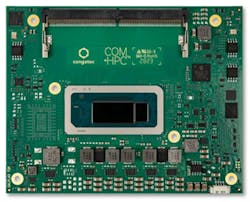
Integrated platforms for workload consolidation are built on a modular architecture that provides a strong starting point for a wide range of applications. A representative platform example is shown in the table. It includes a high-performance compute module, real-time hypervisor, commercial OSs, and pre-integrated middleware to accelerate development.
A typical example of an integrated solution platform.
Hardware is the Foundation
The foundation of this approach is a computer-on-module (COM) based on open standards such as COM-HPC. Centered on a high-performance CPU like the 13th-Gen Intel Core processors, these COMs offer the performance and expandability needed for modern workloads. To ensure thermal stability, these platforms can integrate an active heat-pipe cooling solution.
A sizable 128-GB NVMe solid-state disk (SSD) provides sufficient capacity for multiple workloads, while 16 GB of DDR5 DRAM with error-correction code (ECC) support ensures reliable performance. To support high-throughput and deterministic data paths, COM modules should also offer advanced networking options, such as 10 GbE support and isolated interfaces for safety-critical domains.
Pre-integrated and Pre-configured Software
At the software level, the hypervisor is pre-integrated and pre-configured with isolated virtual machines (VMs). This allows real-time and general-purpose operating systems to run side by side without interference. Commercial OS options such as Ubuntu Pro and industrial-grade real-time Linux distributions are typically supported, providing long-term support and reducing integration risk.
Middleware Makes Its Mark
Supporting the hardware and software stack are libraries and tools for essential functions such as IoT connectivity, HMI development, and cybersecurity. For larger or more dynamic systems, orchestration platforms such as OpenStack, VMware vSphere, or Kubernetes can also be used to manage and deploy workloads more efficiently.
Together, these building blocks form a scalable, validated solution platform that simplifies system integration while providing the flexibility required for complex embedded designs.
Single-Platform Mixed-Criticality Systems
Integrated platforms have removed many of the traditional barriers to workload consolidation. As a result, OEMs can now deploy complex, mixed-criticality systems — combining real-time control, AI analytics, and connected interfaces — on a single platform with greater confidence and reduced development overhead. For OEMs who have been hesitant to adopt virtualization, now is the time to reconsider the benefits of this powerful technology.
>>Download the PDF of this article
About the Author
 Andreas Bergbauer
Andreas Bergbauer
Manager Solution Management, congatec
Andreas Bergbauer is Manager Solution Management at congatec. He has over 15 years of professional experience in product management, IT project management, and software development. After graduating with a degree in Business Informatics from Deggendorf Institute of Technology, he held leadership positions at msg and ConVista. With his expertise in product strategy and technological innovation management, he’s now involved in developing application-ready solution platforms in embedded computing.
Comment About the Article
To join the conversation, and become an exclusive member of Electronic Design, create an account today!
 Leaders Logo
Leaders relevant to this article: