Balloon-Launched Eagle APDS Extends Military Drone Missions from the Stratosphere
What you'll learn:
· How the Eagle APDS uses a high-altitude balloon to begin drone operations in the stratosphere.
· Why its variable wing profile, low observability, and payload flexibility matter for military missions.
· How balloon-launched drone development fits with broader U.S. Army stratospheric platform experiments.
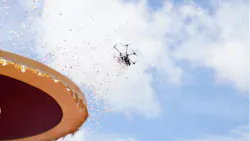
Last year, Landing Zones Canada built the Eagle Advanced Payload Delivery System (APDS), a drone that uses balloons to reach high altitudes as a starting point for long-range missions (see figure). Controlled by humans or autonomously, the system is designed to transport payloads across extended distances and operate in challenging environments.
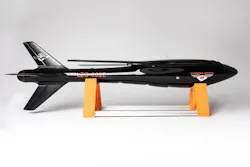
The APDS is equipped with a highly efficient, variable wing profile that supports efficient glide performance and a relatively small radar signature. Landing Zones Canada says the drone can be used for direct delivery of military supplies, movement of munitions, and GNSS-contested environments. It can also be configured for target missions, reconnaissance, communications support, and precision logistics.
The design gives military planners a different approach to airborne delivery. Instead of relying only on conventional launch methods, the drone can be carried to stratospheric altitude by balloon, then released to travel toward a mission area.
That higher-altitude launch point can help extend range while keeping the platform separated from many lower-altitude threats. It also places the system in the broader technical space of unmanned systems that blend onboard computing, navigation, sensing, and communications.
Landing Zones Canada describes the Eagle APDS as suited to both tactical and operational missions. The company says the system can support payloads in the 2- to 25-lb. range while remaining adaptable for different mission profiles. That flexibility may be useful for logistics and surveillance roles where size, weight, range, and low observability all affect deployment decisions.
The U.S. Army is also exploring this part of the operating environment. According to the service, it's developing high-altitude payload balloons that could support sensing, surveillance, and communications from the stratosphere. Those efforts point to growing interest in platforms that can remain above traditional airspace while carrying useful payloads for military operations.
As balloon-launched drones evolve, the design challenge isn't just how far they can fly. Engineers also need to balance airframe efficiency, payload capacity, command-and-control options, navigation resilience, and launch logistics. The Eagle APDS shows how autonomous drones can be paired with high-altitude balloon systems to extend operating range and open new mission profiles for defense users.
This news inspired a cartoon by your's truly, check it out here.
About the Author
 Cabe Atwell
Cabe Atwell
Technology Editor, Electronic Design
Cabe is a Technology Editor for Electronic Design.
Engineer, Machinist, Cartoonist, Maker, Writer. A graduate Electrical Engineer actively plying his expertise in the industry and at his company, Gunhead. When not designing/building, he creates a steady torrent of projects and content in the media world. Many of his projects and articles are online at element14 & SolidSmack, industry-focused work at EETimes & EDN, and offbeat articles at Make Magazine. Currently, you can find him hosting webinars and contributing to Electronic Design and Machine Design.
Cabe is an electrical engineer, design consultant and author with 25 years’ experience. His most recent book is “Essential 555 IC: Design, Configure, and Create Clever Circuits”
Cabe writes the Engineering Life & Engineering on Friday blog on Electronic Design.
See Cabe's cartoons & comic strips here.
Comment About the Article
To join the conversation, and become an exclusive member of Electronic Design, create an account today!
 Leaders Logo
Leaders relevant to this article: