Super-Stable TO-46 Voltage Reference Embeds Heater, Adds Thermal Jacket

Experienced designers of precision analog and mixed-signal systems know that the performance of the voltage reference, whether standalone or embedded in an analog-to-digital converter (ADC), is critical to overall system performance. Both the absolute accuracy and the stability of the reference, which is largely but not entirely a function of temperature changes, establish performance bounds. While accuracy can be calibrated and compensated with some effort, it takes significant work to assess thermal drift and work that into a correction scheme.
That’s why so much emphasis is placed on having an inherently stable reference such as the ADR1399 oven-compensated, buried Zener, 7.05-V voltage reference from Analog Devices (Fig. 1). This four-lead precision shunt reference with integrated microheater features excellent temperature stability with drift of just 0.2 ppm/°C over a wide range of voltage, temperature, and quiescent-current conditions. Long-term stability is 7 ppm/√kHr.
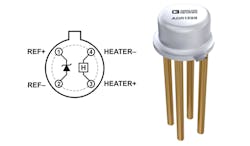
Maximum dynamic impedance is 0.08 Ω and typical reference noise is 1.84 µV rms from 10 Hz to 1 kHz. Applications for the ADR1399 include ultra-stable digital voltmeters, precision calibration equipment, and any system or signal chain that requires highly repeatable ADC readings.
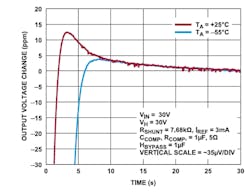
The heater of the ADR1399 operates from a 9.5- to 40-V supply and typically draws between 8.5 and 21 mA, with the largest steady-state current demand at −55°C ambient temperature, of course. The heater current can rise above 100 mA at startup until it thermally stabilizes within a few seconds (Fig. 2).
Two op-amp servo loops inside the ADR1399 help maximize stability. One loop maintains a fixed ratio of Zener and VBE currents, with the total current set by an externally applied pull-up resistor or current source. The second op-amp loop maintains the device die at a nonadjustable setpoint temperature of approximately 95°C, thus precluding most external ambient-temperature fluctuations from affecting operating temperature. These loops also contribute to the excellent load-step response of the ADR1399.
Key Packaging and PCB Placement Details
Packaging and PCB installation are critical for a device such as this reference. The entire unit is housed in a simple four-pin, hermetically sealed, TO-46 package, measuring approximately 5 mm diameter and 2.5 mm high, that’s surrounded by a plastic thermal insulator. This increases the thermal resistance and attenuates fluctuations due to ambient temperature changes as well as reduces the required heater power.
Another design technique that increases thermal resistance is to reduce the solid copper planes of the associated PCB in proximity to the device, as they conduct heat away (which, ironically and contrary to most cases, is a characteristic you don’t want in this situation). Also effective is elevating the device on its leads by approximately 1 cm above the board’s surface, again to reduce the thermal path and allow stagnant air to thermally insulate the device somewhat.
Other subtle layout and use considerations can maximize performance of a precision voltage reference like this one. TO-46 package leads, made of Kovar, are usually soldered to a copper trace in a conventional board design. However, Kovar copper junctions also induce thermocouple voltages of 35 µV/°C, which is about 25X higher than the typical temperature coefficient of the ADR1399.
Therefore, to minimize thermocouple-induced voltage errors, the junctions in series with critical pins should always see the same temperature as the corresponding junction in the return path, with the need to avoid temperature gradients at the two points where the Zener pins contact the PCB.
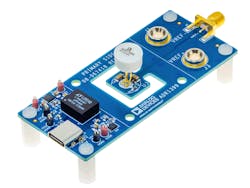
The ADR1399 is priced at $11.81 (100 pieces). Although this is a functionally “simple” four-terminal device that does one thing and strives to do it well, users may still prefer to assess its performance for their situation. To facilitate this, the associated EVAL-ADR1399 Evaluation Board, priced at $49 (Fig. 3), enables efficient prototyping. It includes an edge-mounted SMA connector as well a pair of connectors for basic banana plugs, and is powered by a standard USB connection.
About the Author

Bill Schweber
Contributing Editor
Bill Schweber is an electronics engineer who has written three textbooks on electronic communications systems, as well as hundreds of technical articles, opinion columns, and product features. In past roles, he worked as a technical website manager for multiple topic-specific sites for EE Times, as well as both the Executive Editor and Analog Editor at EDN.
At Analog Devices Inc., Bill was in marketing communications (public relations). As a result, he has been on both sides of the technical PR function, presenting company products, stories, and messages to the media and also as the recipient of these.
Prior to the MarCom role at Analog, Bill was associate editor of their respected technical journal and worked in their product marketing and applications engineering groups. Before those roles, he was at Instron Corp., doing hands-on analog- and power-circuit design and systems integration for materials-testing machine controls.
Bill has an MSEE (Univ. of Mass) and BSEE (Columbia Univ.), is a Registered Professional Engineer, and holds an Advanced Class amateur radio license. He has also planned, written, and presented online courses on a variety of engineering topics, including MOSFET basics, ADC selection, and driving LEDs.