Tiny Higher-Voltage Power Modules Nearly Disappear from Sight

If you associate “power module” with “larger component,” think again. As industrial and consumer products get smaller, their power modules are following the same trajectory. The latest series of four microsystem-scaled, step-down dc-dc power modules introduced by Maxim Integrated increases the input voltage from the 42-V maximum rating of the previous maximum up to 60 V. At the same time, the size of these units (dubbed “uSLIC”)—measuring just 2.6 × 3.0 × 1.5 mm—is shrinking to where they’re commensurate with the tiny ICs and passives they support.
These micro-modules accommodate the wide input-voltage range and fluctuations that are common in factory-automation applications. They also handle the transients that can afflict even benign consumer devices such as USB interconnects that result from hot-swapping and other unavoidable actions.
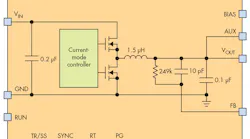
Maxim claims that these tiny modules are less than half the size of their closest competitive offerings. Each module includes a synchronous, wide-input “Himalaya” buck regulator with built-in FETs, loop compensation, integrated and shielded inductor, soft-start, and programmable EN/UVLO threshold, as well as other features. Using these modules, a complete power system requires just two or three added external capacitors and few resistors.
The new devices, along with their unit prices (in 1000-piece lots) are:
- MAXM17552, a 4- to 60-V, 100-mA module with 100- to 900-kHz adjustable switching frequency, 82% efficiency (24-V VIN at 5 V/0.1 A) and external synchronization frequency ($2.53).
- MAXM15064, a 4.5- to 60-V, 300-mA module with 500-kHz adjustable switching frequency, 82% efficiency (24-V VIN at 5 V/0.1 A), external synchronization frequency, and built-in output voltage monitoring ($2.78).
- MAXM17900, a 4- to 24-V, 100-mA module with 100- to 900-kHz adjustable switching frequency, 86% efficiency (12-V VIN at 5 V/100 mA), external synchronization frequency, and built-in output voltage monitoring ($1.39).
- MAXM17903, a 4.5- to 24-V, 300-mA module with 500-kHz fixed switching frequency, 77% efficiency (12-V VIN at 3.3 V/300 mA), external synchronization frequency, and built-in output voltage monitoring, $1.48.
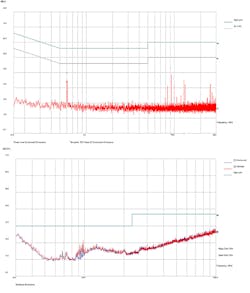
CISPR 22 Class B results for conducted EMI (top) and radiated EMI (bottom) for the MAXM17532—a previously introduced, closely related sibling in the Himalaya family—show that the modules easily pass both tests.
The datasheets for these devices contain a wide variety of performance graphs covering various ripple, transient-response, startup, enable, and other performance attributes, as you would expect for a power-related product. The modules are compliant with CISPR 22 (EN 5022) Class B EMI mandates (see figure), thus eliminating the need for power-supply redesigns. They’re also JEDEC certified to withstand drop, shock and vibration. Design-in support is provided via their respective evaluation kits: MAXM17552EVKIT#, MAXM15064EVKIT#, MAXM17900EVKIT#, and MAXM17903EVKIT# ($29.73 each) as well as EE-Sim models.

About the Author
 Bill Schweber
Bill Schweber
Contributing Editor
Bill Schweber is an electronics engineer who has written three textbooks on electronic communications systems, as well as hundreds of technical articles, opinion columns, and product features. In past roles, he worked as a technical website manager for multiple topic-specific sites for EE Times, as well as both the Executive Editor and Analog Editor at EDN.
At Analog Devices Inc., Bill was in marketing communications (public relations). As a result, he has been on both sides of the technical PR function, presenting company products, stories, and messages to the media and also as the recipient of these.
Prior to the MarCom role at Analog, Bill was associate editor of their respected technical journal and worked in their product marketing and applications engineering groups. Before those roles, he was at Instron Corp., doing hands-on analog- and power-circuit design and systems integration for materials-testing machine controls.
Bill has an MSEE (Univ. of Mass) and BSEE (Columbia Univ.), is a Registered Professional Engineer, and holds an Advanced Class amateur radio license. He has also planned, written, and presented online courses on a variety of engineering topics, including MOSFET basics, ADC selection, and driving LEDs.

Comment About the Article
To join the conversation, and become an exclusive member of Electronic Design, create an account today!
 Leaders Logo
Leaders relevant to this article: