Powering IoT Devices with Wiegand Energy-Harvesting Technologies
What you'll learn:
- The Weigand Effect can be used to produce small, consistent pulses of energy by exposing a short wire made of ferroelectric material to an alternating magnetic field.
- This technology has been used for various types of sensors, but recent advances now enable it to be used as a simple, rugged, low-cost energy-harvesting system.
- Learn how Weigand-based energy harvesting can be used to power low-power wireless IoT devices.

While the “Wiegand effect” has been used successfully in a variety of specialized applications, its full potential for energy harvesting and signal generation has received only limited recognition.
With recent enhancements to the energy output from Wiegand devices and the emergence of a new generation of ultra-efficient electronic chips for wireless communications, the technology is showing significant promise, especially in the realm of the Internet of Things (IoT). UBITO, a member of the FRABA Group of technology companies, is leading research and development projects aimed at fulfilling this promise.
About the Wiegand Effect
The Wiegand effect is a physical phenomenon discovered in the 1970s by John Wiegand, an American inventor who developed a process for altering the magnetic properties of ferromagnetic wire. When a sample of “Wiegand wire” is exposed to a reversing external magnetic field, it will initially retain its original magnetic state.
However, when the strength of the external field reaches a critical threshold, a magnetically soft region of the wire will undergo an abrupt reversal of its polarity. This transition takes place within a few microseconds and can be harnessed to induce a pulse of electric current in a fine copper coil wrapped around the wire.
The electric pulse generated by a Wiegand wire is very brief, but its strength stays nearly constant, regardless of how quickly or slowly the external magnetic field changes. This is what makes the Wiegand effect special: With a Wiegand wire, the amount of electrical energy generated with each reversal of the magnetic field remains consistent over a wide range of speeds.
>>Download the PDF of this article, and check out the TechXchange for similar articles and videos
 dreamstime_rawin_tanpin_395926587
By contrast, while simple dynamos are effective at converting rotary motion into electrical energy, their output power varies with rotation speed. At low speeds, power levels can be too low to be useful.
The combination of a short length of Wiegand wire and a surrounding copper coil is referred to as a Wiegand sensor.
Wiegand sensors work well as event-sensing devices, producing distinct energy pulses with good signal-to-noise characteristics. A typical application has been in fluid flow meters and multiturn rotary encoders. Here, a permanent magnet is mounted on the device’s rotating shaft, close to a Wiegand sensor (Fig. 1).
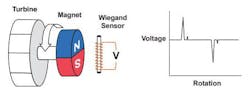
As the shaft turns, the rotation of the magnetic field triggers abrupt polarity reversals in the Wiegand wire, inducing pulses of electric current in the copper coil. The strength and duration of each current pulse is independent of how quickly or slowly shaft rotates.
Using Energy Harvesting to Power Innovation
“Energy harvesting” refers to technologies that extract energy from the local environment to power electronic devices. Several are available, including photovoltaics (energy from light), thermoelectric and pyroelectric effects (energy from temperature variations), and piezoelectric and electrostatic devices (energy from mechanical motion).
Wiegand sensors are good candidates for energy harvesting. In their basic form, these devices produce modest amounts of energy — about 200 nJ. This, however, is enough to energize low-power electronic circuits.
In flow meters or encoders, Wiegand sensors detect shaft rotations and power in an electronic counting system. This means that the counting system is essentially self-powered and will maintain a reliable tally of the number of rotations experienced, even when these occur if system power is unavailable. With no need to install, test, replace, and dispose of backup batteries, maintenance costs are sharply reduced.
Building an Energy Self-Sufficient IoT Node
Recent developments have significantly increased energy output from Wiegand devices and opened possibilities for much more ambitious applications.
An R&D program, carried out by a team of researchers at UBITO/FRABA's technology center and the Rhineland-Westphalia Technical University in Germany, and supported by the German Ministry of Science and Technology, has developed enhanced Wiegand devices that are optimized for power generation.
These “Wiegand harvesters” contain bundles of wire segments and produce up to 9 µJ of energy with each triggering event — around 50X the output from an “ordinary” Wiegand sensor.
As a demonstration,1 the researchers mounted a pair of Wiegand harvesters on the static part of a window frame, with a bar magnet mounted on the moving part. Opening or closing the window would trigger the Wiegand effect and produce enough energy to energize a low-power ultrawideband (UWB) radio transceiver with a transmission range of 60 meters (Fig. 2).
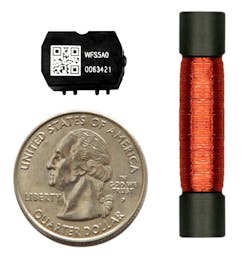
This demonstration points to the feasibility of a new generation of self-powered sensors capable of monitoring a physical action and wirelessly transmitting a notification signal to a monitoring system. Other condition data such as temperature could be coded into the signal.
Such energy self-sufficient, maintenance-free devices could become important components in an Internet of Things. As Christian Fell, FRABA’s head of technology development explains, “The vision of the IoT calls for thousands of smart sensors distributed through homes, commercial facilities, and digital factories, collecting data for monitoring, security, and process optimization. If these devices can be made energy self-sufficient, harvesting electricity directly from their surroundings to power both operation and wireless communications, there will be enormous benefits in terms of simplifying network deployment and reducing maintenance costs.”
The Wiegand effect could provide an excellent power source for remote sensors wherever a changing magnetic field is present.
Looking Ahead
Wiegand technology has proven successful in niche applications such as fluid metering and rotary encoders. It also has significant potential for more advanced uses, both as a sensor for detecting mechanical motions and as an energy-harvesting device for self-contained electronic devices. The advantages of Wiegand technology include consistent performance over a wide range of operating speeds and long-term reliability.
R&D carried out by UBITO is enhancing the energy output from Wiegand generators and creating possibilities for new generation of self-contained, zero-maintenance, wireless sensors designed to operate as nodes in emerging IoT systems.
An Invitation to Experiment
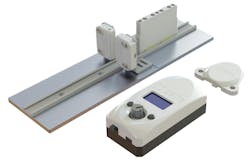
To encourage interest in Wiegand technology, especially in the IoT space, UBITO offers developer kit products including a “Wiegand Harvester Sample Kit” and a “Wiegand IoT Node Kit” (WINK) (Fig. 3, below).
The Harvester Sample kit contains a Wiegand harvester module and neodymium magnet. As mentioned, the harvester module contains a bundle of Wiegand wire segments. Suitable motion of the magnet will cause a “pulse train event” as individual wire segments reverse their polarity, each inducing a pulse of electricity in the coil surrounding the bundle. The cumulative energy output of this train of pulses is approximately 9 µJ. Voltage of the pulses is typically 1.5 V (2-kΩ resistive load).
The WINK kit includes a pair of Wiegand harvesters and a magnet, along with a radio transmitter and receiver units. The wireless communications are based on impulse-response ultrawideband (IRUWB) technology, making use of an SR-1000 UWB transceiver from SPARK Microsystems.
This device transmits very short electromagnetic pulses in a 2- to 11-GHz frequency band. As this technology transmits data in short pulses, it requires less energy than a narrowband radio transmitter. Intermittent transmission is a good fit with the Wiegand effect’s characteristic of generating electrical energy in brief pulses.
The WINK kit is designed to make it easy for system developers to duplicate the basic event-recognition and wireless communications functionality of the window demonstration, while opening possibilities for new application ideas.
Reference
1. J. Wiegner et al., “Wiegand-Effect-Powered Wireless IoT Sensor Node,” Proceedings of Sensoren und Messsysteme 2022 conference, Nuremberg, Germany, 2022.
>>Download the PDF of this article, and check out the TechXchange for similar articles and videos
dreamstime_rawin_tanpin_395926587About the Author
 Tobias Best
Tobias Best
Project Manager, UBITO
Tobias Best joined UBITO’s parent company, the FRABA Group, in 2017 and became a partner in 2024. He briefly worked in FRABA’s German office in 1999, focusing on multiturn encoder technology. Currently based in Singapore, he leads UBITO activities, managing various projects related to Wiegand technology. With a diverse background in music, engineering, and language, Tobias brings a unique perspective to his role. In his free time, he cherishes fatherhood and enjoys playing football.
Comment About the Article
To join the conversation, and become an exclusive member of Electronic Design, create an account today!
 Leaders Logo
Leaders relevant to this article: