U.S. Grid-Scale Battery Production to Support 100% of Renewable Generating Capacity
What you'll learn:
- America’s grid-scale battery manufacturing industry is now capable of fully meeting the storage needs of the electric supply produced by wind and solar.
- The nation’s manufacturing capacity has leapt form “effectively zero” in 2024 to roughly 70 GWh worth of finished grid storage systems each year.
- Battery storage is expected to account for roughly 28% of new U.S. power-plant capacity.

A recent analysis of America’s grid-scale battery manufacturing industry revealed that it’s now capable of fully meeting the storage needs of the growing percentage of America’s electric supply produced by wind and solar.
In his story titled “Suddenly, the US manufactures a ton of grid batteries,” Canary Media’s Julian Spector reports that batteries will account for roughly 28% of new U.S. power-plant capacity built this year. In addition, the country now has more than enough battery-making factories to meet the demand.
This development is especially remarkable because, according to Spector, “the U.S. had ‘effectively zero’ factory capacity for battery cells designed for grid usage.” But, by the close of 2025, U.S. factories operated by companies that include Fluence, LG, Samsung SDI, SK On, and Tesla had brought enough capacity online to annually produce about 70 GWh of finished grid storage systems.
For example, LG Energy Solution’s Holland Michigan-based LFP battery plant was recently expanded to produce 25 GWh worth of storage per year (see image above). Barring unforeseen circumstances, it’s expected that the capacity of these and several new ventures will grow to 145 GWh/year by the close of 2026.
Spector does note that the onshoring trend is still being hampered by limited supplies of domestically sourced lithium, carbon, and other battery materials. He did say, though, that the industry is on track to solve this through rapidly evolving battery recycling technologies and development of North American mining operations.
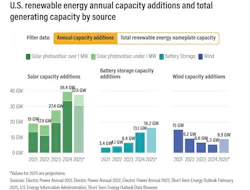
Despite the challenges, grid-scale storage systems are dramatically improving the economics of renewably produced electricity. They store excess power and release it to maintain a steady supply as wind speed varies or the Sun sets. This is particularly notable since the U.S. installed 43 GW of new solar capacity in 2025 (the fifth consecutive year that solar led all new U.S. capacity additions).
According to the Solar Energy Industries Association (SEIA) and Wood Mackenzie, solar and energy storage together accounted for 79% of newly installed capacity during the first year of the Trump administration, as detailed in the U.S. Solar Market Insight 2025 Year in Review report.
Next in This Edition of PowerBites


More PowerBites

 powerbites_promo
About the Author
 Lee Goldberg
Lee Goldberg
Contributing Editor
Lee is the author of the popular PowerBites series.
Lee Goldberg is a self-identified “Recovering Engineer,” Maker/Hacker, Green-Tech Maven, Aviator, Gadfly, and Geek Dad. He spent the first 18 years of his career helping design microprocessors, embedded systems, renewable energy applications, and the occasional interplanetary spacecraft. After trading his ‘scope and soldering iron for a keyboard and a second career as a tech journalist, he’s spent the next two decades at several print and online engineering publications.
Lee’s current focus is power electronics, especially the technologies involved with energy efficiency, energy management, and renewable energy. This dovetails with his coverage of sustainable technologies and various environmental and social issues within the engineering community that he began in 1996. Lee also covers 3D printers, open-source hardware, and other Maker/Hacker technologies.
Lee holds a BSEE in Electrical Engineering from Thomas Edison College, and participated in a colloquium on technology, society, and the environment at Goddard College’s Institute for Social Ecology. His book, “Green Electronics/Green Bottom Line - A Commonsense Guide To Environmentally Responsible Engineering and Management,” was published by Newnes Press.
Lee, his wife Catherine, and his daughter Anwyn currently reside in the outskirts of Princeton N.J., where they masquerade as a typical suburban family.
Comment About the Article
To join the conversation, and become an exclusive member of Electronic Design, create an account today!
 Leaders Logo
Leaders relevant to this article: