Earth Day 2026: E-Waste and Clean Energy
What you'll learn:
- How electronics recycling is scaling through collection, sorting, dismantling, and refurbishment systems.
- Why biodegradable boards, modular design, and easier disassembly matter to sustainability.
- How solar, wind, and battery storage are becoming part of the broader Earth Day technology story.
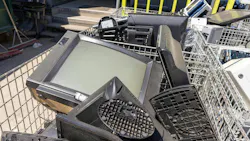
It’s officially Earth Day (Fig. 1)! On April 22nd, Earth Day shows us the impact that industries have on the planet. Since 1970, it has served as a global effort to hopefully address climate change. This year’s theme, “Our Power, Our Planet,” demonstrates how industries, including electronics, take accountability for their impact on the environment.

Electronic waste is worrying (Fig. 2). It worsens on a global level every day and is the fastest-expanding waste stream. Earth Day is a big eye-opener to this growing problem. How can we retrieve and reuse the materials more effectively?
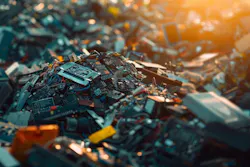
E-Waste Recycling
Recycling electronics is complex. That’s because devices are built with components, such as circuit boards, batteries, rare metals, glass, and other materials. And those are difficult to separate. For that reason, recycling centers have a multi-step system in place, including collection, data destruction, sorting, dismantling, recovery, and refurbishment.
Companies operate within that framework at scale, and it works. Electronic Recyclers International (ERI) said it processed 123.98 million pounds of e-waste in 2023. It has eight U.S.-based facilities, up to a billion pounds of shredding capacity per year. ERI uses robotics and proprietary shredders, working with Fortune 500 companies and government agencies to recycle everything from tablets to TVs, which reveals the industrialization and structure of e-waste recycling.
There’s also a big transition happening. Companies aren’t throwing away electronics. Instead, they’re sticking to a system that keeps materials out of landfills while staying on top of environmental regulations.
>>Check out this TechXchange for similarly themed articles and videos
 Green printed circuit board morphing into trees
Dell is also active in the e-waste recycling space. The company is well-known for its take-back and tracking initiatives. In collaboration with the Basel Action Network, Dell installed trackers inside returned electronics to see where they end up after collection. With this visibility, materials are staying within responsible recycling streams rather than being sent into poorly regulated channels that don’t meet environmental standards.
In this e-waste age, people want to recycle batteries. Wearables and portable electronics are all over the place. And that means more lithium-ion batteries. To make those issues disappear, firms like The Battery Network expanded drop-off programs and bulk collection efforts, helping customers and businesses safely dispose of batteries.
According to the company, it has over 20,000 collection sites across the U.S., and 80% of Americans live within 15 miles of a drop-off location. This is especially crucial as those batteries must be carefully handled and disposed of.
Advances in Recycling Technology
Even recycling facilities are getting better with tech. We’re talking robotics, computer vision, and AI to sort materials. Systems find and separate all of the necessary parts of a device, like components, PCBs, and plastics, faster than a human worker. This ensures useful materials don’t get lost in the recycling process while it recovers reusable metals. Such a mindset influences electronic product design.
Since we’re noticing more recycling challenges, engineers are considering sustainability in the early stages of development. They have worked on reducing a device’s environmental footprint before it gets sold.
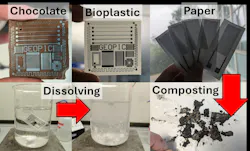
This shift appears in several ways. Researchers from the University of Glasgow have developed 99% biodegradable circuit boards using zinc-based tracks on biodegradable substrates like paper, bioplastics, and chitosan (Fig. 3). These are different from standard PCBs due to the substrate breaking down while the conductive parts do their job. Using these materials ensures that recycling is far less complex. Related work on biodegradable circuitry provides more context on where this area of electronics design is heading.
Researchers are experimenting with modular designs, enabling users to switch faulty components without replacing the whole system. Making product disassembly easier has also gained traction as it improves material recovery and extends product life.
The Latest Strides in Renewable Energy
In addition, Earth Day reminds us that electronic sustainability goes beyond recycling. While we’re seeing an uptick in devices, the energy demand to manufacture them also increases. Renewable energy is rapidly progressing. To date, the most interesting developments are taking place in solar, wind, grid support, and storage.
Solar power production is improving in a big way, too. Perovskite-silicon tandem solar cells have proven to be more efficient than silicon panels. Recent reports reveal that their efficiency is 34.85% (Fig. 4). This makes a big difference as it means these panels generate more power from the same surface area.
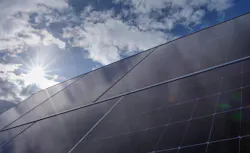
Deploying them on commercial buildings, rooftops, and utility-scale sites in the future will make a huge difference in producing more power. We’re expecting to see an additional 43.4 GW of utility-scale solar capacity installed in 2026.
Solar-plus-storage is a leading clean energy model, combining solar power with batteries to balance supply and meet demand at nighttime. Texas is expected to deploy 621 MW of solar and storage capacity at Lunis Creek BESS and 600 MW at Clear Fork Creek. Bellefield 1 in California installed 1 GW of solar-plus-storage, with 500 MW of solar and 500 MW of four-hour battery storage.
Wind is a big part of the clean energy shift. America projects to install 11.8 GW of wind capacity across Texas, New Mexico, Illinois, Wyoming, and offshore markets. From 2026 to 2029, the U.S. will deploy 46 GW of wind capacity.
Battery storage is quickly expanding. This year, the Energy Information Administration says that 24.3 GW of battery storage capacity will come online. Utilities can use it to store excess power from solar and wind while reducing congestion. The technology helps keep power flowing even as renewable-energy production slows down.
Bezos Earth Fund
In 2020, Jeff Bezos pledged $10 billion toward climate and nature projects through the Bezos Earth Fund. At the time, this was the largest philanthropic commitment. After five years, the money’s been going out, but gradually.
So far, it has distributed about $2.3 billion, leaving a significant amount, $7 billion, to be spent before the 2030 cutoff. Where it ends up has changed a bit. Earlier, it was meant for climate science and nature-based solutions. But now? It’s landing in food systems and new tech like AI tools for environmental research and nuclear energy.
With its 2030 deadline approaching, Lauren Sanchez Bezos serves as the vice chair to determine how the rest of the funds should be distributed. She announced $37.5 million in grants in September 2025 for major ocean conservation projects throughout 12 Pacific Island nations.
Alongside that, she revealed $30 million in Phase II awards as part of the fund’s AI Grand Challenge for Climate and Nature, which contributes up to $100 million to AI-powered climate solutions. The fund is focused on scaling climate solutions at scale before the deadline.
As for myself, I have several huge boxes full of electronics and cables to recycle. Plus, I started a nonprofit called “Dev Boards Without Borders” in an effort for us engineers to place our surplus where it can do the most good. More on my efforts later.
What are you doing to help the ol’ planet?
Let us know in the comments below.
>>Check out this TechXchange for similarly themed articles and videos
Green printed circuit board morphing into treesAbout the Author
 Cabe Atwell
Cabe Atwell
Technology Editor, Electronic Design
Cabe is a Technology Editor for Electronic Design.
Engineer, Machinist, Cartoonist, Maker, Writer. A graduate Electrical Engineer actively plying his expertise in the industry and at his company, Gunhead. When not designing/building, he creates a steady torrent of projects and content in the media world. Many of his projects and articles are online at element14 & SolidSmack, industry-focused work at EETimes & EDN, and offbeat articles at Make Magazine. Currently, you can find him hosting webinars and contributing to Electronic Design and Machine Design.
Cabe is an electrical engineer, design consultant and author with 25 years’ experience. His most recent book is “Essential 555 IC: Design, Configure, and Create Clever Circuits”
Cabe writes the Engineering Life & Engineering on Friday blog on Electronic Design.
See Cabe's cartoons & comic strips here.
Comment About the Article
To join the conversation, and become an exclusive member of Electronic Design, create an account today!
 Leaders Logo
Leaders relevant to this article: