Applying Edge AI to DC Arc Fault Detection (Part 1)
What you’ll learn:
- What are DC series arc faults, and why are they especially dangerous in solar energy, EV charging, and battery systems?
- How can these faults silently damage connectors, busbars, insulation, and enclosures before human detection?
- Reasons why traditional arc fault protection methods often miss early arc signatures, and how edge AI on microcontrollers enable fast local detection.
- What makes on-device inference more responsive, adaptable, and scalable for real-world power systems.

DC systems are everywhere, from solar on rooftops to electric-vehicle (EV) charging and battery packs. DC went from niche to essential rather quickly, but one problem doesn’t get enough attention until something breaks: DC series arc faults. The aftermath of arc faults includes melted busbars, burned connectors, possibly fire damage. One little arc that no one caught in time can wreck a whole system.
Because traditional protection isn’t great at catching arc faults, edge artificial intelligence (AI) is starting to make sense, with local processing, fast response, and pattern recognition that are missed by older methods.
The first installment of this three-part article series presents an overview of DC series arc faults, uncovers the advantages of edge AI-enabled microcontrollers (MCUs), and summarizes the technique of how to train AI models on MCUs.
>>Download the PDF of this article, and check out the TechXchange for similarly themed articles on edge AI
 arc_dreamstime_436948156
 Edge AI TechXchange
What’s a DC Series Arc Fault?
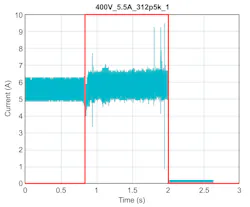
A DC series arc fault is an unintended electrical discharge that happens in series with the load. It’s not a ground fault where current leaks to earth. The fault stays in the circuit — along the wire, at a connector, inside a switch — which is why it’s sneaky. The center of Figure 1 shows the arc signature at a controlled testbed, where a normal current transitions and results in an arc before the system is manually turned off.
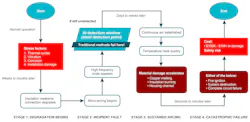
As illustrated by the flowchart in Figure 2, the arc occurs when something degrades: insulation cracks; a solder joint fails; a connector vibrates loose over time; or maybe a cable was nicked during installation. The result is an erratic, high-frequency current signature. The energy concentration is intense, burning through copper, melting plastic housings, and starting fires if the conditions are right.
DC series arc faults can occur in:
- Solar inverter systems: Photovoltaic strings are located outdoors, exposed to weather and thermal cycling. In some instances, it’s possible to trace faults back to corroded MC4 connectors or hairline cracks in cable insulation. The arc travels back toward the inverter, and if detection isn’t fast, expensive modules may need replacing.
- EV chargers and battery packs: With high current (sometimes >200 A) plus vibration and heat cycles, busbars and welds inside the charger or battery-management system take a beating. In one example, a busbar weld failed after about 18 months in the field. Thermal imaging caught it late, but an arc detector would’ve flagged it much earlier.
- High-voltage DC links and DC microgrids: These faults occur when there are tight cable bundles and high voltages. During a maintenance visit or trenching work, one accidental nick could eventually lead to an arc. Arcs are also harder to isolate when everything is connected in series.
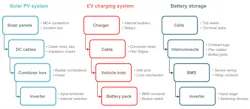
- Stationary storage: In large, densely packed lithium-ion arrays, one loose cell interconnect or bad crimped lug can propagate a fault through the string. Energy density makes it burn hot and fast. Every modern system consists of multiple subcomponents that are prone to arc faults. Figure 3 shows an example breakdown of subsystems and the corresponding points most prone to arc faults.
The common weak point between these causes is a mechanically or thermally stressed conductive path. Because DC doesn’t have a zero crossing like AC, once an arc begins, it’s harder to self-extinguish.
DC series arc faults are concerning for several reasons:
- Safety: A DC arc that doesn’t self-clear can hit ≤1,500°C, causing melted cable trays and scorched enclosures. Any flammable material nearby (insulation, wire jackets, plastic housings) could ignite.
- Reliability: Even if the arc doesn’t cause a fire, it degrades components over time, resulting in intermittent faults that are a nightmare to diagnose. The system may shut down randomly and the issue isn’t replicable when technicians arrive, yet it happens again two weeks later.
- Regulations: Underwriters Laboratories (UL) 1699B for arc fault detection, International Electrotechnical Commission 62606 for solar, UL 1741 for inverters, and International Organization for Standardization 26262 for automotive aren’t optional anymore. Commercial, or grid-tied equipment, design requires compliant arc detection.
- Money: One fire at a solar farm or battery site can cause hundreds of thousands of dollars in damage — perhaps millions if it spreads or takes the whole array offline. Even a failed module swap or unplanned downtime adds up fast. Prevention is more economical than reaction.
How Detection Has Evolved from Simple Trips to Edge AI
Traditional protection is pretty basic: overcurrent relays, root-mean-square monitoring, maybe a voltage drop detector. Those work reasonably well for big, obvious faults, but they miss the early warning signs. A series arc has a high-frequency noise signature that develops before things become critical, and threshold-based methods are unable to see it.
Modern MCUs, especially those baked into power-stage application-specific integrated circuits (ASICs), sample current at hundreds of kilohertz now. A fast Fourier transform (FFT) or wavelet transform can be applied to the data stream and start identifying spectral features that correlate with arcing. The MCU does this locally by:
- Streaming raw data continuously without depending on the cloud.
- Running signal processing in real-time and flagging potential arc events in microseconds.
- Triggering protection immediately by opening a contactor and shutting down the stage without waiting for a remote server to respond.
That’s already a huge improvement. But where it gets interesting is when AI inference is placed directly into the MCU.
Some of the advantages of edge AI include:
- Pattern recognition is much more sophisticated. Even a small convolutional neural network (CNN) can learn the time-varying harmonic fingerprint of an arc forming. It’s able to distinguish an arc from normal operation, such as inductive kickback when a motor starts, switching transients, or load steps that would trip a basic threshold detector.
- It’s adaptable. Every installation is different: cable lengths, connector brands, ambient electromagnetic interference (EMI). With edge AI, the model can be retrained or fine-tuned on-site using real data from that specific system. Edge AI becomes smarter over time, whereas factory defaults remain the same.
- Latency is almost zero. Inference runs locally, usually under a millisecond. Sending data to the cloud and waiting for a response lets the arc burn for tens or hundreds of milliseconds. When limiting energy release is the objective, every millisecond counts.
- Bandwidth and privacy. The system isn’t constantly streaming gigabytes of waveform data. The MCU only reports when something anomalous happens. For residential solar or home EV chargers, users appreciate not having their electrical usage patterns uploaded 24/7.
- Scales well. One AI-capable MCU can monitor multiple strings or phases at once. Such deployments on solar farms with dozens of combiner boxes are significantly more cost-effective than installing a separate high-end processor in every box. The same logic applies to fleet EV chargers or large battery racks.
The ability of an edge AI model to catch an incipient arc that an FFT-based detector completely missed is impressive. The models aren’t perfect — designers still need good training data and there’s tuning involved — but it’s a big step forward.
Conclusion
AI is moving faster than expected, finding its way into automation, design optimization, and predictive maintenance scenarios. In transmission and power electronics, teams are using machine learning to model dynamics that once took weeks of simulation. Machine learning helps catch wear patterns before things fail, tweaks control loops, and saves energy.
It makes sense that companies are pushing AI into their workflows to speed up development cycles and make systems smarter and more autonomous. Safety metrics are improving as well.
The second installment of this series will explore solutions to the early arc fault detection challenge from the software perspective, providing an overview of how designers can begin to develop and deploy code for edge-AI-enabled arc fault detection.
>>Download the PDF of this article, and check out the TechXchange for similarly themed articles on edge AI
arc_dreamstime_436948156Edge AI TechXchangeAbout the Author
 Adithya Thonse
Adithya Thonse
Systems Engineer, Texas Instruments
Adithya Thonse is a systems engineer for application-specific MCUs at Texas Instruments. He holds an engineering degree from the Indian Institute of Science (IISc).
Comment About the Article
To join the conversation, and become an exclusive member of Electronic Design, create an account today!
 Leaders Logo
Leaders relevant to this article: