Electric-Eel “Gel” Leads to Biocompatible Battery
What you'll learn:
- How researchers used hydrogels, based on electric eel electrocytes, to create a battery.
- How they modified the hydrogels for improved performance in the application, using spin coating for fabrication.
- The power density and other attributes they realized for various formulations and fabrications.
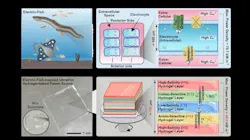
The quest for batteries that can function in different ambient environments has led to some interesting approaches. Researchers at Pennsylvania State University (PSU) College of Engineering have worked on developing a rechargeable battery that can be used in or around biological tissue, where it must be flexible and non-toxic while still powerful enough to support small-scale medical devices or soft robotics. For a power source, they looked at the biology of electric fish such as eels.
The team applied a state-of-the-art fabrication method to layer multiple types of hydrogels — water-rich materials capable of conducting electricity — in a specific pattern that mimics the ionic processes used by electric eels to generate electrical bursts. Their approach produces power sources with higher power densities than other hydrogel-based designs while remaining flexible, support-free, environmentally stable, and biologically compatible (Fig. 1).
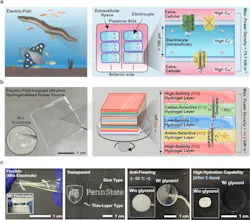
Eel-Based Thin Hydrogels
Unfortunately, most existing eel-inspired devices produce limited power, and they require mechanical support to function. To address these problems, the team adjusted the material chemistry to fabricate very thin hydrogels, which can produce more power without the need of mechanical supports.
Joseph Najem, assistant professor of mechanical engineering and corresponding author on the team’s paper, explained that “The electrocytes in electric eels are ultra-thin biological cells, capable of generating over 600 V of electricity in a brief burst. These cells achieve very high-power densities, meaning they can produce a lot of power from small volumes.”
[Note: Electrocytes are specialized, flat, disc-like cells found in electric fish (such as electric eels and electric rays) that function like tiny biological batteries. They are modified muscle or nerve cells that don’t contract but generate electricity by controlling the flow of charged ions (like sodium and potassium) across their membranes.]
To construct the battery, they used spin coating to deposit ultra-thin layers of material on a rotating surface (Fig. 2).
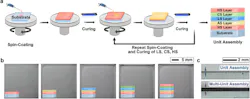
They layered four different hydrogel mixtures, each only 20 µm, resulting in a thin geometry that reduces internal resistance, a critical factor for producing high power while preserving mechanical strength and flexibility (Fig. 3).
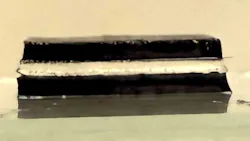
To make their hydrogel thinner, the team had to adjust its chemistry so that the hydrogel could spread uniformly during spin coating, yet remain mechanically stable and be thin enough to maintain low electrical resistance. They noted that conventional formulations would simply fly off the spinning surface during spin coating.
The upgraded hydrogel also offers temperature range and hydration improvement. By incorporating the chemical glycerol, the hydrogel power sources remain functional at temperatures as low as −80°C (−112°F) without freezing (it’s unclear to me why a biological battery would need that low operating range).
The material also retains water longer than conventional hydrogels. While standard hydrogels can dehydrate within a few minutes and lose conductivity, the new formulation is able to remain hydrated for up to five days in air.
What About Performance?
The team took electrochemical measurements for parameters such as discharge rate, power density, and conductive potential (Fig. 4). Their new power sources demonstrated power density of about 44 kW/m3, which is higher than previously reported for hydrogel-based power sources. They also had an area-normalized resistance of 2.0 × 10⁻³ Ω-m2.
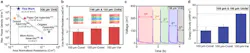
Furthermore, tests were run on units with different layer thickness and formulations. For dynamic performance, they characterized the critical charge/discharge curves under various conditions.
To briefly demonstrate one version of the device, they built a complete battery by serially stacking ten 100-μm units with PEDOT:PSS electrodes on either end. After assembly and an initial recharging cycle, the scaled power source produced 2 V, sufficient to power a red LED. As they expected from the rapid discharge profiles in these systems, the LED was illuminated for only half a second.
[Note: Poly(3,4-ethylenedioxythiophene) polystyrene sulfonate (PEDOT:PSS) is a composite material where PEDOT (the conductive polymer) provides electrical conductivity, and PSS (polystyrene sulfonate) acts as a counter-ion to balance the charge and improve the water solubility and processability of PEDOT.]
These values are comparable to those of the electric eel, which they say marks a significant step toward functional emulation of this unique biological system. They believe this work points to a source that’s capable of efficiently powering complex devices such as implanted medical sensors, soft robotics controllers, and wearable electronics — within limits, of course. As you’d expect, more research is needed.
If you want to know more, the work is presented in a detailed yet readable paper “Electric-Fish-Inspired Thin Hydrogel Electrocytes Achieve High Power Density and Environmental Robustness” published in Advanced Science.
About the Author
 Bill Schweber
Bill Schweber
Contributing Editor
Bill Schweber is an electronics engineer who has written three textbooks on electronic communications systems, as well as hundreds of technical articles, opinion columns, and product features. In past roles, he worked as a technical website manager for multiple topic-specific sites for EE Times, as well as both the Executive Editor and Analog Editor at EDN.
At Analog Devices Inc., Bill was in marketing communications (public relations). As a result, he has been on both sides of the technical PR function, presenting company products, stories, and messages to the media and also as the recipient of these.
Prior to the MarCom role at Analog, Bill was associate editor of their respected technical journal and worked in their product marketing and applications engineering groups. Before those roles, he was at Instron Corp., doing hands-on analog- and power-circuit design and systems integration for materials-testing machine controls.
Bill has an MSEE (Univ. of Mass) and BSEE (Columbia Univ.), is a Registered Professional Engineer, and holds an Advanced Class amateur radio license. He has also planned, written, and presented online courses on a variety of engineering topics, including MOSFET basics, ADC selection, and driving LEDs.
Comment About the Article
To join the conversation, and become an exclusive member of Electronic Design, create an account today!
 Leaders Logo
Leaders relevant to this article: