Passive 3D Thermal “Cloak” Hides Objects from Heat
What you'll learn:
- What are some applications for thermal cloaking and invisibility?
- Why previous approaches were limited to two-dimensional cloaking.
- How a new approach provides 3D cloaking.
Nearly every system and circuit designer is concerned with two aspects of power: Getting enough of it to where it’s needed, as well as dissipating the resultant heat so that individual components and the system don’t go into thermal overload.
But there are two other aspects of thermal physics that sometimes are also critical:
- Managing a heat source so that it’s not visible to outsiders (thermal detection).
- Ensuring external heat doesn’t direct more heat onto a component.
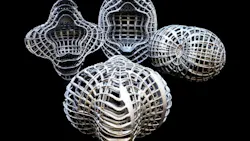
Addressing these latter two issues, researchers at the University of Illinois/Urbana-Champaign have developed a technology for producing passive “heat cloaks” that render objects nearly invisible to thermal imaging (Fig. 1).
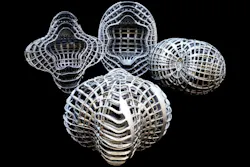
Note that this isn’t just a thermal barrier preventing heat from reaching or leaving a target. Instead, it directs the flow of heat around the target object. (Although there are some outward similarities, don’t confuse this thermal cloak with the well-known Romulan cloaking device of Star Trek — but then again, you never know what the future will bring!)
Past cloaking experiments have only worked in two dimensions or along a single direction of heat flow, far from the ideal of a true 3D cloak. Therefore, controlled heat only goes across flat surfaces or along one predetermined route. If heat approached from another direction, the temperature disturbance created by the hidden object could become visible.
Transformational Thermotics
To solve this problem, the team went back to the basic of transformational “thermotics” (for some reason, they chose this archaic term for what we now call thermodynamics). They asked, “What kind of material structure could cover almost all of the thermal properties needed for a perfect cloak?”
Their solution investigated and calculated how heat must travel around a protected region to make the surrounding temperature field look unchanged. The idea is similar to rerouting an electrical or water-flow current around an obstacle and reconnecting it on the other side without leaving an obvious disruption.
Their implementation is based on a new type of lattice-type material that can be fully adjusted in three directions. By tuning these dimensions, the researchers could precisely control how well different regions conduct heat. This design covers a much wider range of thermal conductivities than previous approaches — sufficient to closely match the theoretical requirements for ideal cloaking.
They used advanced CAD and thermal-modeling tools to calculate how heat must travel around a protected region to make the surrounding temperature field look unchanged. The challenge was turning that mathematical prescription into a structure that could be manufactured. Different regions of the cloak needed carefully selected thermal conductivities, meaning they had to move heat at different rates and along different directions.
Implementation and Test Results
The team’s thermal cloak isn’t just a computer model — it has been physically fabricated and tested. The device is a hybrid material using 3D-printed metal to create a precise aluminum lattice that acts as a high-conductivity material. Mold casting was then used to fill in the structure with a rubber-like material with low thermal conductivity (Fig. 2).
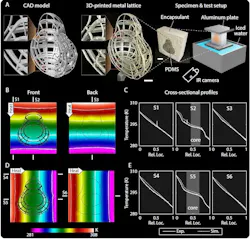
The geometry of the lattice can be adjusted independently in three dimensions, as changing the shape and arrangement of the lattice allows each section to conduct heat differently. This broader range of thermal behavior brought the physical device close to the conditions predicted for an ideal cloak.
For evaluation, the researchers placed the cloak between hot and cold regions, producing a temperature gradient across the device. Two aluminum plates were used to create smooth heat paths. The top plate was connected to an electric heat source, and the bottom plate was soaked in iced water. The four side-faces were cast with a 2-mm-thick coating of PDMS (polydimethylsiloxane, a widely used silicon-based organic polymer, often referred to as dimethicone or silicone oil) layer to create the adiabatic boundary condition.
The hot end’s temperature was set to 40°C. The temperature distribution was recorded to capture how heat moved through and around the structure. From the outside, the thermal pattern looked almost as though the concealed object didn’t exist. Heat passed around the protected region and rejoined beyond it without producing the strong distortion that would normally reveal an obstruction. Inside the cloak, the temperature stayed uniform and remained insulated from the surrounding hot and cold conditions.
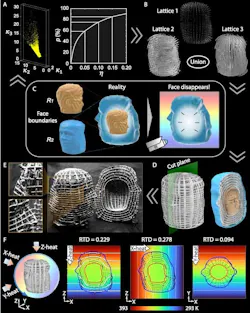
Their strategy allows them to engineer 3D thermal meta-devices with record-breaking geometric complexity. They further demonstrated this using a 3D thermal cloak with the shape of human faces (Fig. 3). These tests showed that the method could accommodate irregular geometries rather than only simple objects designed for controlled experiments.
The work is detailed in their readable paper with the unusually simple and crisp title “Free-form thermal cloaks in three dimensions” published at Nature Communications. In addition to full technical exposition and analysis, their paper also discusses other efforts to achieve thermal cloaking and why they fell short of providing full 3D cloaking.
About the Author
 Bill Schweber
Bill Schweber
Contributing Editor
Bill Schweber is an electronics engineer who has written three textbooks on electronic communications systems, as well as hundreds of technical articles, opinion columns, and product features. In past roles, he worked as a technical website manager for multiple topic-specific sites for EE Times, as well as both the Executive Editor and Analog Editor at EDN.
At Analog Devices Inc., Bill was in marketing communications (public relations). As a result, he has been on both sides of the technical PR function, presenting company products, stories, and messages to the media and also as the recipient of these.
Prior to the MarCom role at Analog, Bill was associate editor of their respected technical journal and worked in their product marketing and applications engineering groups. Before those roles, he was at Instron Corp., doing hands-on analog- and power-circuit design and systems integration for materials-testing machine controls.
Bill has an MSEE (Univ. of Mass) and BSEE (Columbia Univ.), is a Registered Professional Engineer, and holds an Advanced Class amateur radio license. He has also planned, written, and presented online courses on a variety of engineering topics, including MOSFET basics, ADC selection, and driving LEDs.
Comment About the Article
To join the conversation, and become an exclusive member of Electronic Design, create an account today!
 Leaders Logo
Leaders relevant to this article: