Surface-Mount X-, Y-Capacitors First to Carry AEC-Q200 Rating

What you’ll learn:
- The role of X- and Y-capacitors and where they’re mandated.
- How versions in surface-mount packages ease production flow.
- The key parameters of these capacitors in their unique roles.
Designing a new product is difficult enough, but the requirement for mandated safety-related components can cause additional challenges when designers aren’t aware of them early in the design cycle. That’s why smaller design companies often bring on a regulatory-standard compliance expert, and larger companies have a similar specialist on staff to make sure the design, its components, and their placement meet the many mandates.
This is the case with what are called X- and Y-capacitors. Such AC-line capacitors are mandated by good design practice as well as regulatory standards in AC-power situations.
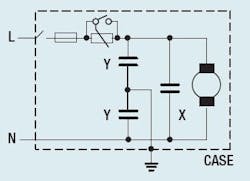
These two special classes of capacitors, which filter AC power-source noise, are often collectively referred to as “safety capacitors.” The X-capacitors are used for differential-mode EMI filtering, while Y-capacitors perform common-mode EMI filtering by bypassing the interference from the wires to ground.
X and Y Classification
First, the obvious question: Why are they called X-capacitors and Y-capacitors (also called “Class-X capacitors and Class-Y capacitors)? I did some research and came up with conflicting, unsupported answers; I suspect some electronics-industry historian may have the answer.
Perhaps if you look at them individually on a schematic diagram or redraw the schematic to have oblique rather than right-angle connections, and with some imagination, you can see that each one forms a crude representation of its respective letter…maybe (Fig. 1). But we’ll let this issue go and move on.
The need for these capacitors isn’t new, but the applications that need them are expanding. Traditional applications include AC-line powered appliances. However, they’re now needed to provide EMI/RFI suppression and filtering in onboard chargers, traction inverters, and battery-management systems, as well AC-DC converters in electric, hybrid electric, and plug-in hybrid electric vehicles.
First Surface-Mount Y1-Capacitor
To meet these needs, Vishay Intertechnology has introduced a series of automotive-grade qualified (AEC-Q200), AC-line rated, ceramic-disc safety capacitors that are the industry’s first with a Y1 rating to be offered in a surface-mount casing. (Y1 is a subclass of the more-general Y-capacitor specifications.)
With a Y1 rating of 500 V AC and 1,500 V DC, and offered in capacitance values of 470 to 4,700 pF (±20%), the Vishay SMDY1 Automotive Series devices are designed to provide EMI/RFI suppression and filtering in harsh, high-humidity environments with a Class IIB humidity-grade rating in accordance with IEC60384-14 annex I (the regulatory demands of IEC60384 are strict). They also can be used in suitable X1 situations.
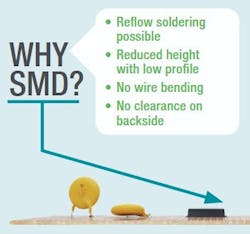
By supporting surface-mount assembly with a reflow soldering process, these SMDY1 Automotive Series capacitors reduce production costs compared to through-hole leaded components. Unlike leaded components, the devices offer a low, flat profile on the PCB to enable flat casings or backside PCB mounting, and without the clearance space required by through-hole capacitors (Fig. 2).
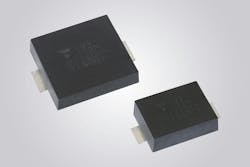
The components consist of a copper-plated ceramic disc and feature encapsulation made of flame-resistant epoxy resin in accordance with UL 94 V-0. They’re offered in two physical sizes: an 8.60- × 14.80-mm “C case” with a creepage distance of 10 mm, and a 14.60- × 19.20-mm “D case” with a creepage distance of 14.5 mm (Fig. 3).
Full details are in the datasheet. Just remember, don’t let anyone casually say “What’s the big deal? It’s just a capacitor” That’s not the case at all, especially where regulatory compliance is required.
>>Check out this TechXchange for similar articles and videos
 Capacitors Ed Promo Kondratova Dreamstime Xxl 34385472
About the Author
 Bill Schweber
Bill Schweber
Contributing Editor
Bill Schweber is an electronics engineer who has written three textbooks on electronic communications systems, as well as hundreds of technical articles, opinion columns, and product features. In past roles, he worked as a technical website manager for multiple topic-specific sites for EE Times, as well as both the Executive Editor and Analog Editor at EDN.
At Analog Devices Inc., Bill was in marketing communications (public relations). As a result, he has been on both sides of the technical PR function, presenting company products, stories, and messages to the media and also as the recipient of these.
Prior to the MarCom role at Analog, Bill was associate editor of their respected technical journal and worked in their product marketing and applications engineering groups. Before those roles, he was at Instron Corp., doing hands-on analog- and power-circuit design and systems integration for materials-testing machine controls.
Bill has an MSEE (Univ. of Mass) and BSEE (Columbia Univ.), is a Registered Professional Engineer, and holds an Advanced Class amateur radio license. He has also planned, written, and presented online courses on a variety of engineering topics, including MOSFET basics, ADC selection, and driving LEDs.