Advanced Current-Sense Resistors and Thermal Jumpers Help Beat the Heat in Power Designs

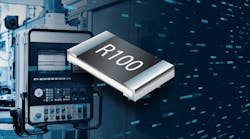
The CSSU2512 current-sense resistors from Stackpole and Bourns’ BTJ Series Thermal Jumper Chips provide the thermal stability and dissipation characteristics required for compact, long-life, high-power applications.
The resistor series features robust all-metal construction and an advanced thermally conductive design that offers substantially lower thermal resistance. This effectively reduces thermal stress on adjacent components while dissipating up to 5 W of power. The resistors achieve thermal performance that’s on par with other 2512-size current-sense chips rated at 3 W.
Available in resistance values from 1 to 10 mΩ, with 1% tolerance and a 50-ppm temperature coefficient of resistance (TCR), the AEC-compliant CSSU2512 offers exceptional durability and consistent performance in demanding environments.
Pricing varies by resistance value and order volume, ranging from $0.22 to $0.30 per unit in full package quantities.
Bourns’ BTJ Series Thermal Jumper Chips combine high thermal conductivity and excellent insulating properties that help protect and prolong system component lifespans. Their advanced design takes advantage of the chips' insulating properties, allowing the space between the heating element and the heat-detection element to be filled, enabling highly accurate heat detection.
The new thermal jumpers can be used to augment thermal-dissipation solutions in a variety of mobile devices and electronic equipment, such as power supplies, converters, and RF and GaN amplifiers.
Additional information about Bourns’ advanced thermal jumpers can be found here.
Next in This Edition of PowerBites

More PowerBites
 powerbites_promo
About the Author
 Lee Goldberg
Lee Goldberg
Contributing Editor
Lee is the author of the popular PowerBites series.
Lee Goldberg is a self-identified “Recovering Engineer,” Maker/Hacker, Green-Tech Maven, Aviator, Gadfly, and Geek Dad. He spent the first 18 years of his career helping design microprocessors, embedded systems, renewable energy applications, and the occasional interplanetary spacecraft. After trading his ‘scope and soldering iron for a keyboard and a second career as a tech journalist, he’s spent the next two decades at several print and online engineering publications.
Lee’s current focus is power electronics, especially the technologies involved with energy efficiency, energy management, and renewable energy. This dovetails with his coverage of sustainable technologies and various environmental and social issues within the engineering community that he began in 1996. Lee also covers 3D printers, open-source hardware, and other Maker/Hacker technologies.
Lee holds a BSEE in Electrical Engineering from Thomas Edison College, and participated in a colloquium on technology, society, and the environment at Goddard College’s Institute for Social Ecology. His book, “Green Electronics/Green Bottom Line - A Commonsense Guide To Environmentally Responsible Engineering and Management,” was published by Newnes Press.
Lee, his wife Catherine, and his daughter Anwyn currently reside in the outskirts of Princeton N.J., where they masquerade as a typical suburban family.