Dual-Motor Driver Board Streamlines Prototyping of Auto Systems
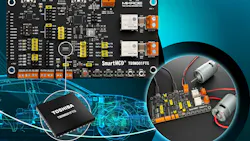
Toshiba Electronics partnered with MIKROE to integrate its SmartMCD for dual brushed DC motors into the SmartMCD TB9M001FTG board. The board helps automotive system engineers accelerate prototyping of automotive applications, including electric sunroofs, wipers, powered windows, and adjustable seats.
The AEC-Q100 (Grade 1) qualified SmartMCD device incorporates an MCU based on the Arm Cortex-M0 core, 16 kB of RAM, and 192 kB of flash memory, with an additional 16 kB of data flash — all with error-correcting code (ECC) for single-error correction and double-error detection (SEC/DED).
The MCU comes equipped with four low-side relay drivers, which enable forward and reverse control of two brushed DC motors. It also contains two high-side drivers for supporting 5- and 12-V loads to external components, a LIN transceiver, and a fully integrated power-management system that generates all of the required voltage levels from the car battery. Its robust suite of safety features includes error detection for overcurrent (low-side and high-side drivers), overvoltage, undervoltage, and thermal-shutdown protection.
Measuring 130 × 73 mm, the SmartMCD TB9M001FTG board maintains all of the circuitry required for motor control and operational testing, such as multiple configurable general-purpose input/output (GPIOs) with several connection options, selectable by jumpers. An on-board debugger, which is compliant with the CMSIS-DAP on-board emulator standard, allows for out-of-the-box operation, testing, and debugging of the target device.
Additional information about the SmartMCD TB9M001FTG IC can be found on Toshiba’s website.
Next in This Edition of PowerBites
More PowerBites

 powerbites_promo
About the Author
 Lee Goldberg
Lee Goldberg
Contributing Editor
Lee is the author of the popular PowerBites series.
Lee Goldberg is a self-identified “Recovering Engineer,” Maker/Hacker, Green-Tech Maven, Aviator, Gadfly, and Geek Dad. He spent the first 18 years of his career helping design microprocessors, embedded systems, renewable energy applications, and the occasional interplanetary spacecraft. After trading his ‘scope and soldering iron for a keyboard and a second career as a tech journalist, he’s spent the next two decades at several print and online engineering publications.
Lee’s current focus is power electronics, especially the technologies involved with energy efficiency, energy management, and renewable energy. This dovetails with his coverage of sustainable technologies and various environmental and social issues within the engineering community that he began in 1996. Lee also covers 3D printers, open-source hardware, and other Maker/Hacker technologies.
Lee holds a BSEE in Electrical Engineering from Thomas Edison College, and participated in a colloquium on technology, society, and the environment at Goddard College’s Institute for Social Ecology. His book, “Green Electronics/Green Bottom Line - A Commonsense Guide To Environmentally Responsible Engineering and Management,” was published by Newnes Press.
Lee, his wife Catherine, and his daughter Anwyn currently reside in the outskirts of Princeton N.J., where they masquerade as a typical suburban family.