Click Board Features Configurable Advanced Microstepping
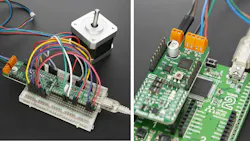
Stepper 29 Click is a compact add-on board for control of bipolar stepper motors in motion control, automation, robotics, and embedded positioning applications. Developed by MIKROE, this driver supports a motor supply operating range from 4.5 to 34 V and can deliver up to 1.8 A of output current. It’s able to control a variety of stepper motors using a single VM power supply thanks to its integrated internal regulator.
The board is based on the TB67S579FTG, a pulse-width-modulation (PWM), chopper-type, two-phase bipolar stepper-motor driver IC from Toshiba Semiconductor. It features manual current threshold adjustment, integrated protection mechanisms, configurable step resolutions up to 1/32 microstepping, flexible decay mode selection, and extended configuration through a I2C port expander for advanced driver control.
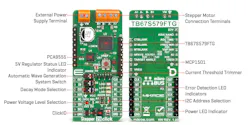
The Click board is suitable for stepper-motor control in office equipment and a range of commercial and industrial equipment. Stepper 29 Click features advanced microstepping with continuous sine-wave phase current for ultra-smooth, low-noise operation — even at full-step mode. It also includes AGC second generation for automatic current regulation and integrated stall detection to prevent motor stalls.
The board is fully compatible with the mikroBUS socket and can be used on any host system supporting the mikroBUS standard. It comes with the mikroSDK open-source libraries, offering greater flexibility for evaluation and customization. What sets this Click board apart is the ClickID feature, enabling your host system to automatically detect and identify this add-on board.
In single-unit quantities, the Stepper 29 Click board is priced at $39 in single-unit quantities.
Next in This Edition of PowerBites
 aerospace_dreamstime_47154110
 dreamstime_armandavtyan_3666592_promo
More PowerBites

 powerbites_promo
About the Author
 Lee Goldberg
Lee Goldberg
Contributing Editor
Lee is the author of the popular PowerBites series.
Lee Goldberg is a self-identified “Recovering Engineer,” Maker/Hacker, Green-Tech Maven, Aviator, Gadfly, and Geek Dad. He spent the first 18 years of his career helping design microprocessors, embedded systems, renewable energy applications, and the occasional interplanetary spacecraft. After trading his ‘scope and soldering iron for a keyboard and a second career as a tech journalist, he’s spent the next two decades at several print and online engineering publications.
Lee’s current focus is power electronics, especially the technologies involved with energy efficiency, energy management, and renewable energy. This dovetails with his coverage of sustainable technologies and various environmental and social issues within the engineering community that he began in 1996. Lee also covers 3D printers, open-source hardware, and other Maker/Hacker technologies.
Lee holds a BSEE in Electrical Engineering from Thomas Edison College, and participated in a colloquium on technology, society, and the environment at Goddard College’s Institute for Social Ecology. His book, “Green Electronics/Green Bottom Line - A Commonsense Guide To Environmentally Responsible Engineering and Management,” was published by Newnes Press.
Lee, his wife Catherine, and his daughter Anwyn currently reside in the outskirts of Princeton N.J., where they masquerade as a typical suburban family.