Ambient Energy Manager Handles Two Energy-Harvesting Sources
What you'll learn:
- Details of e-peas' AEM13920 PMIC and ambient energy manager.
- How the device leverages two energy-harvesting inputs.
e-peas has been in the energy-management arena for a while, and its latest AEM13920 pushes the envelope by supporting two energy-harvesting subsystems at the same time (see figure). The sources could be similar, like the two different solar cells used in the demo or other types of energy-harvesting technologies. I talked with Kevin Daly, VP of Sales for the Americas at e-peas, about the company’s latest power-management integrated circuit (PMIC) (watch the video above).
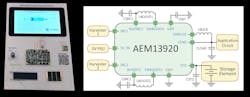
The AEM13920 is a PMIC and ambient energy manager (AEM). In addition to the two energy-harvesting inputs, it has a 5-V input that can charge the storage element. The energy-harvesting inputs implement “maximum power point tracking (MPPT) based on open-circuit voltage ratio as well as constant source voltage regulation features, allowing for harvesting the maximum power available from each source to charge the storage element.”
Its cold-start circuitry is designed to operate with an input voltage as low as 275 mV (min. 1.5 μW power). This is important as many energy-harvesting solutions provide small amounts of power. The system’s thermal monitoring prevents overcharging and discharge of the power storage element. It supports a range of battery technologies like LiC, Li-ion, LiPo, and Li-ceramic pouch.
The buck regular conversion efficiency is 96% with output current up to 100 mA and voltages from 0.6 to 2.5 V. A shipping mode can prevent charging and discharging during shipping. An I2C interface allows for external control of the AEM PMIC. The chip comes in a 5- × 5-mm, QFN 40-pin package.
About the Author
 William G. Wong
William G. Wong
Senior Content Director - Electronic Design and Microwaves & RF
I am Editor of Electronic Design focusing on embedded, software, and systems. As Senior Content Director, I also manage Microwaves & RF and I work with a great team of editors to provide engineers, programmers, developers and technical managers with interesting and useful articles and videos on a regular basis. Check out our free newsletters to see the latest content.
You can send press releases for new products for possible coverage on the website. I am also interested in receiving contributed articles for publishing on our website. Use our template and send to me along with a signed release form.
Check out my blog, AltEmbedded on Electronic Design, as well as his latest articles on this site that are listed below.
You can visit my social media via these links:
- AltEmbedded on Electronic Design
- Bill Wong on Facebook
- @AltEmbedded on Twitter
- Bill Wong on LinkedIn
I earned a Bachelor of Electrical Engineering at the Georgia Institute of Technology and a Masters in Computer Science from Rutgers University. I still do a bit of programming using everything from C and C++ to Rust and Ada/SPARK. I do a bit of PHP programming for Drupal websites. I have posted a few Drupal modules.
I still get a hand on software and electronic hardware. Some of this can be found on our Kit Close-Up video series. You can also see me on many of our TechXchange Talk videos. I am interested in a range of projects from robotics to artificial intelligence.