Electric Propulsion System Helps Trainer Aircraft Make Flying Fun and Affordable
What you’ll learn:
- Bristell’s sporty Energic is one of several electrically powered aircraft that promise to usher in a new era of affordable, environmentally friendly flying.
- Its power plant, supplied by H55, is based on technologies that made the first solar-powered round-the-world flight possible.
- Lee Goldberg shares a close-up, engineer’s-eye look at this beautiful aircraft, and the technologies that make it fly.
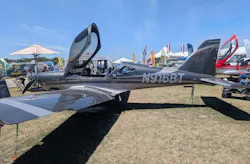
Bristell Aircraft’s all-electric two-place sport aircraft is an early sign of a propulsion revolution that’s on the verge of making many types of aviation more sustainable and dramatically more affordable. Their Energic trainer, scheduled to begin deliveries in 2027, uses the same airframe as its popular B23 sport aircraft paired with a power plant designed by H55, the creator of the Solar Impulse aircraft that made the world’s first solar-powered round-the-world flight (Fig. 1).
Electronic Design met up with Kristen Jurn, North American Sales Manager for H55, at the Sun ‘n Fun Aerospace Expo in Lakeland, Florida. During our conversation, she explained why, even though the present generation of battery technology will initially limit Energic’s endurance to a bit more than an hour, its extremely low operating costs (roughly 25% of a comparable ICE-powered craft) are already garnering lots of attention from flight schools and recreational pilots (see video above).
Roomy, Reliable, and Ready to Fly
Both the Energic and B23 are based on the same Czech-made aluminum airframe and composite components, which create a sleek, sturdy, and well-behaved aircraft with a roomy cockpit and excellent visibility. Both variants are certified to operate under part 23 of the FAA’s airworthiness requirements for general aviation aircraft.
The Energic replaces the B23’s 100 Hp Rotax 912 engine with an integrated electric power plant developed by H55, which consists of an electric storage system (ESS) and an electric propulsion unit (EPU). The ESS includes battery packs, battery-management systems, and all interfaces with the EPU. The EPU integrates a flight-proven electric motor, controller, inverter, and power electronics, all designed to have no single point of failure.
The EPU’s 800-V water-cooled motor is manufactured by Safran, a leading manufacturer of conventionally fueled aircraft engines. Powered by H55’s battery system, it’s rated at 80 kW for continuous operation and 100 kW for short periods during takeoff and high-performance maneuvers. It features two independent windings and dual-channel drive electronics that can operate independently in the event of a partial failure.
Likewise, the ESS’s 53-kWh (48 kWh usable) lithium-ion battery pack is redundant, split into two sections that can function independently in the event of a failure. When fully charged, it allows the Energic to climb at 800 feet per minute, cruise at speeds of up to 110 knots (125 mph), and support a standard 1-hour flight school program with a 30-min. reserve. Under standard conditions, the battery pack can be charged at up to 64 A, giving it roughly a 1:1 use/recharge time ratio.
While still in development, Bristell plans to use commercially available CCS-2 DC chargers that are widely available and easy to install. H55 said that it expects to offer packs with more capacity as battery technologies continue to improve.
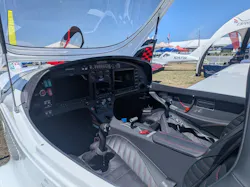
Until higher capacity batteries become available, Energic’s relatively limited flight duration can still meet the mission profiles of most pilot training programs. Configured as a trainer, the Energic’s Garmin G5 electronic flight display, Nav/Com radio, and an angle-of-attack indicator provide a highly functional and cost-effective visual flight rules (VFR) instrumentation package (Fig. 2).
The Return of Affordable Aviation
By eliminating reliance on increasingly scarce and expensive aviation-grade gasoline, the Energic will help flight school operators get their students into the air for a small fraction of the costs associated with conventionally powered craft. Today’s avgas prices average between $6.50 and $9.00 and sport planes like the B23 drink around six gallons per hour. Thus, fuel costs alone for an hour’s flight are already approaching $50 and will likely rise further if recent global economic tensions aren’t resolved soon.
In contrast, the B23 and similar aircraft manufactured by Pipistrel, Aura, and others consume $5 to $10 worth of electricity per hour. These aircraft are also simpler to maintain, so it takes much less time and costs much less to perform their required safety inspections and scheduled maintenance procedures.
During our conversations at the Sun n’ Fun airshow, Ms. Jurn said Bristell will begin delivery of the Energic to its European customers in late 2027, with deliveries to North America expected to begin in 2028.
About the Author
 Lee Goldberg
Lee Goldberg
Contributing Editor
Lee is the author of the popular PowerBites series.
Lee Goldberg is a self-identified “Recovering Engineer,” Maker/Hacker, Green-Tech Maven, Aviator, Gadfly, and Geek Dad. He spent the first 18 years of his career helping design microprocessors, embedded systems, renewable energy applications, and the occasional interplanetary spacecraft. After trading his ‘scope and soldering iron for a keyboard and a second career as a tech journalist, he’s spent the next two decades at several print and online engineering publications.
Lee’s current focus is power electronics, especially the technologies involved with energy efficiency, energy management, and renewable energy. This dovetails with his coverage of sustainable technologies and various environmental and social issues within the engineering community that he began in 1996. Lee also covers 3D printers, open-source hardware, and other Maker/Hacker technologies.
Lee holds a BSEE in Electrical Engineering from Thomas Edison College, and participated in a colloquium on technology, society, and the environment at Goddard College’s Institute for Social Ecology. His book, “Green Electronics/Green Bottom Line - A Commonsense Guide To Environmentally Responsible Engineering and Management,” was published by Newnes Press.
Lee, his wife Catherine, and his daughter Anwyn currently reside in the outskirts of Princeton N.J., where they masquerade as a typical suburban family.