Boundary-scan fixture interface uses Virginia Panel Pull-Thru receiver
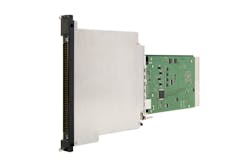
GOEPEL electronic has introduced the PXI 1149/VPC(x), a Pull-Thru adapter developed in corporation with the Peak Group that ensures the signal quality in the interface between GOEPELs PXI/PXIe SCANFLEX boundary-scan controllers and test fixtures, eliminating manual wiring in the interface configuration. The new Pull-Thru adapters are designed to improve the integration quality when seamlessly combining structural test technologies with functional test in volume manufacturing.
As well as the actual JTAG signals, the new Pull-Thru adapter offers additional connections for GOEPEL’s dynamic I/O signals for enhanced handling of all Embedded System Access (ESA) technologies. It provides the ability to test and program highly complex boards, including ones with on-chip flash programming, with significantly reduced test points, and in some cases without the use of traditional test points or probes at all.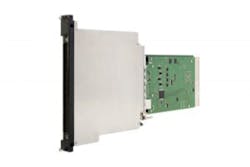
The range of 18 different types of supported SCANFLEX controllers extends up to a high-performance 4-TAP/80-MHz version with single-ended or differential-pair interfaces.
This new option for the PXI- and PXIe-based SCANFLEX controllers is fully compatible with the scalable Mass InterConnect system from Virginia Panel Corp. using Pull-Thru Receiver series G20, G20x, G40, and G14x. Using this option, you can now easily combine JTAG/boundary scan with the PXI Interface Test Adapter (ITA) solutions from Virginia Panel to create a high-performance reliable fixture interface.
About the Author
 Rick Nelson
Rick Nelson
Contributing Editor
Rick Nelson is a technical journalist who has served as executive editor of Test & Measurement World, chief editor of EDN, and executive editor of EE-Evaluation Engineering. He has also contributed to publications including Vision Systems Design and Electronic Design, and he has participated in many live panel discussions and webcasts. Rick has also held systems-engineering and product-development positions at General Electric and Litton Industries. He received his B.S.E.E. degree from The Pennsylvania State University.
Comment About the Article
To join the conversation, and become an exclusive member of Electronic Design, create an account today!
 Leaders Logo
Leaders relevant to this article: