FRAMOS offers ON Semiconductor automotive-grade global shutter sensor
Munich, Germany. FRAMOS has announced it is offering the new AR0135 automotive-grade global shutter sensor from ON Semiconductor. This 1/3-inch format, 1.2-Mpixel imaging device has been designed to address the challenging requirements of automotive in-cabin cameras. The new global shutter sensor allows the camera to freeze fast-moving scene data and ensures effective synchronization with pulsed light sources. The AR0135 sensor incorporates a new innovative global shutter pixel design, with 10X lower dark current and 4X higher global shutter efficiency vs. previous-generation products. These improvements allow the sensor to produce clear, low-noise images, in both low-light and bright scenes, and in high-temperature environments. This performance enables the required eye tracking and gesture detection functionality in next-generation automotive in-cabin systems.
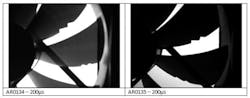
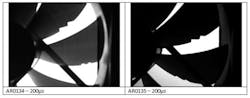
The improved GSE reflects itself in the image quality at low exposure times and high illumination levels. In the image below, the AR0134 and AR0135 are compared under the same operation situation. It can be easily seen that the AR0135 image does not suffer from the ghosting artifacts that prevented the AR0134 being used in applications with undefined illumination conditions.
At the same time the sensor maintains the full register, package and pinout compatibility with its predecessor. The sensor is now available as a monochrome engineering sample and will go into mass production at the beginning of Q4 2016. FRAMOS industry and product experts can provide additional services like development support, engineering, and logistics to help customers use the new sensor for their applications and projects.
About the Author
 Rick Nelson
Rick Nelson
Contributing Editor
Rick Nelson is a technical journalist who has served as executive editor of Test & Measurement World, chief editor of EDN, and executive editor of EE-Evaluation Engineering. He has also contributed to publications including Vision Systems Design and Electronic Design, and he has participated in many live panel discussions and webcasts. Rick has also held systems-engineering and product-development positions at General Electric and Litton Industries. He received his B.S.E.E. degree from The Pennsylvania State University.
Comment About the Article
To join the conversation, and become an exclusive member of Electronic Design, create an account today!
 Leaders Logo
Leaders relevant to this article: