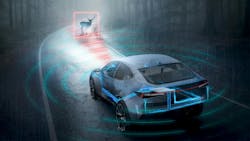
Autonomous Vehicle Technology: Making the Leap Beyond Level 3
Members can download this article in PDF format.
The world of autonomous vehicles (AVs) stands at the threshold of its next level of functionality and performance. Levels 3+ and 4 promise to add a number of enhancements, bringing AVs closer to real hands-free performance, making driving safer, less stressful, and more enjoyable.
Achieving this means vehicle technology must become highly integrated. Software will become the primary technology manager, which creates the unique challenge of decoupling software and hardware.
Sponsored Resources
- Driving Vehicle Autonomy Forward
- Bring AI to Your Entire Fleet with TDA5 SoCs
- Cutting-edge 4D Radar Enables Safer Driving
Decoupling the software development from hardware and consolidating software into a reduced number of electronic control units (ECUs) is a primary objective. This represents a fundamental shift in the design paradigm, facilitating extensive integration across the various technologies and platforms embedded within the software-defined vehicle (SDV) core technological architecture.
The software layer will now be used to manage hardware components, provide upgrades, address performance issues, and bring hardware up to specs if a safety concern arises, for example. And by moving the control plane into the software layer, it makes the platform more scalable and streamlines over-the-air updates. As this design philosophy effuses throughout the vehicle’s design, it will enable more next-level autonomous features.
Peeling Back SDV Tech
Many new developments in the AV space are at the edge, ready to be fused with SDV design (Fig. 1). Some of the more exciting are 4D radar, advanced driver-assistance systems (ADAS), and the integration of AI. In addition, sensor fusion — the melding of advanced radar, LiDAR, and camera data running on automotive Ethernet — is ready to deliver reliable, high-resolution, real-time data across the vehicle network.
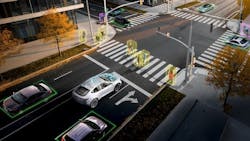
AI Everywhere
As is the case with so many other technologies and platforms, AI is playing an increasingly significant role in the SDV space. And one key enabler is the system-on-chip (SoC).
Heterogeneous, scalable SoCs, such as Texas Instruments’ TDA54-Q1, encompass many computing elements. They’re optimal for facilitating the creation, deployment, and execution of software for sophisticated autonomous, AI-enhanced driving functionality.
These SoCs integrate TI's C7 digital-signal-processing (DSP) neural processing units (NPUs) with enhanced edge AI capabilities. They’re able to delegate certain tasks to their integrated, specialized IP blocks.
Engineers can utilize the chips’ AI capabilities to enhance vehicle response because they can run multibillion-parameter large language models (LLMs), visual language models (VLMs), and sophisticated transformer networks (Fig. 2). This allows them to deliver an efficient power envelope and scalable AI performance ranging from 10 to 1,200 trillion operations per second (TOPS).
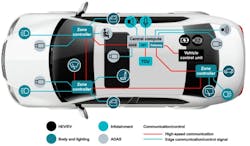
Moreover, its AI performance is scalable over time to accommodate the changing demands of various application requirements. Currently, these demands range from Level 1 features like adaptive cruise control to Level 3 conditional driving automation.
Another feature of these AI-enabled SoCs is their chiplet-ready architecture. Chiplets are an innovative semiconductor architectural design methodology wherein discrete integrated circuits function akin to IP blocks within a heterogeneous SoC. Ultimately, they facilitate the modular construction of specialized chips. This is ideal for emerging SDV designs because of their scalability.
The integrated support for the Universal Chiplet Interconnect Express (UCIe) interface open technology standard enhances the scalability and adaptability of TDA5 SoCs via prospective chiplet expansions. It provides developers with a future-proof platform that may evolve according to their requirements.
Advancing ADAS
Although ADAS has existed for decades, it didn’t get serious attention until the early 1990s and has faced a bit of a bumpy road. However, many of the ADAS challenges over the years have been, or are being, overcome. And with the advances in sensors and the emergence of sensor fusion and AI, ADAS is ready for prime time with state-of-the-art technologies for key sensing systems in radar, camera, and LiDAR.
Today’s ADAS technologies offer reduced system size and cost while enhancing high-speed data transfer. Furthermore, contemporary systems incorporate specialized solutions that efficiently and dependably process data within domain controllers, central computing, and zonal architectures, adhering to International Organization for Standardization (ISO) 26262 standards and Automotive Safety Integrity Levels (ASILs) up to ASIL D.
The increasing stringency of vehicle safety regulations across the globe is a primary catalyst for the rise of ADAS. These systems, which range from adaptive cruise control to automatic emergency braking and blind-spot detection, are becoming indispensable in new vehicles.
Given all of this, the market forecast is optimistic. ADAS is expected to expand at a compound annual growth rate (CAGR) of 14.6%. The ADAS market isn’t just expanding; it’s revolutionizing autonomous vehicle technology.
4D Radar: A Great Enabler
Taking radar to the 4th dimension is one of the more exciting developments propelling SDVs beyond level 3.
4D imaging radar enables high-resolution sensing by adding vertical angle measurement, which adds the capability for the radar to ascertain the height of structures and other objects (Fig. 3). This greatly improves accuracy and performance in marginal and challenging situations such as inclement weather and other poor visibility conditions (dust, ash).

It can also identify and differentiate among items along the path such as road trash, construction debris, pedestrians, other vehicles, the road surface, even an individual crouched beside a vehicle changing a tire.
Conclusion
Evolving technologies, such as 4D radar, are the basis of tomorrow’s advanced ADAS functionality. The move to enhance these technologies by improving performance, lowering costs, simplifying design, and making them scalable and function autonomously is the path to the next levels of autonomous SDVs.
Today, we’re well entrenched in level 3 AVs. And we either have, or will have shortly, the tools to elevate vehicles to level 4. But there are still a number of bumps in the road — not necessarily technology — that need to be addressed before we can go fully hands-free.