
Transforming Energy Systems with Semiconductor Technology
Members can download this article in PDF format.
Driven in large part by the energy needed for cooling residencies and industrial facilities, more electric vehicles (EVs) on the road, and the growth of AI data centers, there’s now a 50% faster annual increase in electricity demand than in the previous decade.
So while you can’t always trust statistics (as someone once said, they should be used in a discussion the way that an inebriated person uses a streetlamp post — for support instead of enlightenment), based on reports from the International Energy Agency (IEA), global renewable electricity generation is forecast to reach over 17,000 TWh by 2030, an increase of nearly 90% from 2023 levels. Solar photovoltaics is expected to account for almost 80% of this global increase.

Efficient Use of Solar
As adoption of solar energy grows, the challenge has shifted beyond power generation alone. It now rests on improving efficiency, flexibility, and affordability. Meeting these expectations requires solar inverters that are smaller, more precise and easier to install without compromising performance. For example, consider the impact of wideband gallium-nitride (GaN) technology.
Like the backup singers on an old hit song, GaN smoothly and seamlessly supports the headline act by allowing for higher switching frequencies and new power topologies that can be deployed, such as single-stage converters. Single-stage converters need a bidirectional switch that drives up power density in part because the passives become smaller.
Sponsored Resources:
- A bright future lies ahead: transforming solar energy systems
- 3 ways semiconductor innovation is powering an evolving energy landscape
- Fueling data center's energy demands with solar
Using GaN-based bidirectional switches, it’s possible to achieve a 40% reduction in power losses compared to conventional GaN devices, while delivering up to 40% more power in the same footprint.
By enabling faster switching and higher power density, Texas Instruments’ GaN-based FETs enable engineers to design more compact and efficient solar inverters, reducing energy losses and simplifying the entire system footprint. These devices help cut down on system-level size, weight, and component count—e.g., reducing magnetics size—simplifying thermal design and allowing for more compact microinverter applications.
AI: Evolving from Novelty to Necessity
Until recently, the rack level in a data center has required less than 100 kW. But with the advent of generative AI and the subsequent addition of more servers to process information, racks now need significantly more power.
In the U.S., data centers are expected to consume as much as 13% of the total electricity mix by 2028. Consider that entering a question into a large language model (LLM) currently requires 10X times the amount of power as entering the same question into a standard search engine.
Discussion now centers on 1-MW data center racks and 1-GW+ data centers, equivalent in some cases to the consumption of a city. Most of the time you're just not able to get that level of power from the grid.
Typically, servers stack on top of each other in data center computing racks, with power-supply units (PSUs) at the bottom. Alternating current (AC) is distributed to every server rack, where a PSU converts it to 48 V and then down to 12 V. Point-of-load (POL) converters in the server then take it down to the processor gate core voltages.
There’s no cheaper way to get the needed power than solar. And enough solar energy shines on this globe whereby supply isn’t the problem. At any given second, the amount of radiant energy that enters the atmosphere is 70,000 TW. Consumption for the entire globe is only on the order of 20,000 TW. But while the sun's radiant energy is virtually limitless, we’re only now beginning to be able harness it efficiently.
Decisions at the Edge
Managing energy in real-time is crucial to help improve grid stability and performance. In today’s dynamic environment, decisions can’t wait for the cloud. Whether triggered by demand spikes, sudden voltage drops, or weather-related disruptions, responses must occur locally and quickly.
Advances at the edge of the grid — the decentralized points where energy is generated by rooftop solar panels, stored in a battery, or consumed by devices like a charging electric vehicle — are reshaping how energy is managed and protected. That’s why edge AI is becoming vital to the modern energy infrastructure.
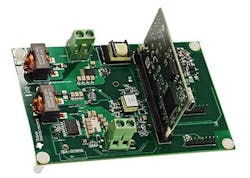
Renewable energy allows electricity generation to be almost completely decarbonized. TI’s precise current- and voltage-sensing technologies enable accurate metering and increase safety by managing overvoltage, overcurrent. and ground-fault detection.
Texas Instruments is transforming energy systems by leveraging wide-bandgap materials and advanced embedded processing to enhance efficiency, power density, and reliability in renewable energy sources. TI’s technology enables smarter, more compact solar inverters, intelligent battery storage, bidirectional charging and improved power distribution.