Boost Next-Gen Data Center Designs with Advanced Control and Power Products
Members can download this article in PDF format.
Modern data centers consume prodigious amounts of energy as they tackle complex artificial-intelligence (AI) and high-performance-computing (HPC) workloads. Indeed, IT rack power requirements are moving from 100 kW to more than 1 MW, necessitating new approaches to distributing power to and within each rack. The effective, efficient distribution of this power requires advanced semiconductor products ranging from power stages to microcontrollers.
Collaborative Effort Addresses High Voltage
Just a few years ago, 48-V voltage levels were sufficient to distribute data center power. However, Texas Instruments estimates that using 48 V to power a single 1-MW rack would require nearly 450 lbs. of copper to keep distribution losses at an acceptable minimal level—a prohibitive approach with respect to both cost and weight. Consequently, the company is working with NVIDIA to develop an 800-V DC power-distribution ecosystem that will scale up to enable practical and reliable power delivery to racks requiring a megawatt or more.
Sponsored Resources:
- Enable the future of AI data centers
- Achieve power delivery with 800V DC architectures
- Powering data centers: From the grid to the gate
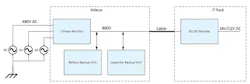
Figure 1 shows the basics of a high-voltage DC system architecture. This architecture includes a sidecar that houses most of the power components. The sidecar is located adjacent to the IT rack, which contains the processors along with some power-conversion components. This division allows more processors to be packed together within each IT rack, minimizing latency in processor-to-processor communications.
High-voltage power conversion is a key requirement for DC power distribution, and gallium-nitride (GaN) technology shows promise for delivering the necessary power density and efficiency in such systems.
As shown in Figure 1, 480 V AC flows from the utility grid to a sidecar, which includes a three-phase high-voltage rectifier that develops 800 V DC. This voltage level charges battery-backup and capacitor-backup units, also located in the sidecar, and a cable delivers the 800 V DC to DC-DC converter modules in the IT rack. Within each IT rack, the DC-DC converters derive the 12 to 54 V DC required for the processors, communications devices, and other components that populate the rack.
Anticipating the Arrival of High Voltage
In a video chat last year, a panel of TI power-management leaders anticipated the arrival of high voltages and the challenges involved in meeting customer requirements. They cited several key observations:
- The most efficient way to deliver power is to get higher and higher voltages closer and closer to the location where it’s being consumed.
- Power converters should switch faster to reduce waste heat and minimize the space required for magnetic components.
- GaN devices require minimal energy to turn on and off, and GaN technology optimizes the tradeoffs between higher switching speeds at higher voltages.
- A server power system must be able to handle rapid changes in load through deployment of battery-backup units and supercapacitors, typically located in sidecars.
- Server downtime can cost thousands of dollars per minute. So, a server power system must achieve reliability through the judicious deployment of protective devices such as eFuses as well as analog monitoring combined with digital intelligence to facilitate predictive maintenance.
Product Portfolio for Data Center Applications
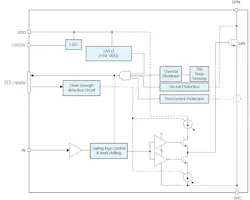
To deliver high voltages to each rack, the company offers the LMG3650R035 650-V, 35-mΩ GaN FET power stage with integrated driver and protection circuitry (Fig. 2). Features include an adjustable gate-driver strength that enables independent control of turn-on and turn-off slew rates, which you can use to optimize performance and minimize electromagnetic interference.
The company also offers mid-voltage GaN devices, such as the LMG3100R017 100-V, 1.7-mΩ GaN FET with integrated driver. It can help optimize power density and thermal efficiency within each rack.
In addition, TI offers components that support processors that are able to request specific voltages from distributed voltage regulators (VRs) to maximize each individual processor’s performance and efficiency.
For example, advanced Intel processors can request voltage levels by means of the Intel Serial Voltage Identification (SVID) bus. Able to provide the correct voltage in response to such requests is the TI TPS53689T dual-channel step-down digital multiphase controller, which supports the Intel VR14 SVID protocol. The device operates on a 4.5- to 17-V input range and provides output voltages from 0.25 to 5.5 V.
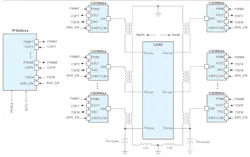
The TPS53689T includes trans-inductor voltage regulator (TLVR) topology support (Fig. 3) and built-in non-volatile memory (NVM). It employs TI’s D-CAP+ control architecture to provide low output capacitance, fast transient response, and good dynamic current sharing. It also features native support for the adjustable control of output voltage slew rate and adaptive voltage positioning.
In addition to the SVID bus, the controller includes a PMBus interface for reporting voltage, current, power, temperature, and fault information to a host controller. The PMBus also enables configuration of all TPS53689T programmable parameters, with configuration default values stored in NVM to minimize the external component count.
Finally, to orchestrate the interactions of the various components in a data center power system, TI offers its C2000 family of real-time microcontrollers. These devices include advanced security features while enabling seamless in-field firmware upgrades. Members of the family, such as the TMS320F28P65x, include a PMBus interface that enables it to communicate with components like the TPS53689T multiphase controller.
Conclusion
Efficient power conversion and distribution are critical for today’s data centers. On this front, TI offers a portfolio of products ranging from GaN power stages to real-time microcontrollers for design projects ranging from energy-storage subsystems to rack power-supply units.