
Integrated EIS Monitors for High-Cell-Count Energy Storage Systems
Members can download this article in PDF format.
Batteries represent one of those technologies that are encumbered with incremental advances. Unlike Moore’s law, battery technology has yet to find the hallelujah moment, where a new process or material is discovered that will improve battery performance by an order of magnitude or more.
Even as new battery technologies are discovered and existing ones are improved, and battery systems reach into the thousands of cells with thousands of amps in capacity, the fundamental physics of batteries remain the same. With a few exceptions, all secondary batteries use the ionic process to charge and discharge, regardless of the chemistry.
Sponsored Resources:
- Watch How TI Redefines Energy Storage With EIS
- Next-Gen Energy Storage Monitoring With TI EIS
- TI EIS Technology for Next-Gen Energy Storage
Therefore, advances in battery technology have fallen largely on battery management. It’s where real innovations are emerging. Not that improvements in batteries haven’t happened — there certainly have been. But battery management systems (BMSs) are largely responsible for where we are today.
The most destructive event that plagues battery technology is thermal runaway. With today’s mega systems, runaway becomes much more damaging, both directly and collaterally, than in earlier years. Because battery technology has become so ubiquitous, there’s a renewed emphasis on safety and reliability. That has changed the mentality of battery monitoring.
Battery-management systems have become the logical area for growth. It’s now possible to monitor battery systems at the cell level, which adds a new dimension of management beyond sensors. This is encapsulated with the advent of electrochemical impedance spectroscopy (EIS).
EIS engine-enhanced chips, such as TI’s BQ 79826Z-Q1, have emerged to provide grid-scale battery systems with real-time, intelligent, monitoring, predictive-intelligence, and cell-level data and diagnostics. This is the next level of monitoring technology. Reactive monitoring raises the bar towards intelligent, predictive control and improves safety and reliability. Let’s drill down a bit into the inner workings of advanced battery management.
Deep Insights into the Cell
EIS provides the ability to “look” into the cell — a major advance in monitoring battery dynamics. It offers the capability to monitor what’s happening inside the cell. This makes it possible to spot issues and find potential problems much sooner than just passive monitoring. It also helps keep systems running at optimal efficiency.
Cells have unique electrochemical signatures — a fingerprint unique to each cell’s chemistry, aging, and operating conditions. EIS uses electrical signals to measure this chemical reaction of a battery.
Battery-monitoring chips with integrated EIS engines extract information about the current and voltage parameters inside a cell. This is done by exciting cells with AC current across a range of frequencies and measuring the impedance (Fig. 1).
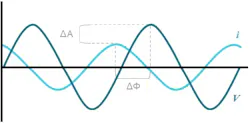
By analyzing the changes in cell temperature, charge, and other battery parameters, over time, knowledge is gained into what’s occurring in the cell, and by extension, the battery.
The Nyquist Function
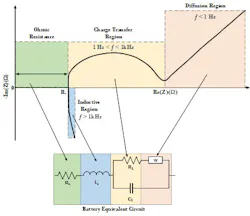
The common tool for accomplishing this is the Nyquist plot. Using the Nyquist principle across a set of frequencies and plotting the results on an x-y plane gleans information about the various parameters and the condition of the cell. These parameters can include temperature and the state of the anode, cathode, lithium diffusion, solid electrolyte interphase (SEI), layer integrity, and more.
Once the data is extracted and plotted, the Nyquist plot x-axis represents the real part of the complex numbers, and the y-axis represents the imaginary part (Fig. 2). The technique applies frequency sweeps and presents comparisons of amplitude variations (impedance magnitude) and time changes (impedance phase). From this information, the state of the cell’s condition can be determined.
The Advantages of EIS
A significant advantage of EIS is the ability to work in real-time. Using EIS predictive monitoring can be realized, which is significantly important to segments such as massive grid-scale systems, for obvious reasons.
Predictive monitoring is a game-changer. It means that failures can now be predicted with much more certainty than with earlier hardware. Predictive monitoring is a huge asset for battery manufacturers, especially in technology sectors such as electric vehicles (EVs) and massive energy storage systems (ESSs). However, all types of rechargeable batteries from across nearly every industry can benefit from EIS.
With EIS, manufacturers can design intelligent BMSs much more efficiently. This benefits them in several ways. First is the economic advantage. Now systems can be precisely designed with the exact amount of margin and components rather than going with a large safety margin that’s needed with reactive monitoring. Another major benefit concerns safety and reliability. Earlier warning of thermal runaway, over/undercharging, precise state-of-charge (SOC) and state-of-health (SOH) estimates improve safety and reliability significantly.
Why It Matters
With today’s capability to manufacture thousand-cell systems, reliability and safety become paramount. Not that it hasn’t always been, but the amplification factor of these huge installations amp up failure to a massive degree. With such systems located in dense population centers, a massive failure such as thermal runaway can be disastrous, far beyond just system damage.
Thus, the ability to “see” inside the cell takes on a new meaning by being able to monitor the actual electrochemical process in real-time. When combined with traditional surface sensors (overvoltage, overcurrent, temperature), BMSs bring a new level of design and engineering capability to these expansive battery systems.
Conclusion
While EIS has been around for over a decade, why is it so hot today? The answer has more to do with the ability to build thousand-cell systems, as well as specialized systems, e.g., EVs. Such applications demand a heightened level of management and monitoring.
Elevated levels of safety and reliability will be a prime directive for the secondary battery industry as it expands. A 12-V battery pack going into thermal runaway is much different than a EV’s battery doing the same.
Going forward, EIS-based battery management will expand into virtually all battery applications, from wearables to robots to space. And not just mega-power, massive cell designs, but for all designs to create a safer and more reliable ubiquitous untethered power base.