
The First Commercial CAN XL Transceiver Targets Production Designs
Members can download this article in PDF format.
As electronic technology gets more capable from a sensing perspective, engineers find themselves needing to move more data through communication networks. Automotive and humanoid robots, for example, are generating substantial data for motion control, sensor fusion, diagnostics, and software — more data than traditional Controller Area Network (CAN) technologies were designed to handle.
CAN has been fundamental to automotive and industrial networking for more than 35 years. It has evolved from classic CAN to CAN FD (CAN Flexible Data-Rate) and now CAN XL (CAN Extended Data-field Length), reflecting the growing demands of modern systems, including higher-complexity sensing and actuation, larger software payloads, and greater security requirements.
Sponsored Resources:
- CAN XL technology, now at your fingertips
- TI's TCAN6062 CAN XL transceiver
- Find the right protocol for your system
CAN Classic offered up to 1 Mb/s and eight data bytes per frame, which was sufficient for many years. CAN FD extended this to 64 data bytes and enabled flexible switching of bit rates within the data phase, reaching up to 8 Mb/s.
CAN XL now continues this path by supporting payloads of up to 2,048 bytes per frame and data rates of up to 20 Mb/s when operating in its fast mode. Its large payload enables things like security and compatibility with other communication protocols such as Ethernet. Moving to 20 Mb/s enables engineers to do all of this at significantly higher speeds.
CAN XL's 2,048-byte payload enables a large diagnostic data segment to fit into one frame instead of as many as 32 separate CAN FD segments. It won't replace CAN FD or Ethernet, but in the future, CAN FD, CAN XL, and Ethernet will work together in the same designs.
CAN FD will remain important for cost-sensitive control networks, while CAN XL will support applications that exceed the practical capabilities of CAN FD. Ethernet will continue to provide the high-speed backbone for systems with much greater bandwidth-intensive systems.
First CAN XL Transceiver
TI's TCAN6062, the first commercially available CAN XL transceiver, gives design engineers a way to begin implementing and validating CAN XL in production designs today (see figure). It supports communication up to 20 Mb/s while maintaining compatibility with CAN, CAN FD, and CAN SIC (CAN Signal Improvement Capability) networks. CAN SIC is a physical-layer enhancement for CAN FD and CAN XL designed to eliminate signal ringing, which is the oscillation of a signal, particularly in the step response (the response to a sudden change in input).
The transceiver further improves edge symmetry and supports higher data rates in complex network topologies. Its SIC technology reduces ringing by as much as 80%.
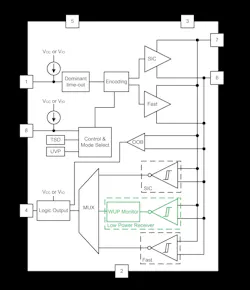
The TCAN6062’s backward compatibility with CAN FD and CAN SIC operations leads to seamless migration to CAN XL, allowing teams to evolve existing designs incrementally without requiring a full redesign.
In addition, the transceiver enables engineers to consolidate communication layers and use Ethernet in mixed-network architectures with Transmission Control Protocol/Internet Protocol (TCP/IP) tunneling. This makes possible efficient transfers of diagnostics, sensor data, control traffic, and over-the-air updates on a single network
Choosing the Right Protocol for Your System
While Ethernet offers higher bandwidth, achieving comparable deterministic communication through time-sensitive networking (TSN) can add complexity and cost that many industrial applications don't require. CAN XL increases data capacity while retaining CAN's arbitration model. It preserves the timing and prioritization guarantees that safety-critical systems depend on, while supporting communication data rates up to 20 Mb/s and payloads up to 2,048 bytes.
Beyond speed and payload, CAN XL introduces other optional enhancements that prepare the protocol for future challenges. One of these is CANsec, a security extension designed to protect against cyberattacks. It embeds authentication data directly into the frame and secures the communication channel without requiring higher-layer security solutions.
Another optional mechanism is frame fragmentation, which allows very large frames to be interrupted. As a result, high-priority control messages can pass through without losing the integrity of the larger transmission.
As data fields become larger, ensuring reliability becomes even more critical. CAN XL introduces two cyclic-redundancy-check (CRC) fields to safeguard transmissions: the Preface CRC protects control information, while the Frame CRC secures the entire frame.
CAN XL won't replace CAN FD or Ethernet. However, it gives designers more flexibility to match the network to the needs of each part of the system. With these capabilities, CAN XL not only surpasses its predecessors, but also positions itself as a bridge technology between traditional fieldbuses and high-speed Ethernet networks.