Embedded Product Portfolio Leverages Zephyr RTOS Ecosystem in AI Era
Members can download this article in PDF format.
For embedded systems designs, a real-time operating system (RTOS) can speed development compared with bare-metal implementations while maintaining deterministic behavior and facilitating task management and resource utilization. When choosing an RTOS, you might consider an open-source version, but you should be aware of the drawbacks of such an approach as well as the advantages.
A key advantage of an open-source RTOS is its cost-effectiveness. It’s also flexible, allowing you to customize the source code to suit your specific needs. In addition, a good open-source RTOS will have the support of a large community, making it possible to leverage a wealth of shared knowledge.
Sponsored Resources:
However, open-source software may not come with the level of support provided by commercial software providers. In addition, modifying open-source code can require expertise not available within your design team. And, finally, in an era when artificial-intelligence (AI) agents are able to write code, do we even need an RTOS — or for that matter, embedded systems engineers — at all?
Production-Ready Solutions
To help you avoid the potential downsides of an open-source RTOS, Texas Instruments offers production-ready solutions based on the open-source Zephyr RTOS. By using the TI platform, you can take advantage of the company’s Platinum-level membership in the Zephyr Foundation to enhance upstream and downstream collaboration across the entire Zephyr ecosystem.
Upstream, you’ll find the official Zephyr repository, which has stable implementations with the latest updates. Downstream, you’ll have early access to TI’s Zephyr repository, which provides pre-validated software compatible with the latest TI hardware before the software is merged into the upstream repository.
TI offers Zephyr support for a variety of components, including general-purpose and real-time microcontroller units (MCUs), microprocessor units (MPUs), and wireless connectivity devices.
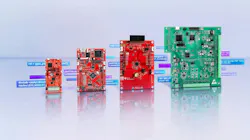
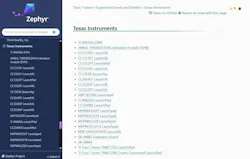
The first step in a Zephyr project is to choose an evaluation module or development board. Figure 1 lists some TI boards ready for Zephyr. Next, you initialize your development environment, download and install the Zephyr software development kit, and build your application. Finally, you flash your project to the board using the Open On-Chip Debugger (OpenOCD), TI’s UniFlash software, or the Zephyr West flash tool.
Sponsored Resources:
RTOS in the Age of AI
To explore the role of an RTOS in the age of AI, on October 7 in Prague, Texas Instruments moderated a panel discussion at the Open Source Summit Europe 2026. Participants emphasized that the role of the embedded engineer today is changing.
With AI agents able to write drivers, writing new code is becoming a smaller part of the engineer’s job. The role shifts from being purely a developer to becoming a systems architect, focusing on decisions that AI can’t reliably make regarding tradeoffs between power consumption and performance in resource-constrained systems.
As Sean Lyons, a software engineering manager at TI, commented, “The core of being an embedded engineer is knowing the interface to the hardware — knowing how your hardware works on a deep, almost intuitive level.”
AI does present challenges to novice engineers, according to Lenka Koskova Triskova, an embedded software specialist, teacher, and researcher at the Technical University of Liberec, Czechia. “If you’re a senior developer, you can use AI effectively, the way you’d direct a junior engineer writing code for you. But if you’re a junior [engineer] with no real prior coding experience, developing with AI is like trying to run a marathon without ever having run before in your life.”
Panelists emphasized that for high-risk work, an RTOS provides a community-validated starting point based on existing APIs, reference implementations, and safety-certification efforts. In addition, they noted, the Zephyr RTOS is adapting to AI workflows, with documentation available through a Model Context Protocol (MCP) server that AI agents can query directly.
Benjamin Cabé from the Zephyr Project elaborated on the state of AI workflows today. “As the documentation maintainer I’m biased, of course, but we have good documentation that out-of-the box AI is usually pretty good at using. Agents can directly tap into this data through an MCP server when answering a question like, ‘How should I add a new driver?’ rather than trying to figure it out by just looking at the code.”
Added Cabé, “The goal is to get to the point where adding a test, flashing something to a board, and verifying that results actually work becomes systematic and repeatable.” He noted that the current state of AI implementation isn’t perfect yet, but the gaps are being closed.
Zephyr’s Evolution
In a November 4 video presentation, Syed Mohammed Khasim, software development manager at TI and a Zephyr Project board member, elaborated on the Zephyr Project and TI’s role (Fig. 2): “Zephyr is celebrating its 10th year, and what started as just a very simple RTOS has now evolved to become an open-source ecosystem in itself.”
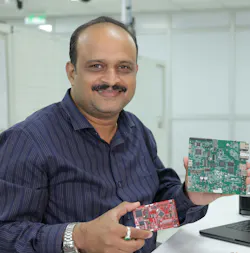
He added that the ecosystem includes well-defined standards for power management, analytics, security, networking, and driver integration. He also noted that the available development tools enable you to quickly begin Zephyr development on any class of MCU or MPU.
Khasim said that MCUs, in particular, have evolved with respect to the type of software they use. “We all know that the MCU world has relied on bare-metal software. But when you scale that bare-metal application to end equipment, you start getting into [potential problems with regard to] multi-threaded protocol integration, power management, and security. The MCU architectures are not like the older generations; they have evolved into their own beasts,” which require the well-defined software stacks such as those available in the Zephyr ecosystem.
Conclusion
AI is changing the nature of embedded design, but it can’t replace the hardware knowledge of an embedded systems engineer or the stability of a verified RTOS. A partnership between the Zephyr Project and TI helps ensure smooth operation across the full RTOS ecosystem. TI’s Khasim concluded that “this partnership removes low-level development complexity, allowing developers to focus on what truly matters: bringing innovative ideas to market faster.”