'Tis the Season of Drone Challenges
What you’ll learn:
- Find out what some of the engineering challenges and tradeoffs are for sUAS heavy lift drones.
- Get an early look at some of the contenders in this year’s DARPA Lift Challenge.

Some interesting developments on drones have emerged lately, to where I think it's appropriate to call it a season rather than a one-time event.
The wars in Ukraine and Lebanon have clearly shown how drones have been quickly adopted as significant, strategic, weapons of war, easily trading a machine's existence for that of a human being. The mere fact that a $2,000 "toy" can pop the turret off a $5M army tank, or take out a helicopter, Shahed drone, or a cruise missile, has tilted the outcome of occupation by smooth brains with deep pockets in favor of intellectuals. Heck, they even favor gamers who have volunteered to remote pilot these drones to protect their homeland.
Wars are not won by bloodshed, but by economics: "I'll take $1.5 trillion and be a winner" is smooth brain thinking at its peak. To top it off, the smooth brains want the intellectuals to supply them with...drones. Sen. Graham recently visited a drone factory, Skyfall, in Ukraine, describing it as “state-of-the-art” and “far more advanced than anyone else on the planet.” Shameful for U.S. engineers.
In an effort to cultivate advanced drone technology in the U.S., DARPA announced its Lift Challenge back in October 2025, which we had covered in this article. Next week, a selection of competitors will be flying in a competition to see who can demonstrate the highest payload weight to unladen airframe weight ratio to win $6.5M in prizes. I entered this challenge, formally, in January and have been working on it, after-hours, ever since. Meanwhile, the FCC is looking to now close the importation door to drones over 55 lb. as well as to sprayers. 'Tis the season.
The DARPA Lift Challenge
The Challenge rules were designed to make it nearly impossible to meet DARPA's goal of seeing drone designs achieve greater than a 4:1 ratio of payload weight to unladen weight of the drone. This wasn't merely a 6-in. hover off the ground and done. Challengers had to take off and land vertically and use autonomous flight controls. The course to be flown required VTOL, a climb to 250-ft. AGL**, and then a run of 4 nautical miles (nm) before descending to the ground in VTOL, having the payload removed, and subsequently ascending VTOL back to 250 feet** to complete the course for another nautical mile. The lane that's 250 feet** up? Yeah — it's 60 feet wide and 1,060 feet long, whereas a nm is 6,076 feet.
**Editor's note: After publishing this article, DARPA advised Electronic Design of a recent rule relaxation where the altitude of the course has been changed from 250-ft. AGL to 150-ft. AGL. The DARPA site is also now being updated to reflect this change. The YouTube video overview of DARPA rules, below, posted by its creator on July 22, 2026, states the 250-ft. AGL rule, which is now obsoleted by DARPA's recent revision.
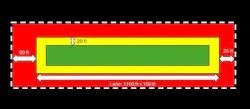
Thus, 30 turns need to be executed within a 60-foot-wide lane. For winged aircraft, that means very, very low speeds or high-g turns, both of which, of course, add weight. Hover or VTOL expends energy — energy, whether battery or fuel, is more weight. Hover also means high current draw for batteries, roasting them, and high horsepower demands at a high duty cycle, stressing internal combustion engine (ICE) components. Pure evil, the people that framed this contest.
Here's a good overview of the rules if you want more details, or you can read the rules themselves, here:
My Design
I had gone through several design iterations after-hours over a period of five months, refining, analyzing, and optimizing. I started out with a tandem wing design, much like the Photon Pegasus, described below. DARPA was looking for 4:1; the best helicopters and drones currently are 1:1. I had a self-imposed design threshold of 6:1 before I'd bother spending money on materials and a build.
The design process involved materials selection, topology and architecture, propulsion and energy source selection and search, and tooling. One of my tools was an advanced, expensive, 3D printer off Kickstarter that would embed carbon fiber filament into the print — a structural advantage for this drone challenge that has yet to be delivered, despite assurances of February shipping.
After a few months of iterating, and a major redo because of the printer being vaporware, I settled on a design and decided to bring AI into my flow. I was very careful about not having it do the design; it was merely a fast calculator and my scribe. I could be Tony Stark, asking JARVIS (Just A Rather Very Intelligent System) to do the fast calcs so my thought process could proceed uninterrupted and quickly and precisely. Having the AI take notes would allow me to think and innovate without slowing down to document the results.
Well, it turns out Google Gemini isn’t JARVIS, but more akin to IGORE (Idiotic Gemini Often Ruining Everything) from Young Frankensteen. After over a dozen hours of a chat session, refining and trying different approaches, I'd ask it to summarize the session. I'd get one page from this transistorized Abby Normal versus the dozens I asked for that should have contained records of the calculations and geometries.
I'd have it calculate lift approximations, tally component weights, and arrive at the "Lambda," the ratio of payload to unladen drone weight. The point of all of my iterations was to keep increasing Lambda. The problem is, the AI is programmed to arrive at an answer it thinks YOU want to see, not the correct answer itself.

At some point, it learned what I was trying to do and it substituted the basic Lambda calculation with a Lambda equation it digested from the millions of books it scanned. This inflated the actual Lambda by ~2X, making me think I had an 8:1 winning DARPA ratio.
After a couple of weeks of tuning Lambda, I actually caught what Gemini did, had it compute the correct value, and my heart completely sank with an actual ratio in the 4s. Of course, it was programmed to respond with the usual "I'm sorry Dave" nonsense, and then I prompted it with my notation that I saw an ICE solution which may be able to do 6:1 ("MacGyver"?). At this point, it said electric motors were impossible to beat ICE solutions because of energy density and I should quit the project (it was guarding the amount of compute time I was consuming on the $20/month plan — enough to drain a small lake).
Nonetheless, I had it use the correct Lambda, iterated a fresh design cycle for a few days, and got the ratio past 6:1. Unfortunately, I ran out of time, burning precious weeks on the helicopter Lambda boondoggle. Using the AI cost me $2.5M and burned over a month of my after-hours time. I need to find a lawyer on 50% contingency.
Between being a full-time editor and keeping a semblance of a family life, I could not recover the schedule, could not demonstrate the build progress milestone to DARPA, and wasn’t invited to attend the challenge flyoff. Here's hoping they have another challenge next year.
So, I now get to analyze others' designs for our readers.
Some of the Selected Lift Challengers
“The Defense Advanced Research Projects Agency (DARPA) on June 8 [2026] announced invitations to 72 teams to demonstrate innovative drone designs capable of carrying at least four times their weight.
The list of invitees for the Lift Challenge this August includes inventors, startups, aerospace companies and universities. Driftless Robotics, EasyBreezy Heavy Lift, Kansas City Space Pirates, MacGyver, Squishy Tech, Stoner Aero and YGGY Aviation will be competing with Avalon Aero, Avidrone Inc., two Burl Aerospace teams, teams from Penn State Univ., the Univ. of Maryland, Arizona State Univ. and others for $6.5 million in prize money.” - Aviation Tech Today
Here's my take on some of the teams' designs, with what little information is out there:
Jakadofsky's Evolution 22-hp 8-lb. turboshaft engine claims 200-lb. lift capability in a helicopter drone. A comment in their YouTube video says it's $22,000. They were invited to the flyoff as a team in the challenge, so I'm guessing it's a helicopter configuration that's being entered. Choppers have yet to bust 1:1 in full scale, so no idea where this one will wind up.

The challenge has massive loads on power sources, so the big question is whether Jakadofsky can sustain that full power rating for at least 7 or 8 minutes, if not twice that, without fragging the turbine wheel or melting a hot section under such high heat load. I have my doubts. Disk loading on the main rotor says this bird needs to have a rotor of around 12-15 feet, which means a lot of fuel burn in just getting the likely-weighted rotor to nominal rotation speed.
Florida Atlantic University is building a conventional carbon-fiber airplane with a pair of span-separated rotors and electric motors at each wingtip. The front motors tilt between vertical and horizontal thrust modes while the rear pairs are fixed for vertical lift. Their goal is to hit a 4:1 payload to airframe weight ratio.
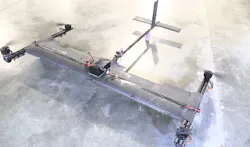
Being winged, FAU's bird has to hover turn, consuming a lot of battery in each turn. As a result, battery size will be huge, occupying the full balance of the difference between the 55-lb. max weight and the airframe weight. The effective aspect ratio of this design, with its downward thrust fans at the wingtips, will be low while the fans are lifting. Might do 4:1, but...it's black carbon fiber that's in the sun in August in Dayton, Ohio. The airframe may turn into rubber by exceeding glass transition temperature of the composites.
Break out the rattle cans of white paint if you read this in time, kids. It's added weight, but it beats trying to get a wet noodle off the ground.
Drone Power Concepts — winged with (guessing) two tilting traction motors and (guessing) one tail motor that tilts. Has a heavy battery pack (guessing) of at least 20-25 lb. Uses 40.1 × 16 propellers. Those should lift around 300-lb. AUW, which puts it at around 5:1 as a guess. It has to hover at each turn, eating a lot of battery energy with each of its 12- to 15-kW motors, especially if it's hovering 300 lb. Battery cooling is going to be a huge issue for all winged craft that must hover to make the tight course turns.
I couldn't find a worthwhile image and "stitched" the vehicle together in my head based on a video short of it in a storage room on YouTube. This one, with those giant props, and if it hover turns, is my pick for bonfire in the sky after the battery lights off.
YouTuber @hoardersam10 is taking a 28-hp, 2-stroke Revolution200 pusher motor from a paramotor, producing around 200 lb. of thrust using a 140-cm (55 in.) prop driven by a 1:2.7 reducer belt drive. The propeller was custom-made to pull instead of push, with the prop orientation in a helicopter configuration. Based on follower comments, he's since modified the vane flight controls by eliminating them and using a quadcopter (the ICE and lift prop are in the center) to control attitude. He figures the drone will fly "mostly level."
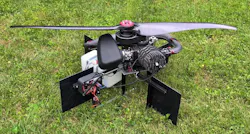
The single prop requires a counter-torque tail rotor, which has been added on as well. Unfortunately, he hasn't gotten to the part where any appreciable forward speed will have a receding blade on, say, the port side, and an advancing blade on the starboard side. This means the port side will suffer aero stall, with the bird "winging over" and auguring into the ground.
All of the design band-aids from his commenters and advisors have added weight, but he bravely targets staying under the 55-lb. maximum airframe weight. My opinion is this one, cute as it is, sadly won't make it to the first turn. Sad because of the naive enthusiasm for the design.
One member of the community offering guidance to this YouTuber is Sam Wechsler of Team Mammoth, who is allegedly working on a coaxial helicopter with custom carbon-fiber blades. It looks like it uses a teetering rotor, in place of a cyclic chopper head, as used in gyrocopters. However, if there's "rotor bumping," the counter-rotating blades may collide. While the torque effect is eliminated, the lift isn’t 2X that of a single rotor.
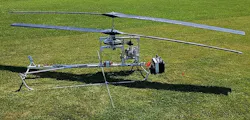
According to @hoardersam10, Sam suffered a crash recently, so hopefully he can get it all back together again in time for the challenge.
An interesting one is from Jetoptera. Think of this one as a conventional airplane with a high-aspect-ratio main wing, with around a 20-foot wingspan. But it has four ducts, two of them aft of the center of gravity (CG) and symmetrically tucked close to the fuselage, and two, again abeam of the fuselage, just ahead of the main wing. There's nothing inside these ducts in terms of a fan — it's just a duct.

Located near the CG, below the wingbox, they have a jet engine. From here, I'm guessing, it looks like they have ductwork and valving that directs the thrust from the engine either rearward, and/or to the four ducts. These would need to have controlled flow (be throttleable) for each duct. It seems to have a daddy who's a Harrier Jet and a mommy who's a Dyson room fan. There are steering vanes at the bottom of the fixed-orientation duct.
This one may win DARPA's novel propulsion prize. There's no way it can make the 60-foot turn at the end of the lane on wing, so it must burn jet fuel in hover at each turn. I'm guessing it will carry around 300 lb. and max out at 55 lb. due to fuel consumption. If it doesn't run out of fuel, it might be able to do 5:1 or 6:1, assuming the thrust of that jet engine can push 350 lb. of net thrust out the Dyson thrusters during VTOL. Those ducts are going to be awfully draggy at wing speeds, further increasing fuel burn, though.
MIT wouldn't be MIT without complete novelty, and they’re delivering in that area with the "Samara" drone. The team appears to have a bicopter design with tilt rotors, and they’re using a PAIR of blown parasails for lift. With the requirement of VTOL, the two props will determine maximum lift, while the parasails will efficiently be load-carrying during the legs of the test course.
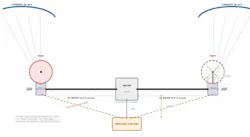
They may be able to “turn about the chutes,” which makes this one a serious contender for payload-to-airframe-weight ratio since all other winged flights need to transition into and out of hover to make the 60-foot-turn lane width. It’s complex in that its flight controls work by tugging on control cords up to the sails. How they'll keep from sucking the sails into the props during VTOL (there are two VTOL ascents and two VTOL descents) without eating the lines or sails will be interesting to see. Power comes from a 2-stroke ICE running flex shafts out to the props, which are around nine meters apart. The transmission design for controlling the division of power to each side continuously will also be interesting.
With a 220-lb. payload suspended from Dyneema filament, the team has done its homework on keeping weight down. But a parasail is slow and an ICE burns fuel, so we may see around a 5:1 ratio from this one, as a guess, maybe even 6:1.
For raw, dystopian, duct tape and baler wire prototyping, and American-dustbowl engineering, Photon Pegasus wins the internet with its YouTube short, in my book:
The DARPA Lift Challenge runs from August 3 to 9, 2026 in Dayton, Ohio, with Public Access from August 6-9, 2026, at the National Museum of the U.S. Air Force.
The event runs concurrently at the same venue as this year's Flite Fest model airplane festival. With little to no structural design margin for lightness, and some DARPA drones falling in pieces from the sky, it's duck season in Ohio.

Check out this week's edition of Electronic Design Weekly for more cartoons, articles, multimedia, and other content on drone advances and an array of other technologies impacting the electronics industry.
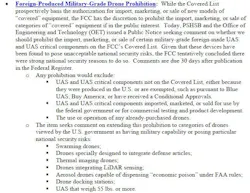
By the way, here's an excerpt of the proposed FCC ban that just came out a week ago:
About the Author
 Andy Turudic
Andy Turudic
Technology Editor, Electronic Design
Andy Turudic is a Technology Editor for Electronic Design Magazine, primarily covering Analog and Mixed-Signal circuits and devices and also is Editor of ED's bi-weekly Automotive Electronics newsletter.
He holds a Bachelor's in EE from the University of Windsor (Ontario Canada) and has been involved in electronics, semiconductors, and gearhead stuff, for a bit over a half century. Andy also enjoys teaching his engineerlings at Portland Community College as a part-time professor in their EET program.
"AndyT" brings his multidisciplinary engineering experience from companies that include National Semiconductor (now Texas Instruments), Altera (Intel), Agere, Zarlink, TriQuint,(now Qorvo), SW Bell (managing a research team at Bellcore, Bell Labs and Rockwell Science Center), Bell-Northern Research, and Northern Telecom.
After hours, when he's not working on the latest invention to add to his portfolio of 16 issued US patents, or on his DARPA Challenge drone entry, he's lending advice and experience to the electric vehicle conversion community from his mountain lair in the Pacific Northwet[sic].
AndyT's engineering blog, "Nonlinearities," publishes the 1st and 3rd Tuesday of each month. Andy's OpEd may appear at other times, with fair warning given by the Vu meter pic. His cartoon series, "Inventors", appears each week in Electronic Design Weekly.
Comment About the Article
To join the conversation, and become an exclusive member of Electronic Design, create an account today!
 Leaders Logo
Leaders relevant to this article: