DARPA Offers $6.5M in Prizes for Advanced Drone Design
What you'll learn:
- Battery technology is on the cusp of enabling high-performance flight applications.
- DARPA just released a “Lift Challenge” for drones, with a prize pool of $6.5M.
- DARPA is hosting a live webinar on Zoom on December 4, 2025, from 1-2 pm, to provide information to potential competitors.
Drones need lots more lift
Bernoulli’s or Newton’s rules?
Make Ben Franklin stacks
So, I’ve always been a wingnut — well before earning my private pilot’s license back in the late 1980’s. In fact, that’s how I hit it off with Electronic Design’s Lee Goldberg during the mid-90s telecom heyday. We had dinner with Lee, arranged by TriQuint’s PR consultant, Roger Grace, at one of the big telecom shows in Las Vegas to brief him on TriQuint’s latest and greatest gallium-arsenide (GaAs) 10-Gb modulator driver chips.
I can’t recall exactly what I was up to in terms of hobbyist aircraft design at the time. But after hearing about Goldberg’s stint at GE Aerospace, where he was involved in building satellites (namely Mars Observer, and then a few years later hearing about his conspiracy to stash the first human to go to Mars [see Lee’s account of Ira the Necronaut, here]), I asked him if he knew of a source of pyro-bolts that mere mortals could order. The enthusiasm for things that fly, both as pilots and as engineers, has cemented our friendship to this day.
Building Toward Sustainability
About 15 years ago, I started to look toward sustainable tech, having done time in telecom, FPGAs, op amps, and timing semiconductor devices. That’s the time, being sited in Silicon Valley, where I rubbed shoulders with the VC community and tried to get a semiconductor startup off the ground with little success. However, I gained a lot of insight on what made the whole ecosystem tick.
This was right after National had its big layoff, and was also when I decided to try out some of my own ideas. We came up with the first LED bulb to break $10 and then I developed some IP that threw the power switches in a traction inverter into the linear region to intentionally have them produce a few kW of heat energy
That eliminated the need for a heater module for battery and cabin heating in an EV, reducing vehicle cost by about $500...the implementation cost about $20 comprising a special gate driver and an extra power-supply rail. The heater was ahead of its time as manufacturers are just now looking at low-cost EVs for the masses, which we should see about a decade after our patent issued.
I’ve written about some of my aspirations on the EV conversion front and amassed a pretty good inventory of drive units, chargers, and even battery modules and cells. The cars to be converted await me now, for I’m no longer semi-retired by having this editor gig full time, as well as having started teaching at Portland Community College this past semester. I’m determined, despite all this, to start converting one of the cars next summer.
Flight or Fancy?
I’ve also hinted that I’ve got a project in the queue, after the cars, involving aviation. Like the Wright Brothers, I know what I need — it just doesn’t exist in an accessible form just yet. The Wrights knew they needed at least 8 hp at a maximum spec weight (which I don’t recall at the moment) and weren’t quite there when the wind gust picked their Flyer up and enabled them to glide for 108 feet while the engine was running.
The U.S. War Department was pleased to be able to establish U.S.-owned patents on controlled, powered flight, when I think it was Santos-Dumont, in France, who was the first to fly LEVEL. Just like the Wrights, many of us familiar with aviation design understand the power density we need to get off the ground:
“I, for one, as a grounded former pilot, am looking forward to seeing >450 Wh/kg fall out of the current [battery chemistry] efforts that are planned to go to production. This energy-density threshold (400 Wh/kg is close enough for me) cracks aviation open. I’m not talking about the scaled-up billionaires’ quadcopter toys, but legit, fixed-wing, regional transportation we can all use. Meanwhile, some of us might get a head start on Stellantis and rescue the pack out of a crashed 2029 Silverado and see how its repackaged cells do in a converted Cessna 182.” — Electronic Design Nonlinearities Blog, May 2025.
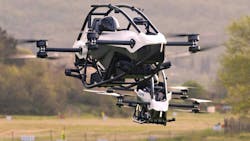
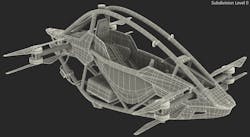
Well, actually, I did have the Jetson ONE quadcopter catch my eye (Fig. 1), which fits nicely into my recently acquired TIG welding skillset and with the tools I have in my shop. The construction harkens back to the old tube and fabric days, sans the fabric.
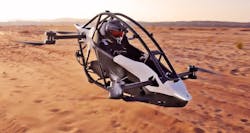
The roll cage is obviously for ground loops, since a drop of double digits feet will likely result in at least a spinal injury if not death. Just as in helicopters, or any kind of ballistic parachute or other safety mechanism, a minimum altitude is needed to deploy the safety backup system, so there’s a distance above ground where the Goldilocks Principle means likely death. Flying it in ground effect is likely the way to do it.
The Jetson ONE does have some interesting specs (Fig. 2), nonetheless:
- Top speed: 63 mph (102 km/h)
- Flight time: Up to 20 minutes
- Range: Approximately 34 km (21 miles) on a single charge
- Weight: Maximum pilot weight of 90 kg (210 lb.) and aircraft weight of 86 kg (190 lb.)
- Power output: 88 kW from eight electric motors
My electric aero projects were waiting for the newer batteries to become available, as I described in my blog posting seven months ago, and with all I have lined up in my projects queue, I thought I could wait. That is, until I saw a recent announcement about a DARPA unmanned (“uncrewed” to be generally correct, but since I won’t be in it, “unmanned” kinda works) drone challenge.
The DARPA Drone Challenge
This DARPA challenge is somewhat intriguing and has my attention because of the interesting problems that need solving. The idea is for a team to build a drone that weighs no more than 55 lb and has a payload capacity exceeding 110 lb, comprised of Olympic-sized barbell weights. The weights are to be carried for 4 miles at 350-ft. AGL, dropped off by the drone descending vertically to 0’ AGL, then the drone is to fly another mile. Takeoff and landing has to be vertical.
Scoring is computed by the maximum payload weight divided by the aircraft weight (no buoyancy tricks allowed) carried over the flight course. If there’s a tie on this scoring metric, the team with the highest payload will be declared the winner. A further tiebreaking tier is the fastest time over the flight course.
Call me a nerd, but the prizes, to me, are incidental to having the best design in the challenge. Plus, all that money for the following categories going out to the IRS because of cash payouts gives me heartburn:
- Total prize pool: $6.5 million
- First Place: $2.5 million
- Second Place: $1.5 million
- Third Place: $1 million
- Most Revolutionary Aerodynamic Design: $500,000
- Most Revolutionary Powertrain Design: $500,000
- Most Promising Design: $500,000
So, this one has the gears turning in my head, ever since I read the announcement a few days ago.
Advanced battery chemistry supplies are a problem, and with war drone production lines running 24/7, motors are going to be tough to find. This one’s a flashback to the COVID days, where you can’t do a design without first ordering the part and having it in hand. We’ll ignore the miracle of having flight-ready hardware in six months (which kind of says to tinfoil-behatted me that some people may have these ready to go and this challenge may have been crafted around what they have).
Registration for this DARPA Challenge is expected to open on January 5, 2026. The registration window closes May 1, 2026, with the flyoff, unreasonably IMO, in the summer of 2026. It feels to me that DARPA messed up the flyoff date — it should have been Summer 2027. What do you think?
For more details about the challenge, as well as the link to the proposed rules, the DARPA Lift Challenge, DARPA-SN-25-09 announcement is attached for your convenience, below.
DARPA is also hosting a live webinar on Zoom on December 4, 2025, from 1-2 pm, to provide information to potential competitors. Pre-registration, click here, is required. Give them a piece of your mind about how unreasonable a summer 2026 flyoff is when you register.
Here’s hoping that some good comes out of all this. Perhaps shipping medical supplies and fresh water into disaster areas would be great for the technology, but the sad reality is that the innovations will likely be used to shred more of humanity’s flesh versus helping out the unfortunate.
Of course, someone will do it, so a possible strategy is to be the one who has the tech that then controls who gets it. DARPA does not assume rights over the IP that goes into these, allegedly. It would be cool to use this tech to do a Jetson-like personal vehicle that carries 300 lb. of typical American bacon with an airframe that’s 40 lb. lighter than Jetson ONE.
Enjoy,
andyT
Andy's Nonlinearities blog arrives the first and third Monday Tuesday of every month. To make sure you don't miss the latest edition, new articles, or breaking news coverage, please subscribe to our Electronic Design Today newsletter. Please also subscribe to Andy’s Automotive Electronics bi-weekly newsletter.
About the Author
 Andy Turudic
Andy Turudic
Technology Editor, Electronic Design
Andy Turudic is a Technology Editor for Electronic Design Magazine, primarily covering Analog and Mixed-Signal circuits and devices and also is Editor of ED's bi-weekly Automotive Electronics newsletter.
He holds a Bachelor's in EE from the University of Windsor (Ontario Canada) and has been involved in electronics, semiconductors, and gearhead stuff, for a bit over a half century. Andy also enjoys teaching his engineerlings at Portland Community College as a part-time professor in their EET program.
"AndyT" brings his multidisciplinary engineering experience from companies that include National Semiconductor (now Texas Instruments), Altera (Intel), Agere, Zarlink, TriQuint,(now Qorvo), SW Bell (managing a research team at Bellcore, Bell Labs and Rockwell Science Center), Bell-Northern Research, and Northern Telecom.
After hours, when he's not working on the latest invention to add to his portfolio of 16 issued US patents, or on his DARPA Challenge drone entry, he's lending advice and experience to the electric vehicle conversion community from his mountain lair in the Pacific Northwet[sic].
AndyT's engineering blog, "Nonlinearities," publishes the 1st and 3rd Tuesday of each month. Andy's OpEd may appear at other times, with fair warning given by the Vu meter pic. His cartoon series, "Inventors", appears each week in Electronic Design Weekly.
Related

 dreamstime__242867798_id_242867798_c
Comment About the Article
To join the conversation, and become an exclusive member of Electronic Design, create an account today!
 Leaders Logo
Leaders relevant to this article: