What It’s Like to be a Part-Time Engineering Professor
What you'll learn:
- A college education seems to require personal sacrifice from educators in order to transfer valuable skills and knowledge to students.
- Andy’s got the winter semester off and is looking at designing a drone entry for the upcoming DARPA challenge — got advanced batteries?
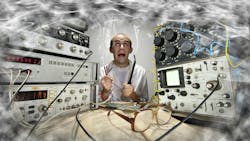
I’m a professor
Teaching students how it’s done
It’s not for the cash.
Last week marked the end of my first semester of teaching as a part-time (“adjunct”) professor at Portland Community College. I taught a digital electronics lab once a week for three hours in their electronics engineering technologist (EET) program.
The semester got off to an interesting start, back in September, where students attended my class on Thursdays yet received lectures on theory on Tuesdays and Thursdays, with the Thursday lecture being AFTER my lab class. Our first lab class was held with the students having one engineering lecture under their belt, after graduating from high school, on electronics as well as anything else in the program before our Thursday get-together that week.
Getting Well-Grounded
My first step was to assess what the students knew. So, I asked if they knew what a circuit was, and I got a blank stare. With that bit of data, I went up to the whiteboard and started sketching out a circuit. I tried to get them to understand that it's a loop in which current flows, driven by a voltage, keeping it rudimentary.
I didn't want to scare them off to the point where they dropped the class that first week, for which there would be a full refund. I did get three drops that week, but those never attended class.
Only three others dropped out during the term. One was an A student with family issues, another was also a promising student whose priorities in life were standing up for their and others’ rights in downtown Portland and getting law-smacked for doing so, and one, despite trying and wanting it badly, simply could not keep pace with the mass of learning material being thrown at him. All three were personally heartbreaking for me — they were “my kids.”
Back to the board, having drawn a voltage source and a load showing the current loop, I then quickly described Ohm’s Law and how to calculate the current in that loop.
That first day's lab was intended to familiarize the students with bench lab equipment, including arbitrary waveform generator, oscilloscope, digital multimeter, and power supplies with an accompanying document written by prior faculty that describes the steps.
Not being my first rodeo, I was well aware of the dangers of students measuring voltage with an ammeter, so I told them to think of the ammeter as a piece of wire; a short circuit of zero ohms. I went back to my whiteboard circuit drawing and changed the load resistor to zero ohms and then asked them how much current would flow using Ohm’s Law.
I then explained that infinite current through an ammeter was not a good idea and to never connect an ammeter across a load — it's a piece of wire. With that — my first formal, totally ad hoc lecture on the basics — they successfully followed the lab instructions and didn't blow anything up for the most part (someone did FAFO and blew a fuse on one of the DMMs despite my warnings).
Everyone, including myself, realized that students assimilating the materials and content of this course would be like drinking through a fire hose as far as doing and understanding it.
Abstract Concepts
One thing that I did require from my students was a formal lab report that contained pretty much the full scientific method, including abstract. I also required that a lab notebook was kept that was patent-compliant proof of work done (numbered pages, no blanks, dated, etc) along with a subsequent, objectively written, graded lab report that was in the third person (part of the reason I landed this editor gig at Electronic Design was that I was an engineer with grammar skills).
This was, perhaps, one of the most difficult things for the students to learn. It’s what I see as a failing of the high school education system and its focus on the literary arts, poetry, and story-writing, with clearly zero emphasis on technical writing.
It took between four and six lab reports for them to write in proper form, with the abstract being a tough nut to crack because an abstract is the first thing in a report but the last part that’s written. Getting the “you” and “we” outta there was a close second and took about as long as well. By the end, ALL of them wrote in the correct form and frame of mind.
I was in this gig to teach, to produce “an employable product,” one who thought like an engineer versus having human feelers. And that refrains from using the bullying words of "you" and "we" — science and engineering is based on facts, not opinion, not popular or mob opinion, not "belief.” This is something John Q. Public doesn't understand when they pretend to dabble in the sciences or state an opinion about science or engineering because they heard it on Facebook in a village-idiot virtual commune.
Each report got bespoke feedback from me in an effort to herd the cats in a unified direction toward objectivity. This conversion to “be Spock,” of course, took time.
Failure by Design
Many of my teaching colleagues got the hack, though: Deliver a lecture, have the students take an auto-graded quiz (in some cases one single question), and not take attendance apart from the first week where the Registrar required it.
That hack delivered a decent hourly rate while my bespoke grading and feedback of lab reports in a formal format got me about 1/3 the effective hourly wage, which is based on the lowest pay grade in the school because I'm new, part-time faculty. Add in prep for the next class and I was in McDonalds' burger-flipping wage territory. My dean has promised to take my experience case to a compensation committee for an exception to the collective bargaining contract (I accepted the job based on the exception), but it’s been crickets so far.
The teachers' union, in its infinite wisdom, has agreed to a contract where a part-timer like me, with over five decades of experience in electronics, starts at the same wage as a new grad. Experience isn’t a factor for part-timer pay, so the system naturally gravitates to gravy train, minimal effort, starving-retiree teaching pools, while the administrative staff does get experience recognized in its compensation.
Had I entered on an administrator track, I'd be getting paid what I was worth in industry. Thus, we'd see more top industry talent producing our next crop of electronics technicians as part-time faculty while working in their full-time jobs.
The school is currently in contract negotiations, and it's not been going well. The core issue of part-timers' pay increases is being declined by the administrators (the people whose salary includes experience as a factor) and it looks like arbitration and a possible, campuses-wide, strike may be in the cards next month. Part-time faculty forms about 3/4 of the teaching faculty as far as I know.
The Trump administration didn't do the State of Oregon any favors, with massive cuts to social programs in a state that sends more to Washington than it gets back for tax money. To preserve social programs, the State issued an edict for all departments to equally cut 5% from their budgets, including the state's Department of Education that distributes funds to colleges and universities.
Being “fair” versus addressing education as an untouchable is an acceptable concept in this society. We, in America, breed incompetence, ignorance (and, in fact, seem to worship it in cults), and a lack of critical thinking skills that are exploited by the fat cats.
Supply Ignores Demand
Despite near-record enrollment (techs are AI-proof and students and their parents know this), the EET program now finds itself allegedly needing to cut back on class hours and staffing because of budget. Ignore that part-time wages are a core issue in the labor contract negotiations and management's need to show the lack of money as they stuff their own pockets with scarce funds.
It’s the students and industry that suffer here, and the only solution I can come up with to this problem are industry grants specifically directed to programs that train the workers they need.
An example of this is a class section I was about to teach on hydraulics and pneumatics this coming winter semester, a core set of skills for working in industry and construction maintenance. But it was cancelled a few weeks before it was allowed to fill.
I protested to management, stating if they really wanted to save money, teaching one lecture on Zoom to 18 students or one lecture to 36 students on Zoom made no difference (I've delivered live lectures to as many as 220 engineers on a worldwide signal integrity series). So, I also "volunteered" myself out of another full class I was supposed to teach as well as a form of protest on behalf of the student demand for seats. Management took me up on the withdrawal.
However, rather than consolidate two lectures held at the same day and time with one instructor, they backfilled me with yet another instructor. The end result: No professoring for me in the winter semester and no contribution to slimming the budget either.
Which is fine.
Being Funemployed
Surprised? I'm doing all this stuff, including this editor job, as a fun thing during my retirement years — yes, I’m on Social Security. The extra money is great to have, of course, but the giving back, the interaction, the legacy, the “sanook” (a Thai word for having fun in what you do) is my goal, not a job. If I wanted a job, I’d easily be pulling in 2X-3X the wage plus I’d be getting equity as comp. Miserable, selfish, and bags of money in the bank in your twilight years? Meh.
It's also fine because I’m genuinely serious about looking at entering a design in the DARPA drone challenge (got advanced battery chemistry cells that you or a connection can donate to the project, even if they’re pre-production?), and that takes time to do. I love design challenges and enjoy the R&D. Nerdvana.
So, I'm not teaching at PCC this winter, but am planning to return in the spring semester to teach electronics hardware stuff to a new crop of students, maybe even some of this past semester’s crew. I’ve even started a discussion with the automotive tech team to see if we can put together an electric vehicle technician program with SAE certifications.
A crop of EET students, this coming semester, likely won't have a dumb-enough instructor spending hours on lab reports getting them to industry standards, or teaching them tricks of the trade, or providing them with the equivalent of working in a startup as I had structured two labs to do with my own lab project writeups. At least a dozen students did get that education in the semester that ended this past Monday, got a unique skillset, and I'm proud of them, even if it’s a one-and-done.
Now, back to looking for batteries and designing that airframe and the mega-output motor(s).
-andyT
Andy's Nonlinearities blog arrives the first and third Monday Tuesday of every month. To make sure you don't miss the latest edition, new articles, or breaking news coverage, please subscribe to our Electronic Design Today newsletter. Please also subscribe to Andy’s Automotive Electronics bi-weekly newsletter.
About the Author
 Andy Turudic
Andy Turudic
Technology Editor, Electronic Design
Andy Turudic is a Technology Editor for Electronic Design Magazine, primarily covering Analog and Mixed-Signal circuits and devices and also is Editor of ED's bi-weekly Automotive Electronics newsletter.
He holds a Bachelor's in EE from the University of Windsor (Ontario Canada) and has been involved in electronics, semiconductors, and gearhead stuff, for a bit over a half century. Andy also enjoys teaching his engineerlings at Portland Community College as a part-time professor in their EET program.
"AndyT" brings his multidisciplinary engineering experience from companies that include National Semiconductor (now Texas Instruments), Altera (Intel), Agere, Zarlink, TriQuint,(now Qorvo), SW Bell (managing a research team at Bellcore, Bell Labs and Rockwell Science Center), Bell-Northern Research, and Northern Telecom.
After hours, when he's not working on the latest invention to add to his portfolio of 16 issued US patents, or on his DARPA Challenge drone entry, he's lending advice and experience to the electric vehicle conversion community from his mountain lair in the Pacific Northwet[sic].
AndyT's engineering blog, "Nonlinearities," publishes the 1st and 3rd Tuesday of each month. Andy's OpEd may appear at other times, with fair warning given by the Vu meter pic. His cartoon series, "Inventors", appears each week in Electronic Design Weekly.

Comment About the Article
To join the conversation, and become an exclusive member of Electronic Design, create an account today!
 Leaders Logo
Leaders relevant to this article: