2025 PowerBest Winners: Power Controllers

What you’ll learn:
- Intelligence and integration have become the foundation for a new generation of motor controllers that offer high levels of efficiency, performance, and protection with lower solution costs and smaller footprints.
- 2025 saw a surge in highly integrated USB solutions capable of supporting the higher power levels and advanced functionality, like SB/EPR/PD, used in many products as USB becomes the de facto standard for powering nearly everything.
- Many other applications, including automotive lighting and battery-management systems have benefitted from the higher levels of integration and intelligence found in today’s power controllers.
- BLDC Controller/Driver Features Advanced Sensing, Control, Protection Functions
- USB EPR PD Solution Leverages Type-C Port Controller and Buck-Boost Battery Charger
- Low-Cost Real-Time MCUs Handle Advanced Motor-Control Functions
- Ideal-Diode Controllers Simplify Reverse Battery Polarity, Overvoltage Protection
- SoC-Based MCU and Smart Battery-Management Software Devoted to Advanced EVs
- Smart LED Drivers Simplify Dynamic Automotive Lighting with Digital Color Mixing

Qorvo's PAC52410 further expands the company’s portfolio of power application controller (PAC) products with an application-optimized solution for controlling and powering next-generation appliances, devices, and equipment.
The PAC52410 integrates a 50-MHz Arm Cortex-M0 32-bit microcontroller core with Qorvo's proprietary Multi-Mode Power Manager, Configurable Analog Front End, and Application Specific Power Drivers to form the most compact microcontroller-based power and general-purpose application systems.
These include:
- 44-V buck/SEPIC dc-dc controller with external NCH FET
- 5-V/200-mA system supply
- Three high-side 44-V, 1.2-A (source)/1.8-A (sink) gate drivers
- Three low-side 20-V, 1.2-A (source)/1.8-A (sink) gate drivers
- Programmable overcurrent shutdown
- Programmable comparator hysteresis and blanking
- VDS sensing
- Simultaneous sample and hold for three-phase
Originally appeared in the February edition of PowerBites
USB EPR PD Solution Leverages Type-C Port Controller and Buck-Boost Battery Charger
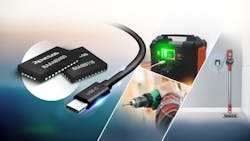
The RAA489118 buck-boost battery charger and the RAA489400 USB Type-C port controller from Renesas Electronics combine to provide an Extended Power Range (EPR) USB Power Delivery (PD) solution.
The RAA489118 functions as either a battery charger supporting two to seven battery cells in series or as a voltage regulator supporting 30-V input and 30-V output. It employs the company’s patented R3 (Robust Ripple Regulator) technology, which combines the best features of fixed-frequency and hysteretic pulse-width-modulation (PWM) technologies. R3 modulation technology delivers acoustic noise-free operation, fast dynamic response, and best-in-class light-load efficiency for longer battery life.
>>Check out the other 2025 PowerBest Award Winners

The battery charger integrates an SMBus, commonly used in power tools, home appliances, and light industrial products, which allows it to work seamlessly with the RAA489400 and other components. Its input- and output-voltage levels also match mainstream solar-power voltage levels.
Originally appeared in the January Edition of PowerBites
Low-Cost Real-Time MCUs Handle Advanced Motor-Control Functions

Texas Instruments’ F28E120SC and F28E120SB microcontrollers (MCUs) help engineers design products with industry-leading performance at a lower cost. They offer 30% faster computing power than previous generations, which can be used for single-motor and power-factor-correction (PFC) systems.
By integrating TI’s C28x digital-signal-processor core, a high-speed digital-to-analog converter (DAC), and a programmable gain amplifier, they eliminate the cost and PCB footprint of additional components for simpler, lower-cost, higher-performing designs. Applications include home appliances such as washing machines and dishwashers, vacuum cleaners, and power tools.
The new MCUs support TI’s proprietary InstaSPIN field-oriented-control (FOC) software and advanced algorithms, which enable smoother, quieter, and more efficient motor performance.
Originally appeared in the October Edition of PowerBites
Ideal-Diode Controllers Simplify Reverse Battery Polarity, Overvoltage Protection
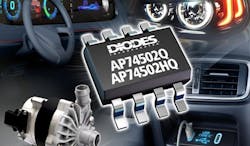
According to Diodes Inc., its AP74502Q and AP74502HQ automotive-compliant, 80-V ideal-diode controllers provide robust, reliable protection against reverse connections and voltage transients.
These devices are primarily intended for use in the growing number of EVs and PHEVs that use a 48-V primary supply to power features like electric turbocharging, improved regenerative braking, and electrified auxiliary components. Typical applications include advanced driver-assistance systems (ADAS), body control modules, infotainment systems, exterior lighting, and USB charging ports.
The ideal-diode controllers have all of the features necessary to implement an efficient and fast reverse-polarity protection circuit. They also include a load disconnect function in case of overvoltage and undervoltage events. Unlike conventional ideal diodes with reverse-current blocking features, these devices are suitable for applications where energy may return to the input supply. However, they can be configured as surge stoppers as well.
Originally appeared in the September Edition of PowerBites
SoC-Based MCU and Smart Battery-Management Software Devoted to Advanced EVs

The PSOC 4 HVPA-SPM 1.0 microcontroller is designed for use in high-voltage Li-ion battery-management systems for electric vehicles (xEVs). The MCU, developed by Infineon Technologies, combines precision, safety, and programmability, while supporting zonal architectures and the transition to software-defined vehicles (SDVs).
Infineon is partnering with Munich Electrification, a provider of innovative battery-management software, to deliver advanced, cost-efficient battery-management-system (BMS) solutions.
The PSOC 4 HVPA-SPM 1.0, a Cortex-M0+-based MCU, integrates high-precision monitoring of current, voltage, and temperature. It works to ensure reliable battery performance, improving the accuracy of state of charge (SoC) and state of health (SoH).
Originally appeared in the December edition of PowerBites
Smart LED Drivers Simplify Dynamic Automotive Lighting with Digital Color Mixing
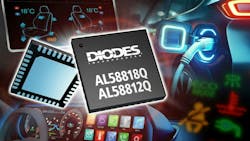
The AL58818Q and AL58812Q are automotive-compliant 18- and 12-channel linear LED drivers designed to provide precise color mixing and brightness control for automotive rear lamp modules, grille/emblem lights, and interior ambient lighting.
Developed by Diodes Inc., the devices help designers simplify the development of advanced lighting elements and other complex animated LED lighting modules, such as infotainment displays, automotive status indicator lights, touch panels with vivid lighting effects, and zero audible noise.
Each of the drivers’ channels features an internal 12-bit pulse-width-modulation (PWM) generator operating at 30 kHz for fine-tuned color mixing (16 million color combinations) and brightness control. System designers can select between I2C or SPI digital interfaces through a hardware-selectable pin, providing enhanced programming flexibility.
Originally appeared in the October issue of PowerBites
>>Check out the other 2025 PowerBest Award Winners
About the Author
 Lee Goldberg
Lee Goldberg
Contributing Editor
Lee is the author of the popular PowerBites series.
Lee Goldberg is a self-identified “Recovering Engineer,” Maker/Hacker, Green-Tech Maven, Aviator, Gadfly, and Geek Dad. He spent the first 18 years of his career helping design microprocessors, embedded systems, renewable energy applications, and the occasional interplanetary spacecraft. After trading his ‘scope and soldering iron for a keyboard and a second career as a tech journalist, he’s spent the next two decades at several print and online engineering publications.
Lee’s current focus is power electronics, especially the technologies involved with energy efficiency, energy management, and renewable energy. This dovetails with his coverage of sustainable technologies and various environmental and social issues within the engineering community that he began in 1996. Lee also covers 3D printers, open-source hardware, and other Maker/Hacker technologies.
Lee holds a BSEE in Electrical Engineering from Thomas Edison College, and participated in a colloquium on technology, society, and the environment at Goddard College’s Institute for Social Ecology. His book, “Green Electronics/Green Bottom Line - A Commonsense Guide To Environmentally Responsible Engineering and Management,” was published by Newnes Press.
Lee, his wife Catherine, and his daughter Anwyn currently reside in the outskirts of Princeton N.J., where they masquerade as a typical suburban family.
Comment About the Article
To join the conversation, and become an exclusive member of Electronic Design, create an account today!
 Leaders Logo
Leaders relevant to this article: