2025 PowerBest Winners: Too Cool to Classify

What you’ll learn:
- Tiny MEMS-based switches offer many advantages over their semiconductor-based counterparts.
- Tiny thin-film monolithic power inductors that can be embedded within a power device’s package may change the rules for power-conversion design.
- A simple solution for powering old-school cold-cathode Nixie tube displays makes it easy to add retro-charm to your next design.

Menlo Microsystems’ deceptively simple-looking MEMS-based switch structures offer a number of advantages over today’s semiconductor-based and conventional mechanical switching solutions.
Its “Ideal Switch” structures are fabricated in large arrays by depositing an electrostatically activated beam on a glass substrate using a (mostly) standard MEMS process. The resulting device has low-resistance, corrosion-resistant contact surfaces.
This process can be used to fabricate rugged arrays of switches with remarkably high current densities and low parasitic effects. It enables them to support high-power switching applications from DC to tens of GHz.
Originally appeared in the April Edition of PowerBites
Monolithic Micro-Inductors Enable Powerful Innovation
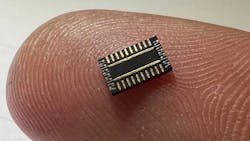
Ferric’s unique technology to integrate high-quality thin-film monolithic power inductors within a power device’s package will enable manufacturers to create chip-scale modules that eliminate both the real estate and parasitics associated with external components. This capability may be a key to developing the next generation of products used to deliver the near-impossible currents required to power modern GPUs.
The micro-inductors will enable the fabrication of devices that Ferric refers to as integrated voltage regulators (IVRs), which integrate interface, telemetry, feedback control, and powertrain circuitry (including power FETs, inductors, and capacitors). The company says that these devices can be up to 25X smaller, >100X faster, and >30% more efficient than other commonly used converter solutions.
For example, the Fe17XX IVR series, which is housed in a 20-mm2package, is able to deliver 56 A at output voltages ranging from 0.25 to 1.5 V.
Originally appeared in the April Edition of PowerBites
Nixie Tube Display Power Solution Brings Retro Charm to Any Project
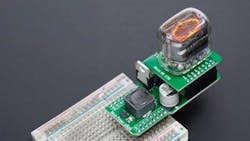
The Nixie Power Click, a booster Click board from MIKROE, provides the high voltage needed to power Nixie tube (cold cathode display) shields. This board features the LM2577 step-up voltage regulator, enabling a two-stage boost conversion from 5 to 150 V. It also integrates Microchip’s 16-bit I/O expander MCP23017 for precise control via the I2C interface and ADDR SEL jumpers for easy I2C address configuration.
Nixie Power Clicks are compatible with MIKROE’s Nixie IN-12B add-on shield boards. The shield boards feature pre-installed IN-12B Nixie tubes with a character height of 18 mm and the ability to display digits 0 to 9 with a left-positioned decimal point. Operation has a typical starting voltage of 150 V with 3-mA current per segment, which is delivered by the Nixie Power Clicks.
Originally appeared in the June Edition of PowerBites
>>Check out the other 2025 PowerBest Award Winners

About the Author
 Lee Goldberg
Lee Goldberg
Contributing Editor
Lee is the author of the popular PowerBites series.
Lee Goldberg is a self-identified “Recovering Engineer,” Maker/Hacker, Green-Tech Maven, Aviator, Gadfly, and Geek Dad. He spent the first 18 years of his career helping design microprocessors, embedded systems, renewable energy applications, and the occasional interplanetary spacecraft. After trading his ‘scope and soldering iron for a keyboard and a second career as a tech journalist, he’s spent the next two decades at several print and online engineering publications.
Lee’s current focus is power electronics, especially the technologies involved with energy efficiency, energy management, and renewable energy. This dovetails with his coverage of sustainable technologies and various environmental and social issues within the engineering community that he began in 1996. Lee also covers 3D printers, open-source hardware, and other Maker/Hacker technologies.
Lee holds a BSEE in Electrical Engineering from Thomas Edison College, and participated in a colloquium on technology, society, and the environment at Goddard College’s Institute for Social Ecology. His book, “Green Electronics/Green Bottom Line - A Commonsense Guide To Environmentally Responsible Engineering and Management,” was published by Newnes Press.
Lee, his wife Catherine, and his daughter Anwyn currently reside in the outskirts of Princeton N.J., where they masquerade as a typical suburban family.
Comment About the Article
To join the conversation, and become an exclusive member of Electronic Design, create an account today!
 Leaders Logo
Leaders relevant to this article: