Distributed Energy: The Future of Power Grids
Key Highlights
- Decentralized energy shifts the grid from one-way delivery toward a system where consumers can also generate and store electricity.
- Rooftop solar adoption is expected to grow substantially, with the IEA projecting more than 100 million homes using it by 2030.
- Renewable projects can often be deployed faster than large centralized power plants, while solar and storage costs continue to fall.
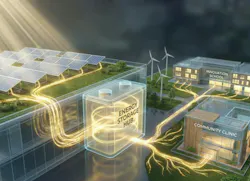
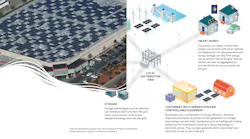
For more than a century, electricity has flowed in one direction—from large, centralized power plants outward to homes and businesses. But today, that flow is changing. Rooftops are becoming micro‑power stations, businesses are installing smart batteries, and wind systems are appearing in places once considered impractical.
Over the last few decades, our centralized, top‑down power system has begun giving way to something far more dynamic: decentralized energy generation. This shift is not simply about adopting renewable energy. It’s about rethinking how entire national grids function and how everyday people—homeowners, small businesses, and communities—participate in the energy ecosystem.
This transition is accelerating quickly. The International Energy Agency (IEA) estimates that rooftop solar alone will be installed in more than 100 million homes by 2030, up from just 25 million today.[1] And as these small power sources multiply, they are transforming everything engineers thought they knew about designing and managing the grid. As distributed energy resources (DERs) scale at a record pace, it’s worth exploring the technologies that make this decentralization not only possible but also increasingly efficient, resilient, and intelligent.
Why Power Is Becoming Decentralized
Centralized power plants—massive coal, gas, hydro, or nuclear facilities—have supported society for a century. But these systems are slow to build, expensive to maintain, and increasingly unable to keep pace with rising demand. Nuclear plants, for example, can take six to eight years to bring online.[2] By contrast, solar farms can be completed in just one to three years,[3] and residential solar installations can be finished in a matter of weeks.[4]
At the same time, renewable technology costs have dropped dramatically. Solar panels and wind turbines that were once niche are now commonplace, and energy storage technologies such as lithium iron phosphate (LFP) batteries are more stable, scalable, and affordable than ever. This combination of faster deployment and lower cost makes dispersed, smaller-scale energy sources an obvious choice for expanding capacity.
But decentralization is driven by a cultural shift as well. More individuals and organizations want energy independence—whether to reduce bills, increase resilience, or lower carbon footprints. This creates a landscape where energy doesn’t just flow in one direction anymore. Today, homes and businesses both consume and produce electricity, fundamentally changing how the grid must operate.
New Technology Is Fueling the Momentum
The story of decentralization isn’t just about more solar panels and wind turbines. It’s a story of engineering breakthroughs that make small-scale energy far more effective.
Smarter, More Efficient Solar and Wind
Early 2000s solar panels hovered around 15 percent efficiency.[5] Modern panels routinely reach 20 percent,[6] and cutting-edge perovskite-on-silicon tandem cells are pushing toward 30 percent.[7] These jumps matter because each percentage point reduces the space needed for solar installations—making them viable for more rooftops and locations.
Wind technology is evolving as well. Bladeless turbines, for example, use oscillations rather than spinning blades to generate power. They have fewer safety concerns, create less noise, and require less maintenance. These engineering advantages allow wind energy to fit into environments where conventional turbines cannot—urban edges, rooftops, or constrained industrial zones.
[1] https://www.iea.org/reports/approximately-100-million-households-rely-on-rooftop-solar-pv-by-2030
[2] https://hannahritchie.substack.com/p/nuclear-construction-time
[3] https://www.theecoexperts.co.uk/solar-panels/complete-guide-solar-farms
[4] https://www.susenergy.co.uk/how-long-does-it-take-to-install-solar-panels.html
[5] https://www.forbes.com/sites/peterdetwiler/2013/07/16/as-solar-panel-efficiencies-keep-improving-its-time-to-adopt-some-new-metrics/
[6] https://www.enel.com/learning-hub/smart-home/solar-panel-efficiency-bill-savings
[7] https://www.oxfordpv.com/press-releases/oxford-pv-solar-energy-innovation
[8] https://www.energy.gov/eere/solar/silicon-carbide-solar-energy