New Battery Pack Concept Features “Superfluidized” Solid Electrolyte
What you'll learn:
- ProLogium and Rimac Technology presented a new battery pack concept mockup at the 2026 Paris Motor Show.
- Their integrated system combines a ”superfluidized” all-inorganic solid electrolyte with a 100% ceramic separator and an all-silicon anode
- The 100% composite silicon anode achieves a high activation utilization of 1,800 to 2,300 mAh/g, nearly 6X that of a conventional graphite anodes.
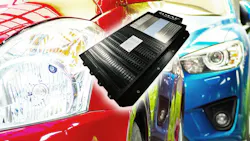
At the 2026 Paris Motor Show, ProLogium and Rimac Technology showcased a new battery pack concept mockup. They also said the next phase will focus on developing functional battery segments to be displayed at CES 2027 in Las Vegas.
The complete battery packs to be shown at CES will establish a basis for testing thermal management, followed by cell integration, all in support of the battery electric vehicle (BEV) market. Initial vehicle and public-road testing are now planned for the second half of 2028.
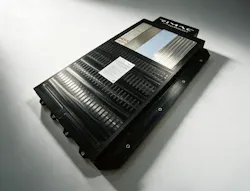
ProLogium and Rimac Technology signed a Memorandum of Understanding (MOU) in September 2025 to develop a next-generation battery platform. The collaboration combines ProLogium’s cell technology with Rimac’s battery system development expertise, focusing on a pouch cell-to-pack architecture (Fig. 1).
Vincent Yang, Founder and CEO of ProLogium, said, “What we are presenting at the Paris Motor Show is the baseline of that collaboration with Rimac Technology (announced) at IAA in 2025. Building on the completed concept mockup and the functional segments currently in development, we are preparing to move into the development and production of a functional battery, progressing toward a full-scale battery pack and subsequent vehicle integration validation.”
Daniel Kišić, Principal Product Architect of Rimac Technology, added, “Rimac Technology is developing a scalable cell-to-pack integration technology for solid-state pouch cells, designed to meet and exceed the requirements the automotive industry is expected to set over the coming decade.
“A wide range of integration solutions is currently being evaluated and tested in parallel on functional battery segments, covering thermal management, swelling management, cell integration, and system-level design. Some of these solutions are oriented towards maximum energy density and reduced space and weight, while others are oriented towards delivering performance.”
Elements of the Battery Architecture
The integrated system combines a superfluidized all-inorganic solid electrolyte with a 100% ceramic separator and an all-silicon anode. What the companies term a “SF-Ceramion Superfluidized Inorganic Solid-State Electrolyte” is an all-inorganic electrolyte technology that combines the high ion concentration of solid materials with the interfacial contact properties of liquids.
According to the companies, the electrolyte is said to overcome three major bottlenecks of traditional solid-state batteries: ionic conductivity, interfacial stability, and manufacturing efficiency. As a result, it’s said to deliver high conductivity, enhanced safety, fast charging, low-temperature operation, and no need for pressurized modules.
An all-ceramic separator, made from non-flammable inorganic oxides, offers safety and structural robustness. ProLogium stated that it’s unaffected by the internal stresses caused by electrode swelling and contraction during charge-discharge cycles, while also withstanding external physical impacts to prevent structural damage.
By effectively blocking short circuits and thermal runaway, the separator enhances battery durability under both external forces and long-term operation, providing safety protection across diverse application scenarios. It’s said to maintain structural integrity at decomposition temperatures above 1,000°C and retains electrical insulation at 300°C, reducing the risk of thermal runaway.
More Performance Metrics
According to ProLogium, core performance metrics also include:
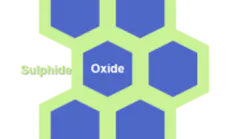
- Active Safety Mechanism (ASM): Under extreme heat or high voltage, the electrolyte decomposes into ASM components that stabilize the cathode structure and transition the anode to a ground state to stop thermal runaway. The electrolyte is intrinsically non-flammable. Even under high-temperature and high-voltage conditions, it doesn’t generate combustible or toxic gases. In contrast, the sulfide-based solid-state electrolyte releases highly flammable sulfur vapors in high-temperature oxidative environments, leading to spontaneous combustion.
- Structural stability: Logithium, ProLogium’s inner electrode layer structure technology, adopts a silicone-based frame adhesive applied via wet film coating, featuring thermosetting properties that are claimed to ensure structural stability and mechanical strength across both high and low temperatures. In addition to reinforcing the cell structure, it also acts as an extra separator, providing moisture resistance and enhancing electrode layer adhesion, delivering protection against structural collapse and edge short circuits. Derived from Logithium, Bi-cell is a double-side thick-film technology that increases the coating thickness of active materials, allowing two single cells to combine and form a Bi-cell architecture. This approach reduces the number of electrode stacking layers, lowers the overall volume and weight of materials, and effectively boosts battery capacity, improving both gravimetric and volumetric energy density.
- Ionic conductivity: Reaches 57 mS/cm at room temperature (25°C), which is roughly 5X to 6X higher than conventional liquid- and sulfide-based solid electrolytes.
- Low-temperature operation: Delivers 12.82 mS/cm at −20°C with 90% to 95% discharge efficiency. Even under extreme low-temperature conditions, it still outperforms the room-temperature ionic conductivity of sulfide solid-state electrolytes and liquid electrolytes, maintaining conductivity advantage and > 90% discharge efficiency. Traditional batteries typically suffer from poor performance decay at low temperatures.
- Energy density: Reaches a volumetric energy density of 860 to 940 Wh/l. The 100% composite silicon anode achieves a high activation utilization of 1,800 to 2,300 mAh/g, nearly 6X that of conventional graphite anodes, while requiring only one-fifth of its thickness. It delivers an energy density of 360 to 400 Wh/kg and 860 to 940 Wh/L, while significantly reducing the unit energy cost to around two-thirds that of graphite (USD/kWh).
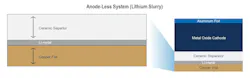
- Anode-less design: ProLogium’s Gen 4 SF-Ceramion technology enables anode-less architectures (Fig. 2). By applying pattern coating technology to ultra-thin lithium metal foils, the cells can achieve an energy density of 430 to 470 Wh/kg and 1,000 to 1,100 Wh/l. They also support roll-to-roll high-throughput manufacturing with costs reduced to a level claimed to be comparable to graphite anodes. Meanwhile, at the anode, it transitions the electrode from an excited state to a ground state, effectively blocking thermal runaway occurrence and providing active safety characteristics.
- Charging speed: Supports fast charging (from 5% to 80% in roughly 4 to 6 minutes).
- Module design: Operates effectively without needing external pressurized clamping modules.
Cost and Scalability Advantage
ProLogium’s Gen 4 lithium ceramic battery has the potential to achieve cost levels comparable to conventional nickel-cobalt-manganese lithium-ion batteries at scale. A key enabler is the superfluidized inorganic electrolyte, which is free of rare metals and unstable precursors. It allows for the use of lower-cost industrial-grade raw materials with 98.5% purity, rather than battery-grade materials with 99.99% purity.
At the battery pack level, Gen 4 technology may provide additional cost reduction opportunities. Its enhanced safety profile may lead to simplified cooling system requirements, while higher cell energy density may enable the use of fewer cells and fewer pack-level components for a given energy target.
Based on the above, ProLogium’s Gen 4 lithium ceramic battery has the potential to reduce battery pack costs by approximately 5% to 10% compared with conventional lithium-ion battery systems.
About the Author
Murray Slovick
Contributing Editor


Comment About the Article
To join the conversation, and become an exclusive member of Electronic Design, create an account today!
 Leaders Logo
Leaders relevant to this article: