Modular Powertrain Series Will Fit All EV Models
What you’ll learn:
- Hyundai Mobis is planning to establish a lineup of three modular EV powertrain models, including a 120-kW version, by the first half of the year.
- The new 215-horsepower (160-kW) drive unit integrates the motor, inverter, and reduction gear into a single casing.
- The company states that it now can develop everything from design to production on its own.
The powertrain has long been at the center of vehicle performance. At its core are all of the components that generate power and deliver it to the wheels. In a traditional internal combustion engine (ICE) this would include the engine, transmission, driveshafts, differentials, and axles.
An electric-vehicle (EV) powertrain, however, is very different — simpler in mechanical structure, but more sophisticated in terms of control and energy management. The power-electronics (PE) system is the EV equivalent to the powertrain of an ICE. It typically consists of an electric motor, an inverter, a reduction gearbox, and a high-voltage battery system.
Unlike ICE designs that need to rev up to produce torque, electric motors provide instant torque, which translates into rapid acceleration and smoother driving. The inverter converts the DC (direct current) stored in the battery into AC (alternating current) required by most electric motors. But more than just a power converter, the inverter also controls motor speed and torque by adjusting the frequency and amplitude of the current.
Modern inverters use semiconductor technology such as IGBT or silicon-carbide (SiC) switches to optimize efficiency, switching speed, and heat resistance. In many EVs, the inverter is integrated within the motor housing to reduce weight and wiring complexity. These components work to convert stored electrical energy into mechanical motion.
Unlike combustion engines, EV powertrains typically operate with fewer mechanical losses, providing smoother acceleration.
A PE System for General-Purpose EVs
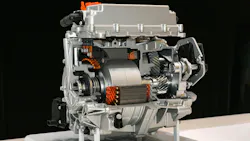
Following the 250-kW PE system introduced last year, Hyundai Mobis has developed a 160-kW version for general-purpose EVs (see image above). In addition, there are plans to complete development of a 120-kW PE system tailored for small mobility vehicles in the first half of this year. Taken together, this will give the company a drive system lineup covering all types of EVs while further enhancing its global competitiveness in electrification components.
With its 160-kW (215-hp) output, the all-in-one drive unit integrates the electric motor, inverter, and reduction gear into a single housing. This results in an all-in-one drive unit that has a 16% higher specific power output compared to similar products from other manufacturers, according to the company, while the overall volume is nearly 20% lower.
During the development of its proprietary PE system, Hyundai Mobis focused on standardizing key auto components and modularizing them. These include the stator for the drive motor, the inverter, and the power module, which is comprised of a bundle of power semiconductors. The level of performance is said to be suitable for application in most electric vehicles currently in mass production.
If two PE systems are installed on the front and rear of the vehicle, the maximum output is doubled. The company says that it plans to proactively propose the PE system developed in this manner to its global customers.
Standardization and Modularity
What makes this new drive unit different is Hyundai’s approach to standardization and modular design. Instead of relying on external suppliers to design and manufacture internal components using their specific techniques, Mobis went for a system-level standardization approach.
Their system-level standard model offers advantages in terms of scalability, as it can be applied to various vehicle models through a platform-like approach. The stator for the drive motor, the inverter, and the power module are interchangeable between the different powertrains, which lowers costs and speeds up manufacturing, according to Hyundai Mobis. This is more efficient than the strategy of developing a new powertrain for each new vehicle launch.
As the number of EV models increases, this approach is expected to be advantageous for future mass production. It also allows the company to expand its electrification portfolio into the powertrain sector.
While developing the PE system as a universal model, Hyundai Mobis also enhanced its performance. Specific power, measured as power output per unit weight, increased by about 16%, while the system’s overall volume was reduced by nearly 20%. The company also improved the motor structure by applying new cooling technology and developed a power module utilizing power semiconductors that maximize energy efficiency.
As mentioned earlier, within the first half of this year, Hyundai Mobis plans to complete the development of a 120-kW PE system tailored for compact cars. This system is characterized by smaller size and lower weight compared to the other two models, while also offering price competitiveness tailored to emerging markets.
Once completed, Hyundai Mobis will have a complete lineup of drive systems covering all types of EVs, from small mobility solutions to high-performance vehicles. It also means that repairing future electric models from Hyundai, Kia, and Genesis could be faster and cheaper, thanks to the modular design of the new drive units.