Are Personal eVTOLs Finally a Reality?
What you’ll learn:
- Velo X Aerospace’s Velocitor X1 is one of a small number of first-gen personal eVTOL aircraft that should be available for purchase in the near future.
- It’s one of an even smaller number of these craft with sufficient payload capacity and range to perform a limited set of useful real-world missions.
- Editor Lee Goldberg’s conversations with the X1’s creators provide a few insights about the technology that makes the craft simple and safe to fly, and what it may mean for the future of personal air mobility.
Velo X Aerospace’s Velocitor X1 is one of a small number of first-gen personal electric vertical takeoff and landing (eVTOL) aircraft that should be available for purchase in the near future. While the X1 and its competitors are all constrained by the limited performance available from today’s battery technologies, its designers claim that smart engineering has given the craft enough range and capacity to support useful, real-world applications.
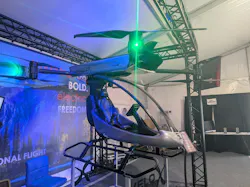
But do its capabilities justify its $156,000 price tag, or is it simply another impractical, expensive play toy for the uber-rich? My conversations with Velo X at the 2026 Sun n’ Fun airshow didn’t yield a definitive answer, but it did provide an interesting hint at what the future of personal air mobility might look like (Fig. 1).
A Big Freaking Drone?
Despite its advanced propulsion system and flight controls, the X1’s design shares many elements of the “multicopter” architecture employed by “the Kitty Hawk Flyer,” a sort of oversized hobby drone, which stirred the public’s imagination back in 2011. Despite the attention it received, Flyer failed to enter commercial production. It was, in part, due to the fact that few people were willing to fork over $150K to $200K for a vehicle with the extremely limited range and performance they could eke out the of the Li-ion batteries available at the time.
My conversation with Jake Meyerink, COO of Velo X, made it clear the X1’s designers took full advantage of the much higher power densities available in today’s Li-ion batteries, as well as advances in power electronics, sensors, and other technologies since those early days.
Velo X’s Velocitor X1 offers a fully enclosed carbon-fiber cabin, a fully redundant eight-rotor propulsion system that’s capable of carrying a 260-lb. payload at speeds of up to 70 mph, and a battery pack that supports flights of up to 45 minutes (plus a 15-minute safety reserve). Its fly-by wire flight-control system integrates several high-powered processors, a large suite of sensors, and multiple GPS receivers that continuously monitor the craft’s position, attitude, and velocity, and adjust them according to inputs from the vehicle’s controls.
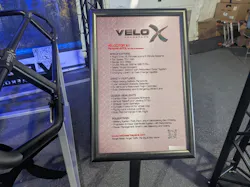
As revealed in the video, the craft is also equipped with a LiDAR-based obstacle warning and avoidance system (LOWAS) that automatically detects and evades hazards, allows it to maintain safe vertical descent rates, and protects the craft against pilot errors that could result in unsafe landings (Fig. 2).
(Nearly) Clear for Takeoff
Meyerink said that two pre-production X1 prototypes are undergoing extensive flight testing at the company’s Michigan-based facility, with the objective of producing the data needed to obtain FAA certification and enter production in 2027.
With an introductory price of $156,000, the X1 has just enough range and load capacity to support at least a few practical applications, such as promptly transporting emergency medical staff, public safety personnel, or field service workers to places not easily reachable by other means. I suspect that it will also find its way into the garages of well-to-do people who simply want to enjoy the freedom provided by personal air vehicles.
You can read more about the Velocitor X1 the technologies that make it possible, and my experience “flying” it in Velo-X’s immersive simulator, in “eVTOLS, eHybrids, and eChoppers, Oh My! Part 1: Electric Vertical Flight Enters the Cambrian Era” recently published in Electronic Design.
About the Author
 Lee Goldberg
Lee Goldberg
Contributing Editor
Lee is the author of the popular PowerBites series.
Lee Goldberg is a self-identified “Recovering Engineer,” Maker/Hacker, Green-Tech Maven, Aviator, Gadfly, and Geek Dad. He spent the first 18 years of his career helping design microprocessors, embedded systems, renewable energy applications, and the occasional interplanetary spacecraft. After trading his ‘scope and soldering iron for a keyboard and a second career as a tech journalist, he’s spent the next two decades at several print and online engineering publications.
Lee’s current focus is power electronics, especially the technologies involved with energy efficiency, energy management, and renewable energy. This dovetails with his coverage of sustainable technologies and various environmental and social issues within the engineering community that he began in 1996. Lee also covers 3D printers, open-source hardware, and other Maker/Hacker technologies.
Lee holds a BSEE in Electrical Engineering from Thomas Edison College, and participated in a colloquium on technology, society, and the environment at Goddard College’s Institute for Social Ecology. His book, “Green Electronics/Green Bottom Line - A Commonsense Guide To Environmentally Responsible Engineering and Management,” was published by Newnes Press.
Lee, his wife Catherine, and his daughter Anwyn currently reside in the outskirts of Princeton N.J., where they masquerade as a typical suburban family.