eVTOLs, eHybrids, and eChoppers, Oh My! (Part 1): Electric Vertical Flight Enters the Cambrian Era
What you'll learn:
- Improvements in batteries, motors, and other technologies have simulated the emergence of a surprising number of eVTOLs, some of which will be commercial as early as this year.
- Some of these early machines will be relatively expensive and offer limited ranges, payload capacities, and performance, but others use innovative “hybrid” architectures to support more demanding missions across distances of 100 miles or more.
- To get a reality check on this emerging market, Electronic Design’s Lee Goldberg visited the 2026 Sun n’ Fun Airshow where he got a firsthand look at several eVTOLs, and the technologies that made them possible.

A recent field trip to the Sun n’ Fun airshow in Lakeland, Fla., provided an opportunity to get a reality check on some of the promises, claims, and confusion surrounding electric vertical takeoff and landing aircraft (eVTOLs). Although early versions of these novel vehicles have been flying since the 2010s, advances in technology and recent disturbances in fossil-fuel supply chains have helped spark a surge of interest.
As a result, the eVTOL market has entered the technological equivalent of the Earth’s Cambrian era. Dozens of startups offered novel, and occasionally unexpected, designs for everything from single-seat personal play toys for the wealthy, to high-mobility service vehicles and multi-passenger air taxis.
To provide a detailed account of this emerging industry, we set up Electronic Design’s Mobile Field Office on the grounds of the airshow and spent four days trudging across the two-mile flightline in search of eVTOLs and other forms of electric aviation (Fig. 1).

Only a few eVTOLs were on display at the airshow. But getting an up-close look at the hardware and having (relatively) candid discussions with their creators helped separate fact from marketing hype, and assisting in identifying the technical, economic, and regulatory realities that are shaping these new classes of flying machines.
Send in the Drones
Most of the earliest entries into the eVTOL space were single-place electric personal air vehicles (PAVs) such as the Kitty Hawk Flyer and e-Volo’s VC1 Volocopter, which took to the skies as early as 2011. It’s no coincidence that they looked suspiciously like oversized hobby drones, since nearly all of them borrowed heavily from technologies originally developed for the small, uncrewed multicopters that hit the market a few years earlier.
These larger human-carrying variants captured the imagination of tech enthusiasts (especially those of us who have been waiting for a jet pack since we were kids). But few were willing to fork over $120K-$200K for vehicles with the limited range and performance they could eke out the of the lithium-ion batteries available at the time.
Recently, though, the future of eVTOLs began to brighten as steady improvements in battery technology allowed them to fly farther and faster, and they cost less. However, even with today’s commercial cells delivering 250 to 350 Wh/kg at prices approaching $100/kWh, eVTOL developers are still struggling to overcome the limits imposed by the relatively low power densities of today’s battery technologies, the complex demands of multimode flight, and steep development costs.
Despite these limitations, careful engineering tradeoffs have enabled a handful companies, including the Jetson One (with its minimalist open-frame dual-motor quadcopter) and Pivotal’s Helix, to reach production, with several more expected to ship products this year.
Both vehicles use lightweight structures and relatively small battery backs to keep their weight under the 255-lb. limit. This, and their top speed that’s limited to 63mph qualifies them as “ultralight” aircraft under the FAA’s Part 103 regulations, allowing people to fly them without a pilot’s license.
Those constraints limit the Jetson One’s endurance to around 20 minutes and its payload capacity to a modest 210 lb. Nonetheless, the manufacturer claims that there were enough people interested in owning their sleek $148,000 play toy that the production runs scheduled for 2026 and 2027 are completely sold out.
While neither Jetson nor Pivotal exhibited their vehicles at Sun n’ Fun, I did have an opportunity to check out a pair of larger and more capable single-person multicopters from Velo X Aerospace and V-Space.
Velocitor X1
With an introductory price of $156,000, the Velo X’s Velocitor X1 offers a fully enclosed carbon-fiber cabin, a fully redundant eight-rotor propulsion system that’s capable of carrying a 260-lb. payload at speeds of up to 70 mph, and a battery pack that supports flights of up to 45 minutes (plus a 15-minute safety reserve) (Fig. 2).

The only downside is that its heavier weight and higher performance mean that this “personal eVTOL” will require a pilot’s license to operate. Still, it’s expected that owners will be able to fly it as a certified Light Sport Aircraft (LSA) under the more relaxed rules of FAA’s new MOSAIC regulations that, among other things, don’t require a special medical exam.
Like the Jetson, and most other vehicles in its class, the X1 uses a fly-by wire flight control system that integrates several high-powered processors, a large suite of sensors, and multiple GPS receivers. They continuously monitor the craft’s position, attitude, and velocity, and adjust them according to inputs from the vehicle’s controls.
Velo X says that this allows for simple, intuitive operation in much the same way modern hobby drones hide most of the complexities of varying the rotor’s thrust required to maintain stable flight from their operator. The craft is also equipped with a LiDAR-based obstacle warning and avoidance system (LOWAS), which automatically detects and evades hazards such as power lines, trees, and structures. It uses the same system to protect against excessively aggressive control inputs, including maintaining safe vertical descent rates and protecting the craft against hard landings.
At present, two preproduction X1 prototypes are undergoing extensive flight testing at the company’s Michigan-based facility, with the objective of producing the data needed to obtain FAA certification. The testing is also being used to fine-tune the hardware and software for production, which is scheduled to commence in 2027.
At least officially, these test flights are being conducted remotely, with the pilot safely on the ground. However, Velo X’s Jake Mcyerinte gave me the opportunity to take a virtual flight in the simulator that the company is using to familiarize potential customers with their machine.
He explained that the control lever on the pilot’s left side is used to adjust altitude in a manner that’s similar to a helicopter’s “collective” control, while the “joystick” mounted on the right functions much like a game controller. It allows the pilot to point the craft in any direction by twisting the handle while pushing, pulling, or leaning the stick enables you to adjust the speed and direction of flight. Once in the immersive simulator, I was impressed at how the flight controller turned my clumsy efforts into smooth and relatively safe flight, even as I struggled to compensate for a simulated crosswind.
I also got to experience the X1’s “hands-free hover” feature. It returns the craft to a stable, zero-velocity hovering mode if the pilot lets go of the flight controls or brings them to their neutral position.
If the straightforward controls and benign flight characteristics of the actual X1 are anything close to what I experienced during my brief simulated hop, the little craft might be a useful tool for helping people get to remote work sites, deliver emergency services, and even allow well-off consumers to make run local errands or short commutes. It’s not surprising, then, that the X1 has generated lots of interest, with several dozen would-be eVTOL owners putting down deposits to reserve their slot in the initial 100-unit production run, scheduled for early to mid-2027.
VS-210 Quadcopter
As a result, Velo X is significantly ahead of V-Space, which was also displaying a mockup of its VS-210 quadcopter at Sun n’ Fun (Fig. 3). While the prototype looked very credible, the company’s website is very light on details other than a claimed payload capacity of 500 lb,, a top speed of 50 mph, and a 25- to 30-minute mission duration.

Much like the websites of several other eVTOL companies I’ve looked at, V-Space’s pages are mostly filled with ambitious claims, very attractive CAD renderings, and few actual photos. And there was precious little hard information about the vehicle’s design, its state of development, plans for production, or about the company itself.
The vehicle’s anticipated specifications were very similar to the X1’s. But the absence of any details beyond that were very typical of many entrants in this young, emerging market being powered as much by enthusiasm and opportunism as it is technology or actual market demand. Nevertheless, I expect at least a handful of these pioneers will find success as improvements in battery capacity and economies of scale attract more customers to the world of personal air mobility.
Wings + Rotors = e-fficient eVTOLS
The basic multicopters on display at the Sun n’ Fun airshow are very agile. However, they require much more power to keep aloft than a comparably sized aircraft equipped with wings because they rely solely on rotors to produce lift by “beating the air into submission.”
In contrast, the “hybrid” eVTOLs use various combinations of wings and rotors to achieve much higher energy efficiencies than basic multicopters. This is why many second-generation delivery drones, such as Amazon’s MK 30 and the heavy-lift flyers manufactured by WING being used by Walmart are based on a hybrid architecture that only uses their rotors during takeoff and landing. Most of their lift comes from wing-like airfoils during horizontal flight.
For similar reasons, most human-capable eVTOLs designed for longer missions and larger payloads employ one of several hybrid architectures that combine wings and rotors. Companies including Joby and Archer Aviation are poised to begin production of hybrid-style multi-passenger air taxis based on “convertiplane” designs.
Such designs have mechanisms that change the direction of their engines’ thrust, enabling them to be vectored vertically for takeoff/landing and then moved to provide horizontal thrust as their wings begin to provide lift during cruise. While convertiplane advocates tout the flexibility and performance afforded by these thrust vectoring mechanisms, they also bring liabilities in the form of additional cost, complexity, weight, and new points of potential failure. Still, the flexibility and sleek designs that this configuration makes possible has attracted several other credible contenders, including Vertical Aerospace’s Valo and AMSL Aero’s Vertiia.
Other manufacturers have chosen to go with a simpler “lift and thrust” system. It uses one set of fixed position motors for vertical flight and a smaller set for horizontal flight where their wings provide most of the lift. Eliminating the convertiplanes’ complex thrust vectoring mechanisms results in a simpler, if less sexy-looking, design that could be less costly to manufacture and maintain.
One of the most successful examples of this style is Beta Technologies' Alia (featured in Electronic Design, June 2025), which will soon enter production and be delivered to customers as either an eight-passenger air taxi or a regional air cargo delivery vehicle. Some of the other eVTOLS currently in development that use a lift-thrust configuration include Air Mobility’s EVE and Airbus’ CityAirbus NextGen prototype.
A Third Approach
While neither Beta’s Alia nor any other eVTOL equipped with separate lift and thrust systems was on display at the airshow, SkyFly’s Axe was there to show off a third way to solve the challenge of eVTOL flight (Fig. 4).
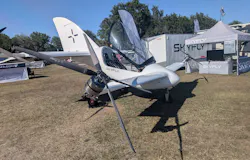
The two-place utility craft uses a single set of four wing-mounted propellers operating at a fixed 45-degree angle to provide both lift and thrust. To take off vertically, the pilot pitches the Axe’s nose upward until its thrust is directed completely downward. In horizontal flight, the angled propellers provide forward thrust while also supplementing the lift of its wings.
Part 2 of this article takes a closer look at how the Axe achieves its high performance and unique flight characteristics, as well as the technologies that are accelerating the evolution of other hybrid eVTOLs.
If you found this story interesting, several other stories from Sun n’ Fun are in the works, plus there’s a recently published article on Bristell’s sporty electric trainer aircraft. And be sure to stay tuned to Electronic Design and our PowerBites blog for more timely dispatches from the frontlines of the electric aviation revolution.
About the Author
 Lee Goldberg
Lee Goldberg
Contributing Editor
Lee is the author of the popular PowerBites series.
Lee Goldberg is a self-identified “Recovering Engineer,” Maker/Hacker, Green-Tech Maven, Aviator, Gadfly, and Geek Dad. He spent the first 18 years of his career helping design microprocessors, embedded systems, renewable energy applications, and the occasional interplanetary spacecraft. After trading his ‘scope and soldering iron for a keyboard and a second career as a tech journalist, he’s spent the next two decades at several print and online engineering publications.
Lee’s current focus is power electronics, especially the technologies involved with energy efficiency, energy management, and renewable energy. This dovetails with his coverage of sustainable technologies and various environmental and social issues within the engineering community that he began in 1996. Lee also covers 3D printers, open-source hardware, and other Maker/Hacker technologies.
Lee holds a BSEE in Electrical Engineering from Thomas Edison College, and participated in a colloquium on technology, society, and the environment at Goddard College’s Institute for Social Ecology. His book, “Green Electronics/Green Bottom Line - A Commonsense Guide To Environmentally Responsible Engineering and Management,” was published by Newnes Press.
Lee, his wife Catherine, and his daughter Anwyn currently reside in the outskirts of Princeton N.J., where they masquerade as a typical suburban family.
Comment About the Article
To join the conversation, and become an exclusive member of Electronic Design, create an account today!
 Leaders Logo
Leaders relevant to this article: