eVTOLs, eHybrids, and eChoppers, Oh My! (Part 2): Electric Propulsion Goes Mainstream
What you'll learn:
- Rapid advances in propulsion technologies and aerodynamics will allow eVTOLs to play a growing number of practical roles in commercial, pubic, and personal air transportation applications.
- While batteries continue to limit eVTOL performance, several companies are already developing vehicles based on “hybrid’ architectures which use various combinations of rotors and wings.
- eVTOLs are expected to find more applications as steady, ongoing advances in motors, batteries, and power-management systems improve their performance, range, and cost.
- The same advances should also pave the way for practical electric helicopters.
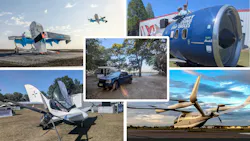
Electric aircraft are making headlines as advances in battery performance, motors, and other technologies have brought them to the threshold of commercial viability. To get a reality check on some of the promises, claims, and confusion surrounding this emerging market, I packed up Electronic Design’s mobile field office and headed to Lakeland, Florida, for the 2026 Sun n’ Fun airshow (Fig. 1). Several companies involved with electric aviation were exhibiting airplanes, electric vertical takeoff and landing vehicles (eVTOLs) and electric propulsion systems.

This two-part series focuses primarily on eVTOLs, the technologies making them possible, and how they have evolved from impractical novelties to potentially useful tools for both personal transportation and commercial applications.
Part 1 looked at how many of the early human-carrying eVTOL designs were based on technologies originally developed for the relatively simple “multicopter” style drones, which remain popular for many recreational, commercial and military applications. It also discussed the operational limits of multicopter-style craft that arise from their low energy efficiency and the low power densities available from today’s batteries.
The story concluded with a brief introduction to “hybrid-style” eVTOLs that use various combinations of rotors and wings to make more efficient use of their battery power and deliver substantially improved range and performance.
Part 2 begins with exploring the three architectural styles that have come to define the emerging hybrid eVTOL market and provides a few examples of each type of vehicle currently in development. It also looks at several companies focused on developing standardized electric power plants that, in some cases, can be used as “near-plug-and-play” replacements for the internal combustion engines (ICEs) currently used in several existing fixed- and rotary-wing aircraft.
Hybrid eVTOLs on the Rise
While multicopter-style eVTOLs produce lift by “beating the air into submission” with relatively small-diameter rotors, so-called “hybrid” eVTOLs use various combinations of wings and rotors to achieve much higher energy efficiencies than basic multicopters. This higher efficiency is why many second-generation delivery drones, such as Amazon’s MK 30 and the heavy-lift flyers manufactured by WING being used by Wal-Mart, are based on hybrid architectures that derive the majority of their lift from wing-like airfoils during horizontal flight and only rely on their rotors for lift during takeoff and landing (Fig. 2).
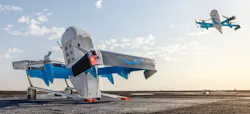
Human-capable eVTOLs are also following this evolutionary trend, as most vehicles intended for longer missions and larger payloads are adopting one of several hybrid architectures.
“Convertiplane” style eVTOLs use a single set of propulsors and mechanisms that either tilt the motor assembly or adjust the angle of their rotors to provide vertical thrust during takeoff and landing. Then they gently transition to horizontal as their wings begin to provide lift during cruise.
Companies including Joby and Archer Aviation are poised to begin production of convertiplane-style multi-passenger air taxis (Fig. 3a). While these and other vehicles based on thrust vectoring mechanisms enjoy great flexibility and performance, they also bring liabilities in the form of additional cost, complexity, weight, and multiple points of potential failure. Nevertheless, the advantages of this configuration, not to mention the sleek sci-fi-style designs it makes possible, has attracted several other credible contenders, including Vertical Aerospace’s Valo and AMSL Aero’s Vertiia.
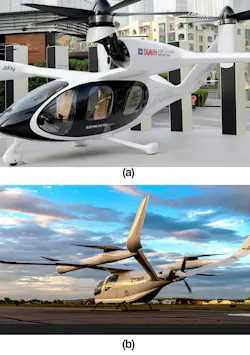
Other manufacturers have chosen to go with a simpler “lift and thrust” system that uses one set of fixed position motors for vertical flight and a smaller set for horizontal flight where their wings provide most of the lift. Eliminating the convertiplanes’ complex thrust vectoring mechanisms results in a simpler, if less sexy-looking, design that could be less costly to manufacture and maintain.
One of the most successful examples of this style is Beta Technologies’ Alia (featured in Electronic Design, June 2025), which will soon enter production and be delivered to customers as either an eight-passenger air taxi or a regional air cargo delivery vehicle (Fig. 3b). Some of the other eVTOLs currently in development that use a lift-thrust configuration include Air Mobility’s EVE and Airbus’ CityAirbus NextGen prototype.
A Third Approach
While neither Beta’s Alia nor any other eVTOL equipped with separate lift and thrust systems was on display at the airshow, SkyFly’s Axe was there to show off a third way to solve the challenge of eVTOL flight (Fig. 4).
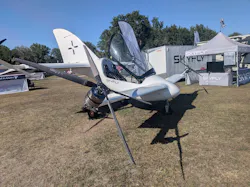
The Axe is essentially a conventional canard-style aircraft with four large (1.9 meters) electrically driven propellers located at the tips of its stubby wings. SkyFly refers to it as a Vertically Capable Aircraft (VCA) because it can take off and land vertically or operate like a conventional airplane.
The two-place utility craft uses the set of four wing-mounted propellers operating at a fixed 45-degree angle to provide both lift and thrust. To take off vertically, the pilot pitches the Axe’s nose upward until its thrust is directed completely downward. In horizontal flight, the angled propellers provide forward thrust while also supplementing the lift for its wings. Vertical landings are accomplished by gradually transitioning from forward flight to a stable hover.
During both transitions, the Axe’s flight-control software handles the trickier aspects of the operation. The motors’ peak output of 280 kW allows it to lift up to 440 lbs. of crew or cargo, providing some performance margin for operations in challenging conditions or during a partial system failure.
While operating as a fixed-wing craft, the Axe relies mostly on its wings, which allows it to perform energy-saving short takeoff and landing (STOL) operations from small airstrips. It can take off and land on short runways at around 55 mph and cruise at speeds of up to 100 mph. During cruise, its wings provide roughly 80% of the lift required to sustain horizontal flight, allowing it to fly for 100 miles on its 70-kWh battery. When not operating as a VTOL, pilots report that it flies pretty much like a conventional “stick and rudder” aircraft. This capability also allows it to perform safe “dead stick” landings like any conventional aircraft in the event of a power failure.
The Axe is one of several commercial eVTOL designs that are based on this configuration, the most notable being Pivotal Aero’s Helix, a lighter-weight, $190K, single-place runabout. It’s designed to operate under the FAA’s part-103 regulations for ultralight aircraft. The company already has several early production vehicles in the field.
While the Helix has attracted some interest for public safety and military applications, the two-place Axe’s larger payload capacity, higher top speed, and longer range allow it to support a greater range of real-world missions. And, unlike the Axe, the Helix can only take off and land vertically in its angled VTOL attitude because it lacks the landing gear needed to operate from short runways in STOL mode.
With preparations underway to begin production in 2027, a base model Axe is expected to cost around $400,000, only slightly more than Diamond’s DA-20, Flight Design’s CTLSi, and several other small two-place fixed wing aircraft.
An Electric Revolution in Progress
In addition to looking at some very cool planes, my conversations with exhibitors at Sun n’ Fun revealed that eVTOLs are beneficiaries of numerous technical developments, leading to all kinds of electric aviation being more practical, affordable, and useful for a growing number of applications.
I learned that, in addition to the dozens of startups entering the market, several major aerospace manufacturers are leveraging advances in motor design and drive electronics originally developed for EVs, as well as steady improvements in battery capacity, to create modular powerplants that can be mass-produced and used in a variety of fixed- and rotary-wing applications.
One notable example is aerospace giant Safran, which has been an early mover in this space. The company is already providing motors and battery subsystems to several electric aircraft manufacturers, as well as small auxiliary powerplants for use in hybrid-electric planes. This includes H55, a leading developer of electric propulsion systems, which announced that Safran’s ENGINeUS smart motor would form the foundation of the powerplant they will provide for Bristell’s B23e electric trainer. You can read the full report on the B23e and its electric propulsion system, published in May of 2026, by clicking here.
Meanwhile magniX, which gained notoriety for its early work in electric alternatives to Pratt & Whitney’s venerable PT-6 turbine engines, recently introduced two new series of integrated powertrains. They were developed as “near-plug-and-play” replacements for several commonly used internal-combustion powerplants used in many existing fixed- and rotary-wing aircraft.
Both new powerplants are modular, consisting of an FAA-rated redundant battery set, a power distribution unit (PDU), and a lightweight electric motor that’s paired with a set of redundant drive electronics (Fig. 5). The Sampson battery set, which made its debut in mid-2024, offers an energy density of 300 Wh/kg and a service life of more than 1,000 full-depth discharge cycles. magniX said that later models will offer higher energy densities as new battery chemistries are fully tested and certified to meet the company’s extensive quality, reliability and safety standards.
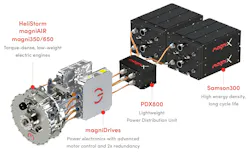
For fixed-wing applications, the air-cooled magniAIR powerplant produces a maximum of 175 kW (roughly 235 hp) and is intended primarily for use in kitplanes, light sport aircraft, and electric flight trainers. To demonstrate its versatility, magniX plans to install a magniAIR powerplant in a Van’s Aircraft RV-10, a high-performance four-place kitplane, anticipated to make its first flight later this year. The company said that it expects the magniAIR to be used to re-power existing general aviation aircraft currently powered by 160- to 235-hp ICE engines.
Electric Helicopters on the Horizon
This spring, magniX also made a bold entrance into the eVTOL market with its “HeliStorm” electric motors for rotary-wing aircraft, a 296-shp liquid-cooled powerplant developed as a direct replacement for the 270-shp (201-kW) Rolls-Royce RR300 turbine (shp = shaft horsepower). Robinson Helicopter has already announced that the new engine will power an all-electric technology demonstrator based on its five-seat R66 model. The demonstrator, which will use magniX’s HeliStorm motor is expected to make its first test flight in late 2026 (Fig. 6).
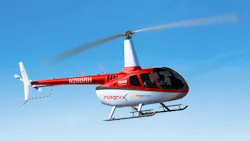
The HeliStorm was developed as part of an ongoing collaboration with Robinson, which included evaluating one of its smaller R44 models that was alternately equipped with an all-electric and a hydrogen fuel-cell powertrain. To make it directly compatible with the transmissions of turbine-powered helicopters, the HeliStorm powerplant was designed to operate at 6,000-7,000 rpm, much faster than the 1,900-2,500 rpm their motors designed for use in fixed-wing aircraft.
In addition, the engine features a dual-redundant, failure-tolerant, three-phase architecture and is liquid-cooled to ensure it operates reliably while delivering full power, even in high altitude/high temperature conditions. A 2025 press release from magniX said the demonstrator would use the company’s existing Sampson battery pack. However, a more recent article, published in Charged EVs on March 30, 2026, says that the Klur Technology Group will be a co-developer of the battery system.
Without any actual flight data, Robinson’s marketing team was hesitant to make any firm predictions about the demonstrator’s expected fight endurance, other than to say it will vary widely according to how the craft is loaded and flown.
During informal conversations, they did speculate that if the pilot limits the use of high speeds, rapid climbs, and extended periods of hovering, it might be reasonable to expect just under an hour’s worth of endurance, plus a modest safety reserve. Though this is insufficient for longer missions, it can easily support shorter flights that are commonly flown during sightseeing, observation, delivery, and training operations.
Robinson’s electric R66 is expected to make up for its shorter flight duration with dramatically reduced operating and maintenance costs. Besides cutting fuel costs by 70% to 90%, the electric motor requires virtually no maintenance or adjustment other than a periodic visual inspection and a relatively inexpensive overhaul procedure at 2,000-hour intervals.
If you found this story interesting, there are several other stories from Sun n’ Fun, including a recently published article on Bristell’s sporty electric trainer aircraft. And be sure to stay tuned to Electronic Design and our PowerBites blog for more timely dispatches from the frontlines of the electric aviation revolution.

About the Author
 Lee Goldberg
Lee Goldberg
Contributing Editor
Lee is the author of the popular PowerBites series.
Lee Goldberg is a self-identified “Recovering Engineer,” Maker/Hacker, Green-Tech Maven, Aviator, Gadfly, and Geek Dad. He spent the first 18 years of his career helping design microprocessors, embedded systems, renewable energy applications, and the occasional interplanetary spacecraft. After trading his ‘scope and soldering iron for a keyboard and a second career as a tech journalist, he’s spent the next two decades at several print and online engineering publications.
Lee’s current focus is power electronics, especially the technologies involved with energy efficiency, energy management, and renewable energy. This dovetails with his coverage of sustainable technologies and various environmental and social issues within the engineering community that he began in 1996. Lee also covers 3D printers, open-source hardware, and other Maker/Hacker technologies.
Lee holds a BSEE in Electrical Engineering from Thomas Edison College, and participated in a colloquium on technology, society, and the environment at Goddard College’s Institute for Social Ecology. His book, “Green Electronics/Green Bottom Line - A Commonsense Guide To Environmentally Responsible Engineering and Management,” was published by Newnes Press.
Lee, his wife Catherine, and his daughter Anwyn currently reside in the outskirts of Princeton N.J., where they masquerade as a typical suburban family.
Comment About the Article
To join the conversation, and become an exclusive member of Electronic Design, create an account today!
 Leaders Logo
Leaders relevant to this article: