Keynoters look to mmWave functionality implemented in silicon

Philadelphia, PA. RF and mmWave functionality implemented in silicon technology was a topic of interest at the RFIC Symposium, held in conjunction with International Microwave Symposium events this week. Keynote presentations Sunday included “Compact Silicon Integrated mmWave Circuits: from Skepticism to 5G and Beyond,” by Zachary J. Lemnios, vice president, Physical Sciences & Government Programs, IBM, and “The Road Ahead for Autonomous Cars: What’s in for RFIC,” by Lars Reger, CTO, Automotive Business Unit, NXP Semiconductors.
Lemnios, who has served in high-level leadership roles in the Department of Defense, outlined nearly 20 years of DARPA support for silicon integration of mmWave circuits, which had traditionally been implemented in III-V processes. He told attendees that a new race is about to begin as vast new waves of mmWave spectrum stand ready to be addressed with silicon-based multi-antenna systems coupled with artificial-intelligence technology.
AI, he said, is beginning to disrupt many industries, extending from healthcare to entertainment. (With regard to the latter, he noted that the Tony Awards were ready to commence as the RFIC Symposium convened its Sunday evening keynote and reception.)
AI is beginning to drive current industries in RF, mobile, IoT, and cloud computing, disrupting every industry with new models and new business partnerships, he said, adding that the ecosystem depends deeply on the RFIC community to integrate, process, and transmit much if not all of the data involved.
AI, he said, is evolving to leverage human-machine engagement. He cited work IBM has done with respect to mmWave phased-array multispectral imaging in the context of IR and visible light cameras.
Future radios must be vertically integrated from the antenna, he said.
RFICs with automotive emphasis
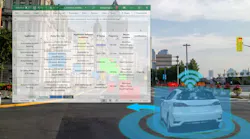
Reger at NXP said during his address that our cars are morphing into connected self-driving robots that can sense the environment, think, and act autonomously—enabling new in-vehicle experiences as well as safety and automation applications like ADAS. He commented that 10 years ago you would have been unlikely to have encountered a keynoter from the automotive industry at the RFIC Symposium, but the situation is quickly changing. “Connectivity is ultimately redefining the way cars are conceptualized and built,” he said. He foresees a future in which all the interfaces—radio, cellular, Wi-Fi, Bluetooth, GPS, V2X, and more—can be integrated into a single, secure smart antenna that serves as both a transmitter and receiver over a variety of channels, standards, and bandwidths.
He noted, however, that wireless technologies can introduce security risks. As the car becomes a hub of connectivity, hackers gain opportunities for potential attacks. Reger asked, “How secure can a fully connected car be? What should future car architectures look like to enhance security? How will RFIC technology and connectivity transform the driving experience of tomorrow, and what are the next big innovations to expect?”
He also asked, “What makes the automotive market interesting?” It has stable growth rates, he said, if not extremely high ones. Other markets are facing declining growth rates, he said, and are becoming feature-saturated, and semiconductor makers can compete only on cost. That’s not the case in automotive, he said, with trends toward connectivity, electrification, autonomy, and a synergistic drive toward 5G.
Reger pointed out that more people die in automobile accidents than are killed by aids, breast cancer, and lung cancer combined. Someone with a proven cure for those diseases would win a Nobel prize, he said, with automotive engineers poised to have an even more beneficial effect on saving lives.
Reger suggested an automotive future in which a centralized server hosts multiple stupid sensors at the edge, although he expects an extended middle ground between widely today’s dispersed ECUs and the ultimate vehicle compute architecture that may eventually arrive. As of now, he sees multiple domains: power train, body and comfort, in-vehicle entertainment, and driver-replacement, for example. Ultimately, driver-replacement could come in the form of a snap-on module. The human driver, he pointed out, operates at a very low data rate.
From NXP’s perspective, he said, RF CMOS, software-define radio, and appropriate software development kits will have a key role to play. He sees automotive radar as a particularly exciting area, with a trend toward 360-degree surround cocooning in a compact footprint at low power. “It’s a nice playground for me and also for you to research and develop,” he told the audience.
About the Author
 Rick Nelson
Rick Nelson
Contributing Editor
Rick Nelson is a technical journalist who has served as executive editor of Test & Measurement World, chief editor of EDN, and executive editor of EE-Evaluation Engineering. He has also contributed to publications including Vision Systems Design and Electronic Design, and he has participated in many live panel discussions and webcasts. Rick has also held systems-engineering and product-development positions at General Electric and Litton Industries. He received his B.S.E.E. degree from The Pennsylvania State University.
Comment About the Article
To join the conversation, and become an exclusive member of Electronic Design, create an account today!
 Leaders Logo
Leaders relevant to this article: