Thailand Upskills Workforce to Meet an Expanding Tech Economy’s Demands (Part 1)
What you’ll learn:
- Already a major player in the Pacific Rim’s tech sector, Thailand handles a large fraction of the region’s electronics assembly and IC back-end/front-end processing and is expanding its economy to support higher-level industries.
- A key element of this initiative is a plan to upgrade the nation’s technical educational system to prepare future engineers, scientists, and tech workers with the skills required by new and existing industries.
- Electronic Design’s Lee Goldberg shares what he learned during a recent visit to Thailand about its strategic approach to upgrading the nation’s technical education system, and how America might benefit from some of those insights.
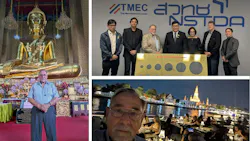
Technical education has been a critical and often neglected source of America’s economic strength. Since the dawn of the 20th century, our trade schools, colleges, and universities prepared their graduates for good-paying careers in research, manufacturing, and service industries that powered the economy.
Now, as we struggle to reverse the effects of several decades of de-industrialization, many businesses are having difficulty finding enough engineers, technicians, and other skilled workers with the necessary education and experience to fill their open positions.
During a recent trip to Thailand, I learned that the country’s surprisingly large tech sector faces similar challenges, but it’s addressing them in very different ways (Fig. 1).
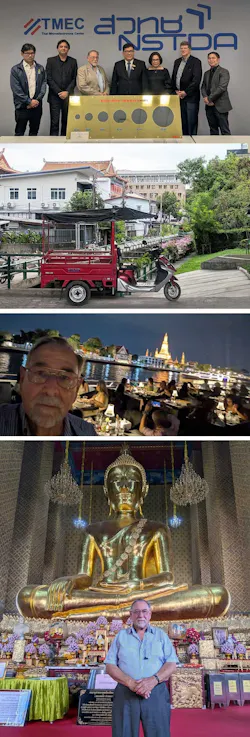
An Eye-Opening Visit
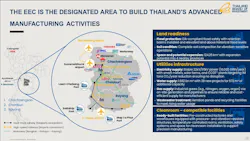
The press tour, hosted by Thailand’s Board of Investment (BOI), was an immersive introduction to the nation’s booming electronics manufacturing sector, which comprises a significant fraction of its economy. Each day of our tour focused on a different area of the nation’s tech and manufacturing belt, located primarily in Thailand’s Chachoengsao, Chonburi, and Rayong provinces (Fig. 2).
In addition to factory tours and meetings with government officials, the tour included opportunities to learn about Thailand’s national strategy for workforce education and development. And we got to see the benefits it’s producing for several of the region’s leading manufacturing and research facilities.
I was able to have some conversations with educators at one of Thailand’s leading technical universities. From those talks, it became even more apparent that the country’s strategic reimagining of its educational system is playing an important role in attracting investments, creating jobs, and strengthening its role as a heavyweight contender in the pan-Asian tech economy.
Those experiences also raised some interesting thoughts about the challenges the U.S. is facing with the development of its own workforce. Could part of our problem be a disconnection that has grown between the rapidly evolving skill sets our industries need and what our educational system actually delivers?
And are our workforce woes being aggravated by the lack of a strategic plan to address them?
Not all of the strategies Thailand employs would be relevant to the U.S. economy. But I think many of them could inform changes we could make to our educational institutions that would help prepare their students to successfully engage the tech economy.
Inside the Thai Tech Tiger
We got plenty of exercise as we hiked across the large labs, sizable shop floors, and ample assembly areas of several electronics manufacturing operations each day. Our itinerary included FoxSemicon’s huge new facility, which will be making semiconductor processing equipment, and Benchmark Electronics, a contract electronics assembly house that’s been in operation for over 40 years (Fig. 3).
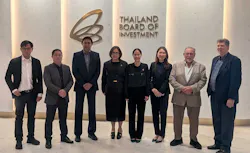
We also visited several “back-end" processing (dicing, testing, and packaging) facilities for integrated circuits, including Microchip Technology’s global back-end processing and distribution center.
During one of our meetings with BOI officials, they explained that several leading semiconductor makers have large facilities in Thailand, devoted to back-end and front-end (wafer fabrication) activities. However, at present, the nation’s only commercial fab, EIC, makes diodes and other discrete devices. This is expected to change over the next decade or so as the Thai government’s long-term initiative, which includes developing indigenous IC manufacturing capabilities, rolls out.
Moving Up the Value Chain
Our hosts said that Thailand has been a significant player in the global tech economy for many decades. They provide skilled and semi-skilled labor for the fabrication and assembly of many basic consumer and industrial electronic products, frequently using ICs and other higher-level components produced in other countries.
Recently, though, the Thai government had begun an initiative to reposition the nation as a leading regional hub for advanced technologies. It focuses on several sectors: clean energy, robotics, advanced automobiles, biosciences, and advanced semiconductors.
The plan begins with creating the technical, financial, and logistic infrastructures needed to support higher, more profitable levels of the semiconductor and electronics value chains, including indigenous IC manufacturing capabilities. As part of this effort, the BOI helped develop a series of policies that streamline the procedures involved with siting, financing, permitting, and construction of these new businesses.
The other element of the plan involves a series of national human-resource development initiatives to “upskill” the existing workforce and begin graduating more students with the specialized skills needed to support the nation’s growing tech economy (Fig. 4).
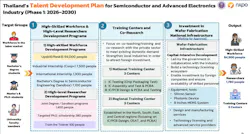
“The BOI identifies the semiconductor industry as a key sector for Thailand's future competitiveness and has launched initiatives aimed at developing more than 100,000 highly skilled workers through training programs, bootcamps, workplace learning, and specialized courses,” said Anawat Chullasewok, BOI’s NY-based Investment Promotion Officer.
Strategically Focused Education
To focus their efforts efficiently, they identified the critical skills needed in various parts of the electronics ecosystem, using so-called “demand-side skill mapping” techniques. This process involves analyses of job postings, inputs from industry experts, and consultation with academic institutions. It helps schools shape their curricula to equip students with skills for existing opportunities and plan for anticipated future demands (Fig. 5).
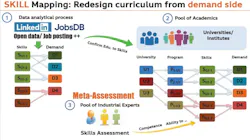
To solve immediate shortages, they developed a series of short-term initiatives for upskilling existing workers. This included a series of free online “Degree Plus” technical training modules, several 10-day onsite training bootcamps on topics such as basic digital and analog electronics, semiconductors, MATLAB simulation, and project management, as well as industry-sponsored, multi-month workplace-based training programs.
BOI also offers incentives for companies to establish their own technical training centers, professional development institutes, and specialized STEM education facilities.
The same inputs also helped influence many longer-term initiatives for developing both baccalaureate-level engineers as well as higher-level degree programs for researchers and educators at colleges and universities throughout the country.
I got to see one example of this strategy in action during my visit to Mahanakorn University of Technology (MUT), located in the Nong Chok District of Bangkok. MUT is a private university, founded in 1990 primarily as an engineering school (Fig. 6). Its ambitious agenda included developing world-class programs for semiconductor and IC design, advanced manufacturing, and an aerospace engineering program that builds and launches its own satellites.
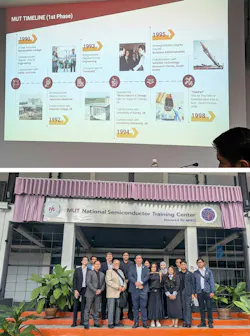
Over the years, MUT has collaborated with many other universities on various programs, most recently entering a strategic partnership with the University of Arizona and its ASU-Cintana Alliance, a global network of universities. MUT has combined these resources with its own creative, entrepreneurial culture to create career-focused degrees in electrical and biomedical engineering, manufacturing, PCB and semiconductor design, robotics, and other tech- and health-related fields.
In addition to its work with MUT, ASU has been very active in partnerships with several other Thai universities that are aligning their policies, workforce development, faculty capacity-building and training infrastructure to support development of an indigenous semiconductor industry.
Part 2 of this series looks at how MUT applies its unique “edu-preneurial” philosophy to several engineering programs, and how they use “hands-on learning” practices to prepare their students for success in their chosen careers. It concludes by exploring how some of Thailand’s strategies might be adapted to upgrade America’s tech education system.
References
https://www.boi.go.th/index.php?newpage=true&page=press_releases_detail&topic_id=124539
https://osos.boi.go.th/EN/news/2280/Thailand-BOI-Approves-New-Investment-Measure-to-Address-Urge/
About the Author
 Lee Goldberg
Lee Goldberg
Contributing Editor
Lee is the author of the popular PowerBites series.
Lee Goldberg is a self-identified “Recovering Engineer,” Maker/Hacker, Green-Tech Maven, Aviator, Gadfly, and Geek Dad. He spent the first 18 years of his career helping design microprocessors, embedded systems, renewable energy applications, and the occasional interplanetary spacecraft. After trading his ‘scope and soldering iron for a keyboard and a second career as a tech journalist, he’s spent the next two decades at several print and online engineering publications.
Lee’s current focus is power electronics, especially the technologies involved with energy efficiency, energy management, and renewable energy. This dovetails with his coverage of sustainable technologies and various environmental and social issues within the engineering community that he began in 1996. Lee also covers 3D printers, open-source hardware, and other Maker/Hacker technologies.
Lee holds a BSEE in Electrical Engineering from Thomas Edison College, and participated in a colloquium on technology, society, and the environment at Goddard College’s Institute for Social Ecology. His book, “Green Electronics/Green Bottom Line - A Commonsense Guide To Environmentally Responsible Engineering and Management,” was published by Newnes Press.
Lee, his wife Catherine, and his daughter Anwyn currently reside in the outskirts of Princeton N.J., where they masquerade as a typical suburban family.
Related

 semiconductor_dreamstime_l_23743616
Comment About the Article
To join the conversation, and become an exclusive member of Electronic Design, create an account today!
 Leaders Logo
Leaders relevant to this article: