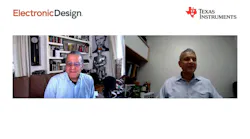
Watch the full interview.
Check out the entire one-on-one conversation via QuickChat video with Alix and Karthik Vasanth to learn more.
AI data centers are pushing power delivery and thermal management systems to new limits. As GPU computing capabilities increase, engineers must accommodate much higher rack power densities while improving conversion efficiency and maintaining system reliability. High-voltage DC architectures, liquid cooling and real-time power monitoring are emerging as important approaches to meeting these demands.
In a recent episode of the Inside Electronics podcast, Electronic Design's Alix Paultre spoke with Karthik Vasanth, vice president and general manager for data converter business at Texas Instruments (TI), about how these requirements are influencing data center design. Vasanth discussed the shift toward more efficient power architectures, the growing importance of precision sensing and why engineers increasingly need complete system-level solutions.
When we think about data centers and the core technologies involved, where do you see us currently? At what stage of development do you see us from where we want to be and where we are today?
The rate of change in data centers is unprecedented. And just in terms of the compute power that is being applied to these data centers, I think it's maybe doubling every couple of years.

Plug in to our podcast.
If you want to learn more about how data centers are changing power delivery and thermal management, listen to the full interview with Alix and Karthik on our podcast.
From a Texas Instruments point of view, the semiconductor concentration inside a data center, really built around these high-performance GPUs, is where we see the broadest opportunity that we have. It's about providing the right power to those GPUs, the right timing infrastructure to those GPUs and basically actually getting the data to go between the GPUs, between racks and across data centers.
When we think about the relationship between power density, thermal management and networking — which of course involves timing — how has it evolved over the last few years?
The heart of the system is the GPU and the CPU. As compute capabilities increase, the power they consume also increases.
In the early 2000s, a rack would consume a few kilowatts. Now we're talking about the racks consuming megawatts of power. That drives the entire ecosystem to be able to support that kind of power density increase.
Power management is thermal management, right? They're interrelated. And then when you talk about the networking aspect, the denser the system, the more critical the communication infrastructure is, right?
Absolutely. You're talking about terabytes of data that are flowing between racks, flowing between the blades in a rack and across data centers. And this is where you hear companies forming entire ecosystems of copper communication, which is actually running out of steam, literally. And you're coming to optical communication.
But I would also like to come back to the power portion of it. One is the efficiency of that power delivery. When we're talking about megawatts going up to gigawatts, small percentage changes in efficiency mean huge amounts of power savings.
The other part people talk about is the reliability of these systems. You really want it to be extremely robust. You can’t afford any downtime.
Beyond more power, what's the most critical architectural bottleneck that will dictate the development speed of next-generation AI and data-center systems?
If you think of the ancillary circuits that go along with it, the innovations that I see are really in the power delivery.
You hear about new data centers that are direct DC-operated systems. So instead of having a step-down transformer and getting 220-volt mains and 40-volt mains, you are basically getting maybe 800 volts, 1,000 volts of DC directly into the data center or into the rack. And you're doing a direct conversion from that high-voltage DC to the supply voltage that the GPUs and CPUs need, which might be sub-one volt.
You're basically getting rid of what I would call the many middleman layers, which are just transforming voltages between different layers. So you're just going from high voltage to the voltage that you need in possibly one step.
That raises efficiency, reduces the number of components and improves reliability. But at the same time, now you have to worry about safety.
If you think of liquid cooling, you need the motor drives that drive the pumps. You need to have the pressure sensors. You need to have the temperature sensors. Simple things like leak detection, we take it for granted. But you might have kilometers of plumbing inside a data center, and that mixed with high voltage is not a good recipe.
Can you explain how the control and sensing technologies have evolved to address this?
You need to have instantaneous or near-instantaneous knowledge of how much power you're dissipating because you have a budget. It might be limited by thermal, or by the total amount of energy in the system.
So when you think of that real-time control, it's really knowing, measuring current, voltage and power in your high-voltage domain, measuring the same in a low-voltage domain and feeding all that information to the controllers that are managing each of those racks.
That is a very, very fast loop. And, of course, we are talking about precision, simply because you want maybe less than or better than 1% accuracy in the total energy that you're consuming.
You're looking for real-time, high-speed current and voltage waveforms that are giving you that information. It's really like building an oscilloscope on top of each processor.
Microseconds are very important. Precision is important. Latency is important. You need to shut that system immediately.
How is TI positioned to help the engineer migrate toward that future data center and make all of this a reality?
This industry is very different from the traditional industries I served in during my career at TI. It's no longer about looking at my four or five parts individually. We need to be smarter to show how they all work in concert.
I talked about the high-voltage power measurement and the low-voltage power measurement — they need to be working together. I need to build a board. I need to show my customer that I can do these measurements with low latency and high accuracy.
We have to come to our customers with more complete solutions as opposed to individual building blocks. It's really about a system solution as opposed to individual pieces. I think that's the change that's happening.
Watch the Video.
Listen to the Podcast.
To learn more about Texas Instruments' solutions, please visit the links below: