Automotive Amp Isolates High Voltages, Yields Ratiometric Output
What you’ll learn:
- Why battery-powered traction-motor battery packs need a high-voltage isolation amplifier.
- How this Texas Instruments iso amp meets stringent application requirements and standards.
- How an evaluation module simplifies assessment of this high-voltage product.
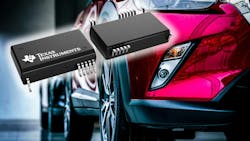
The days of the automotive and other battery-powered/assisted vehicles being 12-V-only systems that you could easily measure with low-voltage components or troubleshoot with a multimeter — without worries about personal safety — are long gone (okay, those 12-V ICE cars do have high-voltage spark plugs). For irrefutable evidence of this reality shift, take a look at the AMC0381R-Q1 analog amplifier from Texas Instruments.
This is a precision, galvanically (ohmic) isolated amplifier with a high-voltage DC, high-impedance input, and single-ended ratiometric output. Its input connects directly to a high-voltage signal source, such as the battery pack of a traction motor in an EV, for direct DC-voltage sensing without external resistors.
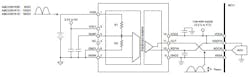
In a typical application, the high-voltage (HV) domain includes the HV battery and the power stage of the traction inverter. The low-voltage domain incorporates the system controller and human interface. The controller must measure the DC-bus voltage while remaining galvanically isolated from the high-voltage domain for safety reasons. The AMC0381R-Q1 enables this measurement due to its high-impedance input and galvanically isolated output (Fig. 1).
The isolation barrier separates the parts of the system that operate on different common-mode voltage levels. This barrier is highly resistant to magnetic interference and certified to provide reinforced isolation up to 5 kV RMS (60 seconds). The iso amp also meets CISPR-11 and CISPR-25 EMI limits.
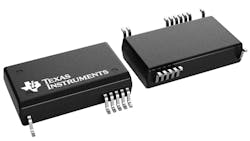
Note the somewhat unusual 15-pin, 0.65-mm pitch, 12.8- × 10.3-mm SSOP package, which is among the tactics needed to meet the physical creep and clearance standards for the reinforced isolation barrier (Fig. 2).
The AEC-Q100-qualified AMC0381R-Q1 is available in three linear input-voltage ranges of 600, 1,000, and 1,600 V. With its integrated precision resistive divider, the AMC0381RQ1 achieves better than 1% accuracy over the full −40 to +125°C temperature range, including lifetime drift. Beyond CISPR-11 and CISPR-25, the component meets relevant DIN EN IEC 60747-17 (VDE 0884-17) and UL 1577 isolation requirements.
Potential users of this type of component would undoubtedly like to assess its capabilities before going to a full-scale design-in. TI offers the AMC038XEVM Evaluation Module, which demonstrates a high-precision, high-voltage sensing design (Fig. 3). The evaluation module can measure up to 1600-V inputs without the need for external voltage-divider resistors.
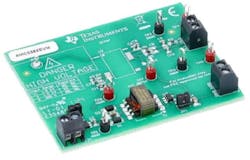
The evaluation board also includes a discrete power section to generate the high-side supply from the low-side supply. Furthermore, screw terminals make for easy access to inputs and outputs. The detailed 20-page datasheet includes full setup and use instructions as well as bill of materials, schematic diagram, and PCB layout images.
About the Author
 Bill Schweber
Bill Schweber
Contributing Editor
Bill Schweber is an electronics engineer who has written three textbooks on electronic communications systems, as well as hundreds of technical articles, opinion columns, and product features. In past roles, he worked as a technical website manager for multiple topic-specific sites for EE Times, as well as both the Executive Editor and Analog Editor at EDN.
At Analog Devices Inc., Bill was in marketing communications (public relations). As a result, he has been on both sides of the technical PR function, presenting company products, stories, and messages to the media and also as the recipient of these.
Prior to the MarCom role at Analog, Bill was associate editor of their respected technical journal and worked in their product marketing and applications engineering groups. Before those roles, he was at Instron Corp., doing hands-on analog- and power-circuit design and systems integration for materials-testing machine controls.
Bill has an MSEE (Univ. of Mass) and BSEE (Columbia Univ.), is a Registered Professional Engineer, and holds an Advanced Class amateur radio license. He has also planned, written, and presented online courses on a variety of engineering topics, including MOSFET basics, ADC selection, and driving LEDs.