Building-Block Analog ICs: Still Very Much Alive and Well

What you'll learn:
- The ongoing role and need for basic analog-function ICs.
- How a new op amp offers improved specifications in terms of low offset voltage, drift, input-bias current, noise, and power consumption.
- How an analog switch provides four independent on/off paths with picoamp leakage current, critical to many instrumentation applications.
Looking at the news attention and coverage across our industry, you might think that the vast bulk of new products being released are GPUs of various flavors along with the components needed to power them.
It turns out that assessment is wrong. Vendors of analog ICs are not only pushing into higher frequencies for RF applications — as you would naturally expect — but they also continue to develop and announce basic building-block ICs that represent yet another step toward even better devices for the designated functions. These blocks are essential in the analog signal chain as well as single-function components, since their performance can be optimized with minimal design and process compromises.
Two recent introductions from Analog Devices illustrate this point.
MAX74801 Op Amp
The MAX74801 amplifier (op amp) features low offset voltage and drift along with low input-bias current, noise, and power consumption. Outputs are stable with capacitive loads of more than 1,000 pF with no external compensation.
Applications for this amplifier include sensor signal conditioning such as thermocouples, resistance temperature detectors (RTDs), and strain gages; process-control front-end amplifiers; and precision diode power measurement in optical and wireless transmission systems. The MAX74801 is also useful in line-powered and portable instrumentation, precision filters, and voltage- or current-measurement and level-setting circuits.
Its top-tier specifications reflect its outstanding performance (Table 1).
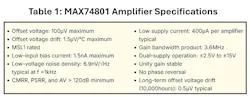
In addition, the MAX74801 has a Moisture Sensitivity Level 1 rating (MSL1) to meet the most stringent assembly process requirements. The amp is available in a 3- × 3-mm, 8-lead mini small-outline package (MSOP) (RM-8) and operates over the extended industrial temperature range from −40 to +125°C. It’s priced at $1.79 (1,000 pieces).
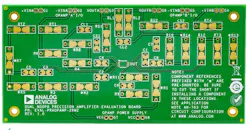
For evaluation, Analog Devices offers the EVAL-OPAMP-2 Evaluation Board, a basic PCB for mounting this op amp (as well as others with the same package), but without any additional components (Fig. 1).
ADG2717 Quad-Channel SPST Switch
The ADG2712 quad-channel SPST switch is a picoamp ultra-low leakage, low-voltage device targeting instrumentation, biosensor measurement, electrochemical measurement, data acquisition, and automatic test equipment, where leakage is a critical performance metric (Fig. 2).
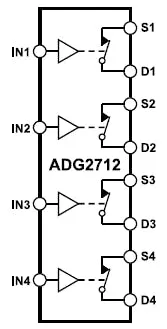
It’s designed with a unique architecture that provides four individually controlled switch channels, each with a typical on leakage current of 8 pA at 85°C and 56 pA at 125°C. This ultra-low-leakage device, coupled with low on-resistance of just 9.1 Ω, provides a compact switching solution for applications that demand the highest precision.
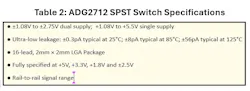
The ADG2712 has a rail-to-rail input-signal range, with overview key specifications called out in Table 2. Each switch conducts equally well in both directions when on. The switches are turned on with a Logic 1 input on the corresponding digital control line. The digital control inputs are 1.8-V JEDEC-compliant for ease of use with microcontrollers and field-programmable gate arrays (FPGAs).
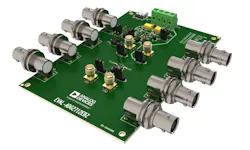
The ADG2712 is priced at $9.87 (1,000 pieces). A multi-connector evaluation board, the EVAL-ADG2712, is available to support this quad-channel SPST switch (Fig. 3).
About the Author
 Bill Schweber
Bill Schweber
Contributing Editor
Bill Schweber is an electronics engineer who has written three textbooks on electronic communications systems, as well as hundreds of technical articles, opinion columns, and product features. In past roles, he worked as a technical website manager for multiple topic-specific sites for EE Times, as well as both the Executive Editor and Analog Editor at EDN.
At Analog Devices Inc., Bill was in marketing communications (public relations). As a result, he has been on both sides of the technical PR function, presenting company products, stories, and messages to the media and also as the recipient of these.
Prior to the MarCom role at Analog, Bill was associate editor of their respected technical journal and worked in their product marketing and applications engineering groups. Before those roles, he was at Instron Corp., doing hands-on analog- and power-circuit design and systems integration for materials-testing machine controls.
Bill has an MSEE (Univ. of Mass) and BSEE (Columbia Univ.), is a Registered Professional Engineer, and holds an Advanced Class amateur radio license. He has also planned, written, and presented online courses on a variety of engineering topics, including MOSFET basics, ADC selection, and driving LEDs.