Micro-ohm Current-Sense Resistors Handle Up to 36 W
What you'll learn:
- The issues associated with high-current sensing using the voltage drop across a known resistor.
- How four new series address those micro-ohm challenges.
- Why the inclusion of a thermistor and small connector simplifies design-in.
Current-sense resistors may not be glamorous, but they’re essential. These devices are tasked with developing a small voltage drop across their accurately known resistance, which allows determination of current magnitude in real-time by use of Ohm’s Law and voltage drop. Typically, the sensed voltage is on the order of 100 mV, so the resistor is sized to match the expected maximum current value (see “5 Current-Sensing Resistors” and “Using Resistors for Current Sensing: It’s More Than Just I = V/R”).
As load currents reach into the hundreds of amps, these modest passives devices need rugged, low-resistance physical connections, low temperature coefficient of resistance (TCR), stability despite self-heating, and, of course, milli-ohm and micro-ohm nominal resistances.
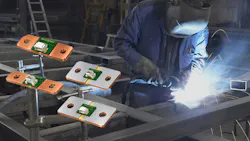
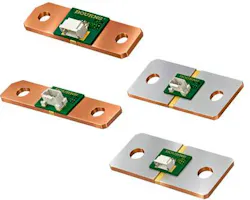
The Bourns CSI2F-6918, CSI2F-7036, CSI2F-8518, and CSI2F-8536 series of current-sense resistors are designed for this scenario (Fig. 1). They’re available in resistance values from 25 to 200 μΩ, all with a 36-W power rating at a terminal temperature of 125°C. Each of the four series, with their overlapping ohm values, offers an operating temperature range from -40 to +125°C with a resistance tolerance of ±5%. Applications range from battery-management systems to welding equipment.
What’s the difference among these four series? Somewhat surprisingly, the brief press release never clarifies this point, but some datasheet detective work revealed it is a slight difference in footprint (and height), with footprints of approximately 18 × 52, 36 × 50, 18 x 60, and 36 x 60 mm, respectively. The datasheets also reveal each series has a very slight difference in temperature dependence on resistive material, which is defined as ΔR (compared to resistance at 25°C) versus temperature.
Another interesting point, which is mentioned in the press release but not explicitly stated in the text of the datasheets, is that each unit contains a standard 10-kΩ negative-temperature-coefficient (NTC) thermistor. The NTC thermistor can be used to sense the temperature of the sense resistor itself, for a calibration/compensation and overload safety feature needed in some applications. The existence of that thermistor is “buried” in the mechanical drawing on the datasheet but not otherwise mentioned (Fig. 2).
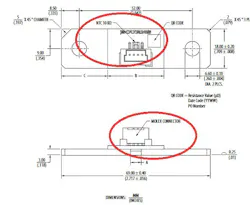
Also not mentioned, but called out in the same drawing, is the 4-pin Molex connector with two leads for reading the voltage across the resistor and two for reading the thermistor resistance.
A nice feature of these connectors is that Bourns offers all of them in both vertical and horizontal orientations, as clearly seen in the photo of Figure 1. Although this may seem like a minor consideration, it can minimize headaches in the dense cabling environment of a real system with respect to wiring harness orientation, strain relief, and tie-downs.
About the Author
 Bill Schweber
Contributing Editor
Bill Schweber is an electronics engineer who has written three textbooks on electronic communications systems, as well as hundreds of technical articles, opinion columns, and product features. In past roles, he worked as a technical website manager for multiple topic-specific sites for EE Times, as well as both the Executive Editor and Analog Editor at EDN.
At Analog Devices Inc., Bill was in marketing communications (public relations). As a result, he has been on both sides of the technical PR function, presenting company products, stories, and messages to the media and also as the recipient of these.
Prior to the MarCom role at Analog, Bill was associate editor of their respected technical journal and worked in their product marketing and applications engineering groups. Before those roles, he was at Instron Corp., doing hands-on analog- and power-circuit design and systems integration for materials-testing machine controls.
Bill has an MSEE (Univ. of Mass) and BSEE (Columbia Univ.), is a Registered Professional Engineer, and holds an Advanced Class amateur radio license. He has also planned, written, and presented online courses on a variety of engineering topics, including MOSFET basics, ADC selection, and driving LEDs.