What Matters When Choosing High-Reliability Connectors
What you'll learn:
- Why connector performance and reliability drive design success.
- How application requirements shape connector selection.
- The role of supplier support in reducing risk and delays.
- Key supplier qualities for long-term project stability.

As electronics are piled into everything from aerospace and automotive systems to consumer electronics, the importance of connector solutions is trending up, too. However, the choice of technology and supplier can make a fundamental difference to both the performance of the final design and its longevity out in the field.
As illustrated in a recent survey of connector specifiers and buyers, reliability is the only factor as important as performance when it comes to selecting and procuring connectors. In addition, the survey revealed those same specifiers and buyers acknowledge that best-practice design goes beyond the product. They also evaluate suppliers on a range of capabilities that can simplify and speed design when deploying connectors in next-generation designs.
As the connector market undergoes a major shift driven by the rising complexity of modern systems, engineers are focusing on far more than robustness and reliability alone. New developments in AI data centers, 5G networks, industrial automation, aerospace and defense, and electric vehicles (EVs) over the last decade are pushing the boundaries of data throughput, power delivery, and environmental resilience. These systems all have extreme demands.
As a result, connectors can no longer be treated as simple commodity components that are chosen by cost alone. Instead, they have evolved into critical design elements that directly influence system reliability, performance, and scalability. In Harwin’s recent survey, this shift came through clearly: Engineers and designers continue to rank connector performance as a top priority in project specifications and supplier selection.
Data, Power, Mixed-Signal: The Fundamental Differences Between Connectors
Connectors fall into one of three main categories — data, power, and mixed-signal — with each category carrying distinct technical demands dictated by its intended application.
In data centers, for instance, the emphasis lies on high-speed signal transmission. Connectors need to maintain low latency while providing tight impedance control to preserve signal integrity at gigabit rates. Telecommunications push these requirements even further, especially for RF connectors designed to operate at gigahertz frequencies.
Industrial connectors will often prioritize environmental resilience above all else, with corrosion resistance, and mechanical robustness being non-negotiable due to the presence of wide temperature ranges, constant vibration, and corrosive atmospheres. However, the aerospace and defense sector has some of the strictest requirements, demanding ultra-high reliability under extreme vibration and shock conditions. In these applications, weight constraints are often vital, too, seeing a need for lightweight and rugged solutions.
Despite these differences, cross-industry overlaps do exist. For example, the familiar DB-9 connector is found across all sectors, yet the versions differ widely in construction standards and reliability levels. What passes as acceptable in a consumer or industrial context might be entirely unsuitable for aerospace use.
The Ins and Outs of Connector Selection and Finding a Connector Provider
When selecting a connector, engineers must weigh numerous parameters, with electrical performance usually coming first, as all connectors must meet current and voltage ratings to ensure safe power delivery while maintaining signal integrity.
Mechanical durability, however, is just as critical. Connectors face repeated mechanical stress when being plugged in and removed and must survive the specified number of mating cycles without failure. Locking mechanisms need to provide secure, vibration-resistant engagement to avoid accidental disconnections that can cause system downtime.
In applications where harsh conditions exist, environmental protection becomes a prime concern. From moisture to dust, such environmental factors have serious effects on connector performance and reliability. Corrosion resistance and vibration tolerance are also points of concern, especially in industrial, aerospace, and automotive applications that usually experience harsh conditions.
Engaging suppliers early in the design phase helps cut development time and risk, where good suppliers offer guidance on connector options tailored to your application, sometimes going as far as to collaborate closely to spot potential pitfalls before they become costly problems. For those involved with long-term projects, lifecycle support is another core factor. Component obsolescence can cripple product longevity and maintenance if not addressed upfront.
As such, choosing suppliers committed to long-term availability, solid technical support, and transparent end-of-life policies will save headaches and money down the line.
Why Choosing a Good Supplier is Critical
The pressure to deliver higher power density and faster speeds driven by AI, edge computing, and other new technologies places extreme demands on connectors. When dealing with such pressures, the reliability of a connector depends as much on the supplier’s manufacturing quality and quality-control processes as the design itself.
Two connectors might look nearly identical on paper or in a catalog, such as the old but faithful DB-9, but their actual performance and durability can differ dramatically. In the case of the DB-9, a desktop-grade variant is unlikely to be engineered to withstand the vibration, shock, or temperature extremes that an aerospace-rated counterpart must survive.
Considering the extreme environment and demands that connectors are now expected to operate in, partnering with trusted, standards-compliant suppliers ensures that connectors meet the necessary specifications, not just initially, but consistently over production runs.
Key Considerations When Selecting a Supplier
Choosing a connector supplier goes far beyond price or lead times; it demands scrutiny of their track record in delivering high-reliability products. For example, a supplier with minimal recalls and field failures indicates a mature manufacturing process and solid quality control, factors that are critical for designs that involve safety and reliability.
Industry certifications represent one of the best methods for providing an objective baseline, as these types of certifications are awarded by independent third-party organizations. One classic example of such a certification (that should be expected at the bare minimum) is ISO 9001, which ensures consistent quality management. An application-specific example that aerospace engineers should look for is AS9100, which extends ISO 9001 to a more stringent set of requirements
Technical support is often another underrated factor, but just as important. Suppliers who offer engineering guidance, design-in assistance, and quick sample delivery not only help to accelerate development cycles, but can also prevent costly redesigns. Considering that any reputable connector supplier would have years (or even decades) of knowledge across numerous industries, engineers can avoid common pitfalls and mistakes by leveraging this experience.
For those developing solutions that have long lifespans, long-term support is another critical concern. In these applications, where devices can be expected to operate for decades, connector lifecycles frequently outlast initial design phases. Therefore, suppliers must commit to product availability, transparent end-of-life policies, and effective obsolescence management.
Finally, a culture of engineering and sales collaboration shows that a supplier is invested in customer success. This is often seen in the form of robust online resources, detailed datasheets, and proactive communication with customers.
Sorting Through Tools and Support from Connector Suppliers
Choosing the right connector is only part of the job, though. Engineers also need the right tools, services, and support around the product if a design is going to be reliable in the field. That’s why many manufacturers now offer far more than the part itself. Cable assembly options, online design resources, and quick access to technical guidance are increasingly built into the package.
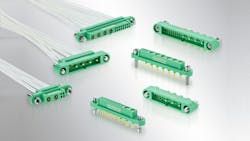
Take Harwin as an example (see figure). Its Gecko range, with a 1.25-mm pitch and 2 A per contact rating, can be supplied in pre-cabled assemblies that save time during prototyping. The Datamate family, rated for 3 A per contact and tested to 1,000 mating cycles, is available in similar formats for harsher environments. Other suppliers do the same across their own lines, showing how the market is shifting toward solutions that are easier to integrate straight out of the box.
Design resources also play a role. Harwin and other vendors publish 3D CAD files, PCB footprints, and selection tools so that engineers can check compatibility before ordering. Furthermore, many provide browser-based cable and connector configurators, which let teams quickly specify length, termination, and layout options without needing to engage directly with production. Free samples and evaluation kits are another common route, giving teams the chance to prove performance in practice rather than rely on datasheets alone.
Support is often a difference-maker in this process. Most established connector companies have deep application engineering teams that can be contacted directly. They’re typically backed by technical libraries and searchable knowledge bases. Getting advice early in a project helps to spot potential issues before they force costly redesigns.
All of these services, assemblies, design resources, and technical support show how connector suppliers are moving from simple component providers to design partners. The connector itself will always carry the electrical and mechanical load, but the ecosystem around it increasingly determines how quickly and confidently engineers can move from concept to production.
Consult More Than the Datasheet When Selecting Connectors
Choosing a connector is rarely straightforward. Performance and reliability matter, but they’re only part of the equation.
Engineers also need to know that the supplier behind the part can be trusted to deliver consistent quality, provide help when issues arise, and keep products available over the long term. In practice, that means looking beyond datasheets and ratings. A dependable partner will back up the hardware with guidance and transparent communication around long-term product support.
When those pieces come together, engineers gain confidence that a design will survive not only its immediate environment, but also the years of production and maintenance that follow.
About the Author
Ryan Smart
VP of Product, Harwin
Ryan Smart is Vice President of Product at Harwin, where he drives innovation and leads new product development. With over a decade in electronic components, he takes products from concept to launch, empowering engineers with cutting-edge connectivity solutions. Ryan is dedicated to building strong partnerships with distributors and the engineers they serve.
Comment About the Article
To join the conversation, and become an exclusive member of Electronic Design, create an account today!
 Leaders Logo
Leaders relevant to this article: