LEGO SMART Play Platform Brings Imagination to Life
What you'll learn:
- How LEGO embedded sensing, audio, lighting, and wireless technology into a standard 2 × 4 brick without breaking compatibility with existing sets.
- Why screen-free interaction and position awareness are key to the SMART Play System's design.
- How SMART Bricks, Tags, and Minifigures work together to create a responsive, context-aware play experience.
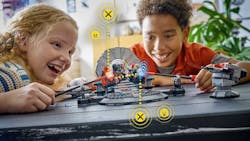
At the Consumer Electronics Show (CES) 2026 in Las Vegas, The LEGO Group unveiled its new LEGO SMART Play system, a new technology platform designed to transform classic LEGO builds into interactive builds without requiring screens or apps. The system's core is a chip-powered brick that senses motion, position, and context, bringing sound, light, and movement to physical LEGO constructions.
The launch is scheduled for March 1, 2026, with the first products released as part of the LEGO Star Wars line.
A Brick with Embedded Technology
At its core, the SMART Play system is built around the LEGO SMART Brick (Fig. 1), a familiar 2 × 4 LEGO brick that hides advanced electronics embedded within a plastic shell.
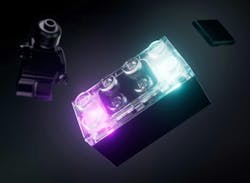
According to LEGO's official press release, the SMART Brick is powered by a custom-designed application-specific integrated circuit (ASIC) measuring just over 4 mm, making it one of the smallest chips highlighted at CES 2026. The custom chip integrates multiple sensors, RGB lighting, sound generation, and wireless communication into a form factor that's fully compatible with standard LEGO pieces.
The SMART Brick integrates an accelerometer to detect motion and orientation, light and sound sensors to interpret motion, and a miniature speaker with an onboard synthesizer that can produce audio effects based on context. It also supports wireless charging, eliminating the need for external cables or visible power connections within builds.
Smart Tags and Smart Minifigures
Along with the SMART Brick, the system includes SMART Tags and SMART Minifigures. SMART Tags (Fig. 2) are flat, studless tile elements embedded with unique digital identifiers. When a SMART Brick is near a tag, it uses this identifier to determine what behavior, sound, or lighting effect to activate.

SMART Minifigures (Fig. 3) also contain identification technology that allows the SMART Brick to recognize specific characters and trigger corresponding responses.
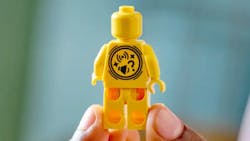
As a result, LEGO builds can be configured to "play back" based on how builders interact with them. For example, placing a Smart Minifigure in a vehicle or moving a tagged element can cause the SMART Brick to emit engine sounds, lightsaber hums, or environmental audio effects for that particular scene or model.
Screen-Free Interaction and Position Awareness
A key technical goal of SMART Play is screen-free interactivity, which LEGO said functions without the need for tablets, phones, or computers during play. Instead, the system uses a combination of sensor feedback and near-magnetic-field detection to identify the relative position and orientation of components. Copper coils embedded in the SMART Brick help measure proximity to other SMART Bricks, tags, and Minifigures, providing a spatial awareness that can influence audio and visual output.
The technology allows LEGO to embed contextual responsiveness into models. LEGO demonstrated how its system works using a realistic helicopter model that made whooshing sounds as its rotors moved, and a birthday cake model that played a celebratory tune when its "candles" were metaphorically "blown." These examples show how physical play actions can be translated into system responses without requiring a screen interface.
Integration with the LEGO System
Regardless of the advanced technology, LEGO states that the SMART Play components are fully compatible with the existing LEGO System-in-Play. Builders can incorporate SMART Bricks into any model that uses standard LEGO connections, allowing for a blend of traditional construction and new interactive capabilities.
This compatibility ensures that SMART Play isn’t a new proprietary system, but rather an extension of LEGO's expansive product ecosystem. The first SMART Play products will appear in three Star Wars "All-In-One" building sets, each including at least one SMART Brick, charged SMART Tags, and SMART Minifigures. These sets, currently available for preorder, are expected to ship by March 1, 2026.
Engineering and Innovation
According to LEGO's press release, the development of SMART Play involved more than 20 patented innovations. The engineering challenge was to miniaturize sensing, audio, and communication technologies to fit within standard LEGO components without compromising structural integrity or play experience.
By embedding processing and sensing directly into bricks, LEGO looks to introduce a new level of imagination and play experience that merges imaginative construction with responsive feedback, all while maintaining the company’s renowned tactile, hands-on engagement.
Check Out More CES 2026 Articles
 CES at Las Vegas Convention Center West Hall
About the Author
 Cabe Atwell
Cabe Atwell
Technology Editor, Electronic Design
Cabe is a Technology Editor for Electronic Design.
Engineer, Machinist, Cartoonist, Maker, Writer. A graduate Electrical Engineer actively plying his expertise in the industry and at his company, Gunhead. When not designing/building, he creates a steady torrent of projects and content in the media world. Many of his projects and articles are online at element14 & SolidSmack, industry-focused work at EETimes & EDN, and offbeat articles at Make Magazine. Currently, you can find him hosting webinars and contributing to Electronic Design and Machine Design.
Cabe is an electrical engineer, design consultant and author with 25 years’ experience. His most recent book is “Essential 555 IC: Design, Configure, and Create Clever Circuits”
Cabe writes the Engineering Life & Engineering on Friday blog on Electronic Design.
See Cabe's cartoons & comic strips here.
Comment About the Article
To join the conversation, and become an exclusive member of Electronic Design, create an account today!
 Leaders Logo
Leaders relevant to this article: