Data Center Storage in 2026: When Storage, AI, and Compute Converge
What you'll learn:
- How AI-driven workloads are reshaping storage architecture and driving new performance requirements.
- The role of SNIA’s StorageAI in optimizing storage, compute, and AI coordination for efficient data workflows.
- Emerging trends and technologies at the intersection of storage, compute, and AI that IT leaders should watch.
As the industry looks toward 2026, data center architects and system designers face a convergence of pressures that make storage design more critical than ever. AI workloads continue to drive unprecedented demand for data movement, capacity, and performance, just as power, thermal, space, and component availability constraints tighten across global supply chains.
Storage can no longer be treated as a passive layer behind compute. It has become an active system component that directly influences performance, efficiency, and overall design risk.
For engineers and engineering managers planning systems that will ship in the next several years, decisions made today around storage architecture will shape not only AI performance, but also power envelopes, rack density, cooling strategies, and time-to-market. Understanding how storage fits into the broader AI infrastructure ecosystem is essential to building resilient and scalable data centers.
As AI and storage technologies converge, organizations must deal with new performance, scalability, and management challenges. SNIA is uniquely positioned to help the industry navigate these changes through standards development, technical guidance, and collaborative initiatives. This article discusses the emerging challenges at the intersection of AI and storage, the role of standards and best practices, and how SNIA is assisting the industry adapt and innovate.
AI Changes the Storage Equation
Traditional data center architectures evolved around a compute-first model. Storage systems were designed primarily for capacity and reliability, optimized to feed general-purpose workloads with predictable access patterns. AI disrupts this model.
Training and inference pipelines demand high bandwidth, low latency, and sustained data delivery across distributed systems. Storage performance variability can stall expensive compute resources and undermine overall system efficiency.
At the same time, data volumes continue to grow rapidly. AI models require access to massive datasets that may span hot, warm, and cold tiers, often distributed across multiple physical locations. As a result, storage decisions now affect network design, interconnect selection, and memory hierarchy planning. Engineers must evaluate storage not in isolation, but as part of an integrated system.
Constraints Shape Design Choices
As 2026 unfolds, forecasts indicate increasing constraints across multiple dimensions of data center design. Power availability is becoming a gating factor in many regions, forcing tighter power budgets per rack and per workload. Thermal limits further restrict how densely systems can be deployed. Space constraints, particularly in urban or retrofit environments, add another layer of complexity.
Component availability also plays a growing role. Extended lead times for certain storage technologies, including high-capacity hard-disk drives (HDDs), require earlier design commitments, and limit flexibility. These realities are pushing architects to reconsider hybrid storage strategies that combine HDDs, solid-state disks (SSDs), and emerging technologies to balance capacity, performance, power consumption, and availability.
Evaluating Storage Technologies for 2026
HDDs remain essential for cost-effective, high-capacity storage, particularly for large datasets used in AI training and long-term retention. However, long lead times and power considerations require careful planning. SSDs offer significant advantages in performance and latency and are increasingly used to replace or complement HDDs in performance-sensitive tiers. The tradeoffs include higher cost per bit and different thermal and endurance considerations that must be addressed at the system level.
Beyond traditional media, the industry continues to explore alternative archival technologies, including novel approaches designed for long-term data retention with minimal power consumption. While these technologies aren’t yet mainstream, their development highlights the need for flexible architectures that can incorporate new storage classes as they mature.
Storage as a System-Level Design Problem
One of the most significant shifts driven by AI is the need to address storage challenges holistically. Storage bandwidth, latency, and reliability directly influence network congestion, compute utilization, and overall system efficiency. Design decisions at the drive, enclosure, and interface level cascade upward to affect board layouts, interconnect choices, and software architecture.
This system-level view is central to SNIA’s StorageAI initiative created to address a growing gap in how AI infrastructure challenges are analyzed and solved. While many efforts focus on individual domains such as compute accelerators, networking fabrics, or storage devices, StorageAI examines how these elements interact under real workloads and real constraints.
StorageAI looks specifically at data movement, placement, and accessibility across the AI pipeline, from ingestion and training to inference and long-term retention. It evaluates where bottlenecks emerge when storage, networking, and compute aren’t co-designed, and how architectural choices at one layer ripple through the rest of the system. For engineers, this perspective helps translate abstract AI requirements into concrete design considerations at the component, board, enclosure, and system levels.
Rather than prescribing a single architecture, StorageAI provides a framework for understanding tradeoffs (see figure). It highlights how storage bandwidth, latency, and endurance affect compute utilization, power efficiency, and scalability, especially as systems move toward more distributed and heterogeneous designs.
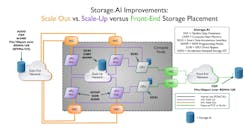
By grounding these discussions in standards-based approaches, StorageAI helps engineers and engineering managers identify balanced solutions that can be implemented, validated, and evolved over time in real-world designs.
The Role of Standards in Reducing Design Risk
As architectures grow more complex, standards play an increasingly important role in managing risk. Standards provide stable design targets, predictable interfaces, and interoperability across components and vendors. For engineering teams, this translates directly into fewer redesign cycles, easier validation, and improved supply-chain flexibility.
SNIA’s long-standing work in areas such as form-factor definitions and storage interfaces has helped the industry adopt interoperable hardware designs through multi-vendor plugfests that scale across product generations. In the context of AI-driven data centers, standards enable engineers to focus innovation where it matters most, while relying on proven frameworks for integration and compatibility.
Standards also support collaboration across adjacent ecosystems, including compute architectures, networking fabrics, and system software. Alignment with organizations such as NVM Express, Open Compute Project (OCP), Ultra Ethernet Consortium (UEC), and the Linux Foundation helps ensure that storage designs integrate smoothly into broader platform roadmaps.
Designing for the New Normal
The data center of 2026 will not be defined by a single technology or architecture. Instead, it will reflect a balance of performance, capacity, power efficiency, and availability, guided by system-level thinking and standards-based collaboration. Engineers must design for constraints — not ideal conditions — and anticipate continued evolution in AI workloads and infrastructure requirements.
For storage, this means minimizing unnecessary fragmentation, increasing commonality of design through industry standards, and still leaving room for differentiated innovation. It also means planning architectures that can adapt to new, emerging storage technologies and evolving AI workflows.
Looking Ahead: Storage and AI
As AI continues to reshape computing, storage will remain a critical enabler of performance and scalability. The choices engineers make today will determine how effectively data centers can support next-generation workloads under real-world constraints. Approaches such as SNIA’s StorageAI help frame these decisions by encouraging system-level thinking across compute, networking, and storage, and by grounding architectural tradeoffs in standards-based collaboration.
By treating storage as an active design element rather than a passive resource, and by leveraging initiatives like StorageAI alongside established standards, engineering teams can reduce risk, shorten design cycles, and build AI infrastructure that’s resilient, efficient, and ready for the challenges of 2026 and beyond.
About the Author
 Scott Shadley
Scott Shadley
Director of Leadership Narrative and Evangelist at Solidigm
Scott Shadley, is a Director of Leadership Narrative and Evangelist at Solidigm, where his focus is on efforts to drive adoption of new storage technologies, including computational storage, storage-based AI, and post quantum cryptography. Over his 27 years in the semiconductor and storage space, Scott has been involved in wafer production, process engineering, R&D design engineering, and most recently in customer-focused roles involving Marketing and Strategic Planning.
Scott has been a key figure in promoting SNIA as a now third-term Board member where he has led the computational storage efforts as former Co-Chair of the SNIA Computational Storage Technical Working Group. He is currently serving as the Co-Chair on the Communications Steering Committee, driving the outward vision of SNIA and its technology efforts, and a member of the Executive Committee.
Scott also participates in several additional industry efforts including the Open Compute Project (OCP), Linux Foundation, and NVM Express.
Previously with NGD Systems, Scott was the VP of Marketing and developed and managed their Computational Storage portfolio. Prior to that, at Micron, he managed the Product Marketing team, was the Business Line Manager for the SATA SSD portfolio, and finished his stay at Micron as the Principal Technologist for the SSD and emerging memory portfolio.
Scott is a subject matter expert in SSD technology and semiconductor design technologies, and is ever evolving his experience and knowledge in the storage stack. Scott earned a BSEE in Device Physics from Boise State University, and an MBA in Marketing from the Univ. of Phoenix.
Comment About the Article
To join the conversation, and become an exclusive member of Electronic Design, create an account today!
 Leaders Logo
Leaders relevant to this article: