May the 4th: Fan-Made Star Wars Props and the Electronics Inside
What you'll learn:
- What props were built using SBCs, microcontrollers, sensors, motors, LEDs, and sound boards.
- How fan builders turn static costumes and droids into interactive electronics projects.
- The clubs and maker communities that help build screen-inspired droids, helmets, and props.
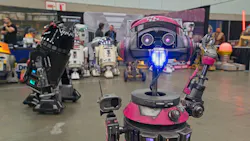
May the 4th be with you!
Revenge of the 5th!
Part 2, Revenge of the 6th? I propose we add this.
It’s that time of year again. We celebrate all things Star Wars. This year, it started with my hand-drawn cartoon. While drawing it, I thought about all of the hand-made Star Wars objects I saw at Celebration in Chicago. The level of creativity and human craftsmanship is unparalleled. I can’t think of anything else where people make something so integral to their life. Take a look at some of the ingenuity that has spawned from the love of world’s greatest space epic.
C3PO Head
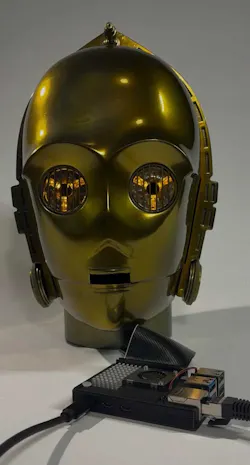
Samuel Potozkin built a 3D-printed C-3PO head(Fig. 1) with a Raspberry Pi computer, allowing users to speak to it. In response, the head talks back in real-time, making the prop more interactive.
So, how does it work? A MEMS microphone picks up your voice before the Pi processes it and produces a talk-back response, which is played through an internal speaker. Rather than using a standard speaker, the C3PO head uses an exciter to allow the sound to come through the shell. This prop demonstrates how a single-board computer (SBC) hosts voice interaction within a prop, enabling Star Wars fandom to come to life in AI-style electronics.
Droid Builders Club
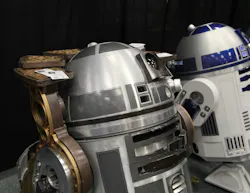
The Droid Builders Club (Fig. 2) is a Star Wars-based fan community that builds Star Wars droids, including R2-D2 and other astromech-style robots. Members use wiring, batteries, motors, lights, sound boards, and remote controls to make working droids that light up and move similar to what we see in the films.
The club helps makers with their droid-building ambitions by providing blueprints and construction tips. Lucasfilm even noticed the club and hired two of its members, Lee Towersey and Oliver Steeples, to help build and oversee droids, like R2-D2, for The Force Awakens.
Plasma Lightsaber
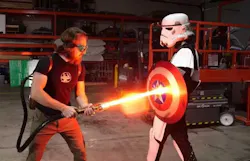
The plasma lightsaber(Fig. 3) is also a very real, experimental engineering feat that will hype up Star Wars fans. Developed by Hacksmith Industries, it uses a fuel-and-ignition system plus a laminar-flow nozzle to produce a very hot plasma beam (4,000°F) inside a retractable blade. A separate power pack provides the huge amount of energy and fuel needed to run it.
All of the electrical and electromechanical work happens in the control, ignition, safety interlocks, power delivery, and portability. Even though this isn’t close to a true Jedi weapon, it still shows how we can use modern tech to create an approximation of the lightsaber.
Mandalorian
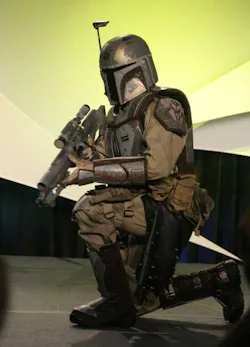
Custom builds involving the Mandalorian (Fig. 4) are an eye-opener. Btutera on Instructables 3D-printed his own helmet, integrating an analog feedback micro servo, LEDs, and hidden wiring. His gauntlet, which has the Arduino Nano and three buttons, sends signals to the controller to activate the LEDs and drives the servo for helmet movement.
The 3D-printed shell ensures all of the electronics are integrated in the armor without making it look bulky. This makes the helmet feel like wearable tech rather than cosplay.
501st Legion
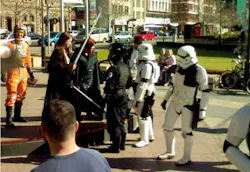
Star Wars fans are also involved in the 501st Legion(Fig. 5), a worldwide costuming club that builds Imperial costumes and helmets. Members create armor for the clone trooper, Sith, and stormtroopers. These typically feature electronics like voice amplifiers, helmet fans, LEDs, and comms to make them wearable and dramatic. They’re well known for appearing at conventions and public appearances, bringing Star Wars villains to life.
Battle Droids
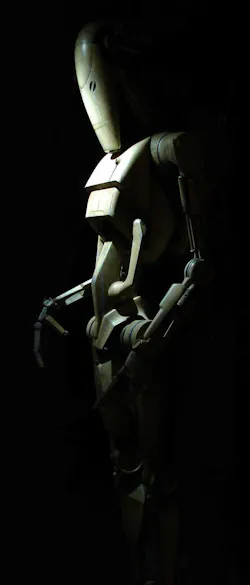
Fans have even taken on more complex builds, like the B1-battle droid (Fig. 6) from the Phantom Menace and Attack of the Clones era. Out2gtcha built a full-sized droid made of furniture hardware to keep the droid’s body in place, along with a backpack and internal sections that store the electronics. It also features a PIR motion sensor and a mini voice processor, allowing it to respond as someone walks by and trigger B1-droid phrases.
A simple build like this shows how a Star Wars prop can be turned into an interactive robot using electronics.
Mouse Droids
Makers went beyond big showpiece droids. The smaller mouse droids, which are tiny service bots, move through Imperial ships and stations. A perfect example is the one created by Mike Senna and Michael McMaster.
They used a servo for the steering, a high-torque motor for the drive system, a simple speed controller, off-the-shelf RC parts, a sound trigger, and a sound board that allows the droid to roll around and output sounds like it does in the movies. Senna and McMaster mention that builders of all levels can build one through the Mouse Droid Builders Club Facebook page.
2-1B Medical Droid
About the Author
 Cabe Atwell
Cabe Atwell
Technology Editor, Electronic Design
Cabe is a Technology Editor for Electronic Design.
Engineer, Machinist, Cartoonist, Maker, Writer. A graduate Electrical Engineer actively plying his expertise in the industry and at his company, Gunhead. When not designing/building, he creates a steady torrent of projects and content in the media world. Many of his projects and articles are online at element14 & SolidSmack, industry-focused work at EETimes & EDN, and offbeat articles at Make Magazine. Currently, you can find him hosting webinars and contributing to Electronic Design and Machine Design.
Cabe is an electrical engineer, design consultant and author with 25 years’ experience. His most recent book is “Essential 555 IC: Design, Configure, and Create Clever Circuits”
Cabe writes the Engineering Life & Engineering on Friday blog on Electronic Design.
See Cabe's cartoons & comic strips here.
Comment About the Article
To join the conversation, and become an exclusive member of Electronic Design, create an account today!
 Leaders Logo
Leaders relevant to this article: