Why Local Storage Still Matters for Performance-Critical and Embedded Systems
What you’ll learn:
- Access latencies for cloud-based storage are measured in tens of milliseconds while latencies for local NVMe are measured in microseconds.
- Local storage is critical for operations that can’t tolerate high latencies or intermittent cloud connections.
- Some systems take a hybrid approach to storage, using NVMe to support tightly bounded tasks such as data logging, analytics, and control loops, while using cloud-storage for bulk and historical data storage.
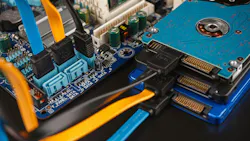
The default architectural recommendation has been simple for the past decade: Move data and compute to the cloud. For many business workflows, that guidance made sense. But the tradeoffs are far more complex for embedded systems, real-time applications, and performance-sensitive software development.
Local storage and processing aren’t legacy choices when latency budgets are measured in milliseconds, bandwidth is finite, and reliability requirements approach deterministic operation — they’re engineering necessities.
Latency, Bandwidth, and Determinism
When you move your storage to the cloud, you’re literally adding physical distance between your data and the work you’re trying to do. In North America, you’re usually looking at 20 to 80 ms of round-trip latency to a major cloud region. It jumps even higher if you’re crossing continents, even with optimized routing.
For a lot of real-world use cases, that delay matters. Especially if you’re running interactive apps, tight control loops, media workflows, or edge AI, then that kind of latency just isn’t going to cut it.
Now, let’s contrast that with what happens when your storage is sitting right there next to the processor. Non-Volatile Memory Express (NVMe) is a protocol designed to access high-speed storage devices like solid-state drives (SSDs) using the PCI Express interface. When used locally, it doesn’t operate in milliseconds. It operates in microseconds. That’s not a small difference. That’s orders of magnitude.
When you’re talking about PCIe 4.0 or PCIe 5.0 NVMe devices, you’re looking at millions of input/output operations per second (IOPS), consistently, with response times that aren’t just fast, but predictable. This even remains very much the case when leveraging technologies, such as Strada.tech, that enable your owned storage for remote workflows.
And such predictability is the key. It's a deterministic performance. You know what you’re going to get, every single time. There’s no variability based on internet congestion, no dependency on routing paths halfway across the country or the world. The storage is right there on the bus, moving at the speed the system was designed to move. No surge demand or cloud service degradation puts your work in jeopardy.
So, when someone says, “Well, the cloud is fast,” I always say, “Compared to what?” Because when you put local NVMe, or even spinning an HDD array, side by side with a remote system, there’s simply no comparison. If your workflow depends on sustained throughput, low latency, and consistent response times, remote storage just can’t match what a properly architected local data solution can deliver.
Bandwidth is another constraint. Moving large datasets, i.e., firmware images, sensor logs, video streams, etc., across a network introduces both time penalties and cost. Engineers frequently discover that data gravity makes repeated cloud transfers impractical.
Relying on persistent connectivity becomes a design risk when systems must operate continuously or autonomously.
Reliability and Offline Operation
When you start talking about industrial equipment, vehicles, medical devices, field instruments — all of these embedded deployments that are actually out there in the real world — you have to remember they don’t live in pristine, climate-controlled data centers with redundant fiber connections. They’re on factory floors. They’re in ambulances. They’re bolted into utility trucks. They’re sitting in remote substations, oil fields, research stations; you name it.
And in those environments, network access is often intermittent at best and completely unavailable at worst. Connectivity drops. Signals degrade. Sometimes there simply isn’t a network to connect to. If your architecture assumes persistent, low-latency connectivity to a centralized cloud, you’re building fragility into the system from day one.
That’s where local storage becomes non-negotiable. When the storage is on the device, logging continues. Analytics continue. Control loops continue. The system keeps doing the job it was designed to do, regardless of whether it can see the outside world at that moment. You’re not buffering blindly; you’re not waiting for a round trip to some distant region. You’re operating autonomously.
And for embedded systems, that autonomy isn’t a nice-to-have feature. It’s the difference between resilience and failure. Local storage ensures the data is captured, the decisions are made, and the equipment stays operational, no matter what the network is doing.
Cloud outages, regional failures… even simple DNS disruptions can halt dependent services. Local systems degrade more gracefully because they retain both data and compute capability on-site.
This isn’t simply convenience from a systems engineering perspective — it’s resilience.
Hybrid Architectures are Becoming the Norm
A hybrid approach is adopted by many modern designs, i.e., local storage for primary operation and the cloud for aggregation, backup, or collaboration.
While still enabling centralized analytics when connectivity permits, this model reduces latency, preserves bandwidth, and improves privacy. Edge devices, for example, may preprocess sensor data locally and transmit only summaries or anomalies upstream.
This architecture, in practice, aligns more closely with how distributed systems behave in the real world.
Local Version Control and Development Performance
Software teams building embedded systems increasingly reconsider where version control systems live. Cloud-hosted repositories provide accessibility. However, local repositories like mirrored local servers can dramatically improve performance for large codebases.
What we’re talking about here involves operations like cloning, branching, diffing, and history traversal that are, for the most part, I/O-bound. Then, when repositories include binary assets, firmware images, or large datasets, network latency becomes a bottleneck.
But, with a local Git server on high-speed NVMe storage, these operations can be reduced from minutes to seconds. Continuous integration pipelines also benefit since build systems can pull dependencies and artifacts without saturating external bandwidth
Local repositories are often mandatory for teams working in secure or classified environments. They also eliminate dependency on external services during outages.
Design considerations include:
- Ensuring adequate redundancy (i.e., RAID, snapshots, replication).
- Managing access control within local networks.
- Providing off-site backup to prevent single-site loss.
- Balancing storage performance against capacity needs.
Teams adopt a federated approach In many cases, local primary repositories synchronized periodically with cloud mirrors.
The Continuing Role of Tape and Cold Storage
A different set of constraints are introduced with long-term archival requirements. Some data must remain usable and intact for many decades (not just years) because of legal, scientific, or archival requirements.
One of the most cost-effective and durable options for this purpose continues to be magnetic tape, particularly modern LTO systems. High capacity, low energy consumption, and inherent air-gap protection against ransomware or remote compromise is provided by tape. Tape complements high-performance local storage by providing a stable archival tier, although not suitable for active datasets.
Local AI Processing and Data Privacy
With advances in hardware acceleration, on-device AI has become increasingly practical. GPUs, NPUs, and dedicated AI cores now allow complex inference workloads to run locally, reducing dependence on cloud services.
When data is processed where it’s generated, latency is minimized and privacy preserved. For instance, sensitive information like medical images, proprietary designs, and surveillance data needn’t leave controlled environments. Local models are even more attractive for edge deployments as they can also operate continuously without usage fees or connectivity requirements.
The Cloud as a Tool — Not a Default
While cloud infrastructure is invaluable for elasticity, global distribution, and collaboration, treating it as the universal solution ignores fundamental engineering tradeoffs.
The advantages of local storage are difficult to replicate remotely for performance-critical systems:
Owning the primary data path often means owning system reliability. We haven’t even talked yet about the exponential benefit on prem offers when true total costs of ownership are understood.
Designing for Control and Resilience
When we talk about designing for control and resilience, what we’re really saying is this: Architecture decisions should be driven by the workload, not by whatever trend happens to be dominating the headlines this quarter. Storage isn’t a fashion statement. It’s infrastructure. And infrastructure must serve the actual operational requirements of the system.
There are characteristics that centralized cloud platforms simply can’t guarantee. Deterministic latency. Continuous operation without connectivity. Absolute control over data locality. Yet those are exactly the characteristics that embedded systems and edge deployments demand every single day. These environments don’t have the luxury of variability — they require predictability, autonomy, and resilience by design.
Now, that doesn’t mean you ignore the cloud. It means you use it intelligently. When you supplement local storage with hybrid synchronization and archival tiers, you get the best of both worlds. You maintain deterministic performance at the point of execution, where it matters most, while still enabling centralized backup, fleet-wide analytics, long-term retention, and governance. That layered approach creates a foundation not just for speed, but for operational continuity and responsible long-term data stewardship.
And if you step back and look at the macro trend, computing isn’t retreating into centralized facilities. It’s moving outward. It’s moving to the edge. It’s moving into devices, into vehicles, into instruments, into environments that are dynamic and distributed. As that shift accelerates, the importance of keeping critical data physically close to the hardware that depends on it isn’t going to diminish. It’s going to increase.
Control and resilience aren’t accidental outcomes. They’re architectural choices. And keeping data close to the point of use is one of the most important choices you can make.
About the Author
 Larry O'Connor
Larry O'Connor
Founder and CEO, Other World Computing (OWC)
Larry O'Connor is the Founder and CEO of Other World Computing (OWC), a leading provider of cutting-edge storage, connectivity, and expansion solutions for professionals and enthusiasts worldwide. With a passion for innovation and a commitment to customer satisfaction, Larry founded OWC in 1988 in Woodstock, Illinois, at 14 years old. Since then, he has grown the company into a globally recognized brand that’s trusted by creative and business professionals as well as tech enthusiasts for delivering high-performance, reliable products that enhance workflows and maximize technology investments.
Under Larry’s leadership, OWC has pioneered many advances in storage and upgrade solutions for Mac and PC users. His vision for empowering users to do more with their technology has driven OWC to develop a diverse range of products, from high-speed SSDs and external storage devices to memory upgrades and high-speed connectivity solutions. Larry is also known for his commitment to sustainability, leading OWC to achieve zero-emissions status and championing eco-friendly business practices.
Beyond his role at OWC, Larry is an industry thought leader with a deep understanding of the evolving technology landscape as well as a deep involvement and understanding in areas of regenerative, renewable technologies. He frequently shares insights on topics like data management, disaster recovery (DR), business continuity, and the future of storage. A dedicated advocate for the creative community, Larry continues to guide OWC in its mission to support professionals and prosumers with the tools they need to push their creative boundaries.

Comment About the Article
To join the conversation, and become an exclusive member of Electronic Design, create an account today!
 Leaders Logo
Leaders relevant to this article: